

Layers of a Square in Beyazıt, from the Roman Forum to the Grand Bazaar
Sign in to like and rate
Beyazıt Square is one of the few places that have been at the centre of Istanbul for centuries. In the Byzantine period the city's largest square, the Forum of Theodosius, stood here. At the beginning of the 16th century the complex of Bayezid II rose at one corner of the square, and right next to it grew the Grand Bazaar, the commercial heart of Istanbul. Within a few hundred metres, this route shows these layers in turn: column shafts left from the Roman forum, an Ottoman bathhouse carrying stones of that forum in its foundations, a market where booksellers have worked for more than a century and the great bazaar itself with its vaulted streets.
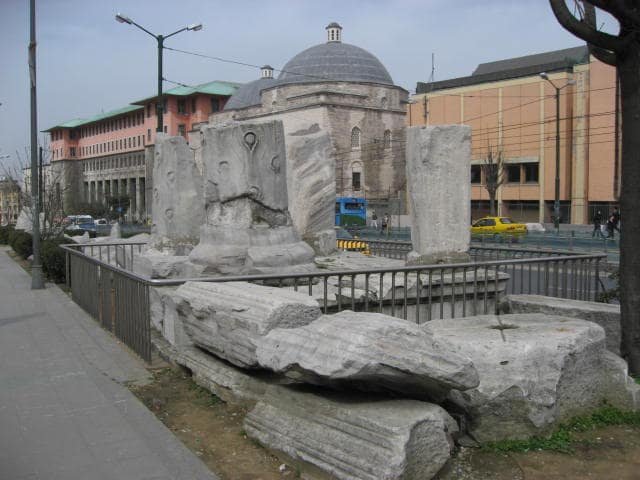
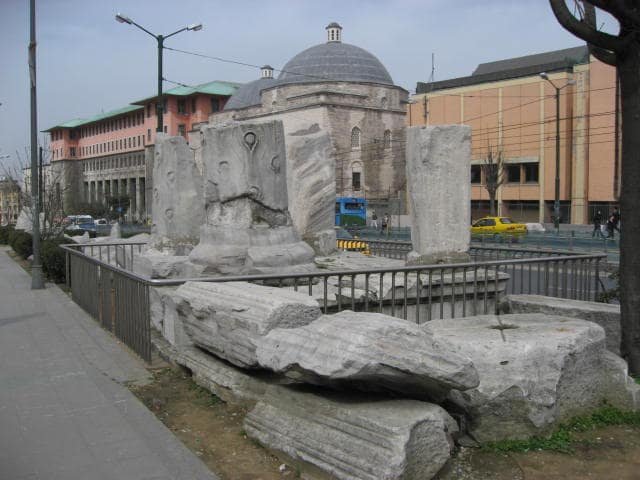
The first stop is the group of marble fragments on the edge of Ordu Street, left from the western triumphal arch of the forum. Columbia University's Istanbul documentation project states that the arched entrance foundations of the arch and some of its column shafts remain where they were found. From the same spot you can also look towards the courtyard of the Beyazıt Mosque on the north side of the square.
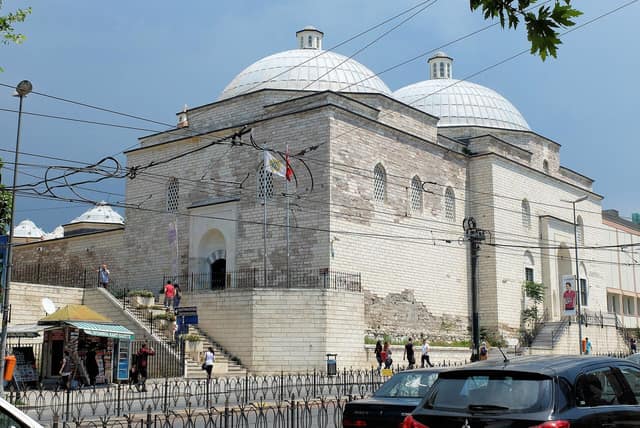
The second stop is the Bayezid II Bathhouse. Built as an endowment of Gülbahar Hatun, this double bathhouse was used for many years as a depot and workshops before it was restored by Istanbul University. Today it is a free museum devoted to Turkish bathing culture and also displays Byzantine and Ottoman stone pieces found during the restoration.
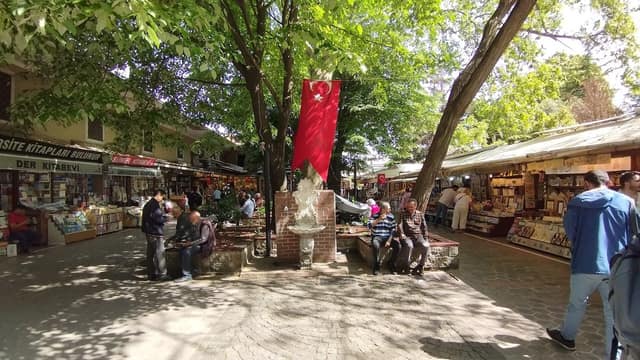
The third stop, the Booksellers' Bazaar, stands between the Beyazıt Mosque and the Grand Bazaar on the site of the old Engravers' Market. Booksellers began to move here before the earthquake of 1894 and settled in the early 20th century. In the market rebuilt after the fire of 1950, only books were allowed to be sold.
The last stop is the Grand Bazaar. The bazaar grew over time around two covered markets, and from the early 18th century its wooden streets were roofed with masonry vaults. Entering through the gates on the Beyazıt side and walking along Kalpakçılar, the main street, to the Inner Bedesten ends the route at the core of the bazaar.
The stops carry on each other's stories. Stones taken from the forum went into the foundations of the bathhouse, booksellers once opened shops in the courtyard of the neighbouring mosque, and when the repair of the bazaar dragged on, the booksellers settled where they are today.
The order follows the flow of time, moving from the Roman period to the 16th century, then to the booksellers of the 20th century and to a bazaar still working today. All the stops are within walking distance, and the total walk from the forum to the Grand Bazaar is under a kilometre. Plan the route for a weekday. The square is a busy traffic area, so cross the road at pedestrian crossings. Watch your valuables in the bazaar and check current opening hours with official sources.
Sources
- Columbia Üniversitesi, Istanbul Documentation Project, Forum of Theodosius, https://mcid.mcah.columbia.edu/istanbul-documentation-project/forum-theodosius
- TDV İslam Ansiklopedisi, Beyazıt II Camii ve Külliyesi (İstanbul) maddesi, https://islamansiklopedisi.org.tr/beyazit-ii-camii-ve-kulliyesi--istanbul
- TDV İslam Ansiklopedisi, Beyazıt Hamamı maddesi, https://islamansiklopedisi.org.tr/beyazit-hamami
- İstanbul Üniversitesi, II. Bayezid Türk Hamam Kültürü Müzesi, Tarihçe, https://turkhamamkulturu.istanbul.edu.tr/tr/content/kurumsal/tarihce
- TDV İslam Ansiklopedisi, Sahaflar Çarşısı maddesi, https://islamansiklopedisi.org.tr/sahaflar-carsisi
- TDV İslam Ansiklopedisi, Büyük Çarşı (İstanbul) maddesi, https://islamansiklopedisi.org.tr/buyuk-carsi--istanbul
- Kültür Portalı (T.C. Kültür ve Turizm Bakanlığı), Kapalıçarşı, https://www.kulturportali.gov.tr/turkiye/istanbul/gezilecekyer/kapalicarsi
- T.C. Fatih Kaymakamlığı, Kapalıçarşı, https://fatih.gov.tr/kapalicarsi
Route Stops
The Ruins of the Theodosius Forum
Begin the route in front of the marble fragments standing behind iron railings on the southern edge of Ordu Street. These pieces are left from the Forum of Theodosius, the largest square of the city in the Byzantine period. The TDV Encyclopaedia of Islam states that the Beyazıt Mosque was built at a corner of this square, the Forum Tauri. According to Columbia University's Istanbul documentation project, the forum was planned by Theodosius I and the square was inaugurated in 393.
A monumental column rose in the middle of the square. It was probably erected in 386 to celebrate victories over the Goths, and its shaft was decorated with reliefs of high quality. The column is thought to have had a spiral staircase leading to the top. Each of the two main entrances of the forum, on the east and west, had a triumphal arch; the remains in front of you belong to the western arch.
The western arch had three passages and rose on four pedestals, each carrying four columns of Proconnesian marble. The width of the central passage has been calculated at about 7.20 metres and that of the side passages at 3.60 metres. Look closely at the column shafts; some are carved with tear-drop motifs and others with oversized human hands. The arched entrance foundations of the arch and some marble shafts are preserved where they were found.
Now turn across the road to the large domed bathhouse; that is the next stop. According to TDV, Pierre Gilles, who came to the city in the 16th century, wrote that he had heard from old people that the Monument of Theodosius was pulled down when the bathhouse was built. The encyclopaedia states that relief-carved column fragments were used as building stone in the foundations of the bathhouse and that a few pieces were taken to the Istanbul Archaeological Museums. Look carefully at the foundations of the bathhouse facing the street and try to find these pieces. Because the ground level was lowered when the road was widened in 1955-1957, the bathhouse door now sits high above the pavement.
Then look north across the square towards the courtyard of the Beyazıt Mosque. According to the encyclopaedia, construction of the mosque began in 1501 and the building was completed in 1505. The outer faces of the courtyard gates take on a monumental look with marble niches filled with muqarnas. The wide red porphyry slabs set in the marble paving of the courtyard were very probably cut from Byzantine sarcophagi. The green porphyry shafts of the fountain are also reused pieces. So within a few hundred metres, stones of the Roman square appear reused inside Ottoman buildings. For a photograph, you can frame the column shafts with the bathhouse dome behind them from the western end of the railing.
Source: Columbia Üniversitesi İstanbul belgeleme projesi; TDV İslam Ansiklopedisi.
II. Bayezid Bath (Museum of Turkish Bath Culture)
Across the road, the Bayezid II Bathhouse is regarded as part of the Beyazıt Complex. According to Istanbul University's museum page, the bathhouse was built as an endowment by Gülbahar Hatun, wife of Bayezid II and mother of Selim I. Because the bathhouse has no inscription, its date of construction is uncertain; the museum gives 1507-1508 on the basis of 16th-century archival records, while the TDV Encyclopaedia of Islam suggests 1500-1505. Called the New Bath in the records, the building was also known as the Great Bath because of its size.
It is a double bathhouse with men's and women's sections, each with its own entrance. The large domed changing halls of both sections face Ordu Street; the one in the women's section is slightly smaller. North of the changing halls lie the warm and hot rooms, and at the back the furnace runs along the whole width of the building. The hot rooms follow a four-iwan plan with private cubicles at the corners. According to TDV, the bathhouse drew its water from a deep and wide well with a water wheel.
The building has not had an easy history. The encyclopaedia reports that the bathhouse was damaged in a fire in 1715 and repaired at once. After the 1930s the building was used for a long time as a depot and workshops and was badly worn in this period. In 2000 the bathhouse was expropriated and passed to the ownership of Istanbul University. Restoration projects were prepared in 2003 and 2004 as a joint work of Istanbul University and Istanbul Technical University. Restoration for the museum began in 2013, and the warm and hot rooms of both sections were arranged as the Bayezid II Turkish Bath Culture Museum. The changing hall of the men's section is used for temporary exhibitions and events.
As you walk through the exhibition, look at the objects that tell of everyday bath life. The exhibits include sofa covers, bath wraps, wooden clogs, towels embroidered with gold thread, bath bowls, healing bowls, clay and soap boxes, washing mitts and combs. The coffee and tea sets served after bathing are a reminder that the bathhouse was a social space. Byzantine and Ottoman architectural stone pieces found inside the bathhouse and in its immediate surroundings during restoration are also on display. These pieces let you link them directly with the forum remains you saw at the previous stop. Pause for a few minutes in the hot room and watch the light falling through the glass openings in the dome.
According to the museum page, admission is free and the museum is closed at weekends, on religious holidays and over the New Year holiday. Check the current hours on the museum's page before your visit. When you leave the bathhouse, cross the square towards the east; after about 400 metres you reach the Booksellers' Bazaar.
Source: İstanbul Üniversitesi II. Bayezid Türk Hamam Kültürü Müzesi; TDV İslam Ansiklopedisi, Beyazıt Hamamı.
Secondhand Book Market
The Booksellers' Bazaar lies in the area between the Beyazıt Mosque and the Fesçiler Gate of the Grand Bazaar. According to the TDV Encyclopaedia of Islam, the booksellers were once inside the Grand Bazaar, on the old Booksellers' Street now called Halıcılar Street. Evliya Çelebi wrote in the 17th century that there were about fifty bookshops inside the bazaar, with some 300 people working in them. Its present site was formerly the Hakkaklar Çarşısı, the market of the seal engravers.
The booksellers began to move here before the earthquake of 1894, and when the repair of the Grand Bazaar dragged on after the earthquake, most of them settled here. At the end of this move, which went on until the 1910s, the market took the name Booksellers' Bazaar. After the fire of 1950 the market was demolished by the municipality and rebuilt in reinforced concrete. According to TDV's article on the Beyazıt Complex, until the new shops were finished the booksellers opened temporary shops under the courtyard porticoes of the mosque between 1951 and 1954. In the new market that opened in 1952, the municipality made it a condition that only books be sold.
The market has two entrances with flattened arches, one opening onto the square and the other onto Çadırcılar Street. Enter from the square side and walk the whole length of the market. When you reach the flower bed in the middle, look at the bust of İbrahim Müteferrika, founder of the first Turkish printing press, set up in 1981. In the same year the municipality also had a display case of lithographic materials built at the entrance on the square side. There are two fountains in the market, one at the square entrance and the other on the Çadırcılar side; try to find both.
When the new market first opened it had twenty-three shops, twelve of them on two floors, a coffee stall and an auction and exhibition hall. Over time the hall and the coffee house were also turned into shops. In 1977 the street booksellers of the square were moved into the market temporarily, and these spots gradually became permanent shops. The encyclopaedia notes that, although the market has partly lost its role as a cultural centre, it is still a regular stop for book lovers. The Culture Portal also recommends this market between the Beyazıt Mosque and the Grand Bazaar to lovers of old books.
Browse the shelves without hurrying and compare several shops for the same book. If you stop to take photographs in front of the shops, take care not to disrupt the shopkeepers' work. There are also passages from the market to the eastern entrance of the Beyazıt Mosque. Leave by the Çadırcılar entrance and in a few steps you reach the Beyazıt-side gates of the Grand Bazaar.
Source: TDV İslam Ansiklopedisi, Sahaflar Çarşısı.
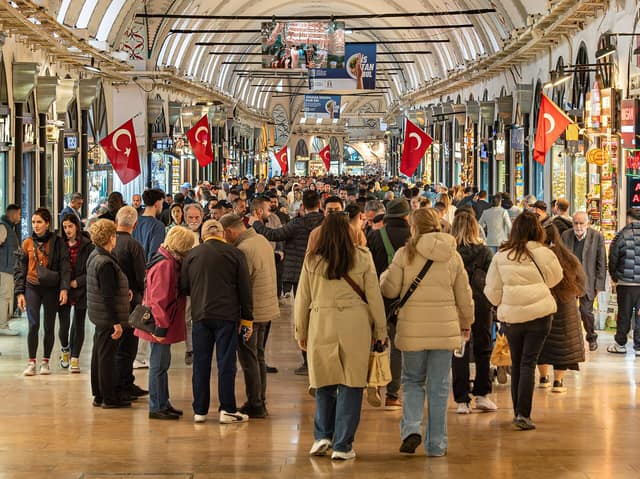
Grand Bazaar
When you enter the Grand Bazaar from the Beyazıt side, you are at one end of the old Kalpakçılar Street, the main street of the bazaar. According to the TDV Encyclopaedia of Islam, this street runs between Beyazıt and Nuruosmaniye, and a new gate was built at each end in the reign of Abdülhamid II. The gate on the Beyazıt side has a pointed arch but is not as rich as the one at the Nuruosmaniye end. The arch of the second gate a little beyond this entrance carries the monogram of Abdülhamid II and an inscription by the calligrapher Sami Efendi; look up as you go in.
The encyclopaedia explains that the bazaar was not built in one go but formed as the inns and streets clustered around two covered markets were gradually roofed with vaults. The Culture Portal writes that the foundations of the bazaar were laid in 1461 and that it began with the buildings Mehmed the Conqueror had built to provide income for Hagia Sophia. The core of the bazaar is the Inner Bedesten with fifteen domes, which now stands in the middle; it is also called the Jewellers' Bedesten. Head for the Inner Bedesten along Kalpakçılar and look at the row of barrel-vaulted shops on its outside. The second covered market, the Sandal Bedesten, is on the Nuruosmaniye side and is roofed with twenty domes. The encyclopaedia notes that opinions differ on the date of the Sandal Bedesten, but that today it is generally attributed to the reign of Mehmed the Conqueror.
The streets and shops of the bazaar were long made of wood and burned many times in great fires. After the fire of 1701, Mustafa II banned the building of wooden shops, and the roofing of the streets with masonry vaults began after this date. As you walk through the vaulted streets, remember that the roof above you is the product of this change. In the earthquake of 1894 the bazaar was badly damaged; during the repair, which lasted eighteen months, its boundaries were reduced and Çadırcılar Street was left open to the sky. The move of the booksellers into the old Engravers' Market at the previous stop is also linked to the long duration of this repair. The bazaar also suffered major fires in 1943 and 1954.
The Fatih District Governorship describes the bazaar as a labyrinth of 66 streets and about 4,000 shops. The Culture Portal states that today a very wide range of goods is sold here, from carpets and textiles to gold and silver jewellery, antiques and tiles. To keep your bearings, treat Kalpakçılar as the main axis and branch off into the side streets from it. Look at the eagle relief above one of the gates of the Inner Bedesten; the encyclopaedia explains that it is an older piece set into the building as decoration.
According to the Culture Portal, the bazaar is closed on Sundays and religious holidays; check current hours with official sources. Carry your bag in front of you in the crowded streets. You can end the route by leaving through the Nuruosmaniye gate and walking towards Çemberlitaş to reach the T1 tram line.
Source: TDV İslam Ansiklopedisi, Büyük Çarşı; Kültür Portalı; Fatih Kaymakamlığı.
Comments
Loading...
