

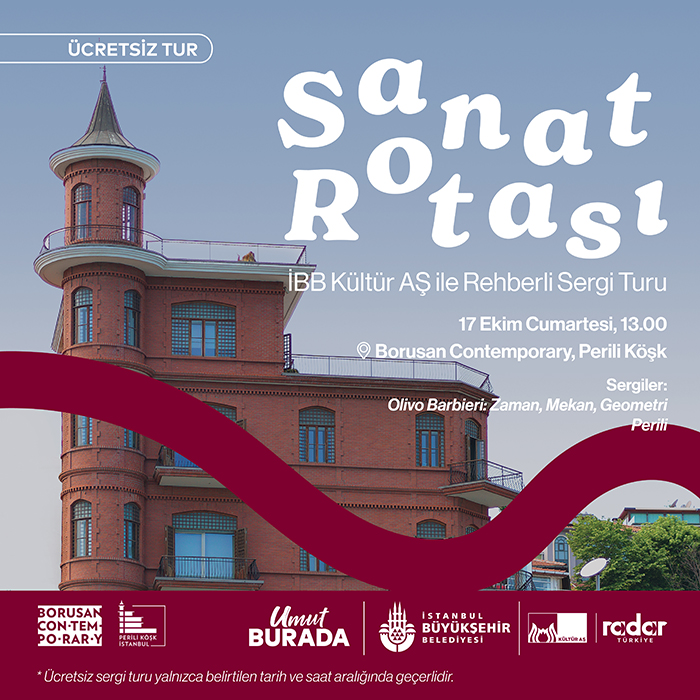
Sanat Rotası Borusan Contemporary'de
The exhibition tour, organized in collaboration between İBB Culture Inc. and Borusan Contemporary, will be open to art enthusiasts on Saturday, October 17th.
About the exhibition content:
Time, Space, Geometry.
Olivo Barbieri's photographic practice should be considered a radical aesthetic proposition that invites us to reconsider our perception of landscapes. His photographs not only question what is visible, but also how it is seen. Through his work, which he has been producing for nearly forty years, and particularly through the optical manipulation techniques he developed from the 1990s onwards, he brings a unique visual perspective to architectural structures, natural formations, and urban landscapes. Barbieri's compositions, in a sense, disrupt and reconstruct the viewing experience; they transform scale, perspective, and space, rendering them unfamiliar and focusing attention on the representation itself.
The exhibition brings together the artist's five main series, offering a comprehensive overview of Barbieri's relationship with landscape, time, space, and memory. Time, Space, Geometry. (2023), location-specific. (1999–2013), Waterfall Project. (2006–2007), The Alps. – Geography and People. (2012) and... Capri. The works, categorized under the title "(2013)," create a thematic continuity that extends from archaeological sites to global metropolises, exploring the relationship between the splendor of nature and human fragility, and encompassing the image-rich coasts of the Mediterranean.
Haunted.
Evoking Memories of the Future.
On the road to Thebes, the Sphinx poses a riddle to Oedipus: "What walks on four legs in the morning, two legs at noon, and three legs in the evening?" The answer to the riddle not only saves the city of Thebes and shapes Oedipus's destiny, but also points to a fundamental narrative of Western thought. For it is through this riddle that humanity, for the first time, comes to occupy the center of philosophy, art, and science for centuries; becoming the measure of truth. From ancient Greece to the present day, humanity is considered the subject that defines the meaning of the world, the fundamental measure of existence, and the privileged possessor of knowledge. However, Oedipus's tragedy lies not in solving the riddle, but in his inability to unravel the riddle of his own existence.
Today, the same riddle is once again relevant. However, this time, the riddle is not posed by a mythological creature standing between humans and animals, but by a ghost standing between humans and non-humans; it is posed by algorithms and artificial intelligence systems. While the Sphinx's riddle has endured for centuries, humanity, like Oedipus marching towards Thebes, is moving inexorably towards its own destiny.
To participate in our tours, which have limited capacity, you can download the Radar Türkiye app and register starting at 10:00 AM on Tuesday, October 13th.

