

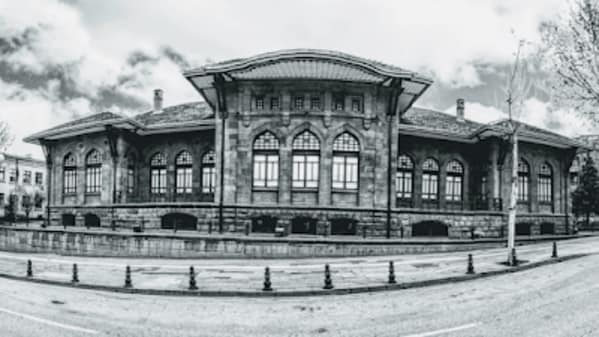
From Ulus to Bakanlıklar, the Three Buildings of the Grand National Assembly
Sign in to like and rate
The Grand National Assembly of Türkiye has worked in three different buildings in Ankara, and all three still stand today. This route follows them in the order they were used, from north to south. The first building, on Ulus Square, housed the Assembly from 23 April 1920 until October 1924 and is today the War of Independence Museum. The second building, a few minutes away, was used from 18 October 1924 until the third building came into service, and since 1981 it has been the Republic Museum. The third building stands in Bakanlıklar, at the highest point of the area set aside for state buildings in Hermann Jansen's city plan of 1932, and it has been the Assembly's home since January 1961.
The three buildings also tell how architecture changed in the first forty years of the Republic. The first was designed in 1915 as a club building, was left unfinished in the war years and was completed with roof tiles brought from the homes of Ankara's people. The second was designed by the architect Vedat Tek; with its crown gate, its tiles and its decorated ceilings it reflects the national architectural approach of its time. The third was built to Clemens Holzmeister's design after an international competition opened in 1937.
The route is made on foot and by metro. Between the two museums in Ulus there is only a walk of a few minutes. Then you take the metro from Ulus, get off at Kızılay and take a break in Güvenpark. The Security Monument in the middle of the park was also designed by Holzmeister, the architect of the Assembly building, so the second half of the day passes between two works by the same architect. Finally you walk south along Atatürk Boulevard and reach the Assembly grounds.
The real weight of the route lies in the two museums, because their rooms and assembly halls are preserved in their original layout. In the first building you see the hall where the first constitution, the Teşkilatı Esasiye Law, and the national anthem were adopted, and in the second the assembly hall where the Nutuk speech was delivered. The third building you will mostly view from outside; its interior can be visited on the open days set by the Assembly. As a time plan, two hours in total for the two museums in Ulus, half an hour for Güvenpark and forty-five minutes in front of the Assembly are enough; that way the route fits comfortably into half a day.
The order is both historical and geographic: as you follow the Assembly's journey in Ankara step by step, you walk from Ulus, the centre of the old city, towards the planned government quarter of the Republic. Check the museums' visiting days and the conditions of the Assembly's open day on the official pages before you go. Wear comfortable shoes and follow the photography rules at security points and in the museums.
Sources
- Kültür Portalı, Kurtuluş Savaşı Müzesi (Birinci TBMM Binası), https://www.kulturportali.gov.tr/portal/kurtulussavasimuzesi
- Kültür Varlıkları ve Müzeler Genel Müdürlüğü, Cumhuriyet Müzesi broşürü, https://kvmgm.ktb.gov.tr/Eklenti/118309,ankaracumhuriyetmuzesi16102023ipdf.pdf?0
- SALT Araştırma, TBMM Yapıları, https://saltonline.org/tr/2236/tbmm-yapilari
- Kültür Envanteri, Güvenpark, https://kulturenvanteri.com/yer/guvenpark/
- Kültür Envanteri, Güvenlik Anıtı, https://kulturenvanteri.com/yer/guvenlik-aniti/
Route Stops
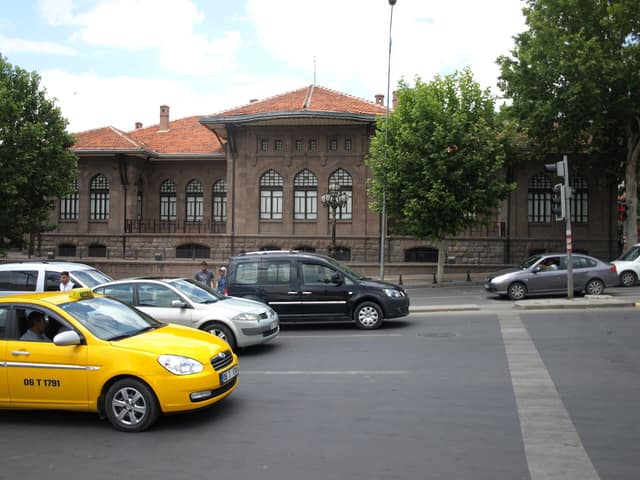
Kurtuluş Savaşı Museum: A Historical Place Witnessing the Birth of the Republic of Turkey
Begin the route at the First Grand National Assembly building on Ulus Square, today the War of Independence Museum. The building was designed in 1915 by Salim Bey, architect of the Pious Foundations administration, as a club building for the Committee of Union and Progress. The military architect Hasip Bey, who took on the construction, finished the masonry part of the building, but the roof and other parts were left unfinished because of the war and the shortage of materials. When it was decided that the Assembly would open on 23 April 1920, there was no other building of sufficient size in Ankara. For this reason the unfinished club building was repaired and completed. The missing roof tiles were brought from the homes of Ankara's people and from the Numune School in Ulucanlar.
Look at the facade before you enter. The building is built of the pink and purple local andesite known as Ankara stone and is one of the first examples in Ankara of the First National Architecture style. Inside, a corridor 42 metres long greets you. On its walls hang paintings by Refik Epikman, Saip Tuna, Mehmed Ruhi Arel, Mehmet Sami Yetik and Cevdet Bilgişin, along with photographs of the plenary sessions. The second room on the right of the corridor is the Speaker's Room, also used as Mustafa Kemal's study, and it is preserved in its original state.
The heart of the museum is the General Assembly Hall, the third room on the right of the corridor. In the middle of the hall with its boat-shaped ceiling stands the rostrum of the Speaker and the Presiding Board, with the rostrum of the minute clerks just in front of it. The benches facing the rostrum were reserved for the Council of Ministers, those at the sides for the deputies. The balcony on the right was for diplomats, the one on the left for the public, and the space under the balconies for the press. The benches were brought from the Teachers' School and from the school known as the Stone School, while the oil lamps and sheet iron stoves came from nearby coffee houses. As you stand in the hall, remember that the first constitution, the Teşkilatı Esasiye Law, was adopted here on 20 January 1921, the national anthem on 12 March 1921 and the abolition of the sultanate on 1 November 1922.
The other rooms along the corridor are also worth seeing one by one. The National Anthem Memorial Room displays objects that Mehmet Akif Ersoy used during his stay in Ankara, such as oil lamps and a copper dish, along with a cast of his face. In the Communications and Firepower Room you can see a manual telephone exchange, a cipher machine, a field telephone and Morse devices. The Şer'iye Committee Room, used as the constitutional committee room, displays the table on which the Treaty of Lausanne was signed and drafts of the Teşkilatı Esasiye Law. In the lobby room stands the first flag raised over the building on 23 April 1920.
The building opened on 23 April 1961 as the Grand National Assembly Museum, took the name War of Independence Museum on 23 April 1981 and today operates under the Speaker's Office of the Grand National Assembly. When you leave the museum, walk for a few minutes to the second Assembly building on Cumhuriyet Boulevard.
Source: Kültür Portalı, Kurtuluş Savaşı Müzesi; SALT Araştırma, TBMM Yapıları.
The War of Independence Museum located in Ulus Square in Ankara is one of the most important historical buildings witnessing the establishment process of the Republic of Turkey. The building used as the Grand National Assembly of Turkey between 1920-1924 is where the War of Independence was managed and the foundations of the Republic of Turkey were laid.
The building was constructed in 1915 for the Committee of Union and Progress, but was later allocated for the newly established assembly. This structure, which hosted the opening of the Grand National Assembly of Turkey on April 23, 1920, became the center for critical decisions made during the War of Independence. Important developments such as the ratification of the Treaty of Lausanne, the acceptance of the National Anthem, and the proclamation of the republic took place in this assembly.
Today, the building serves as a museum and houses many valuable documents, photographs, official papers, and objects from the period related to the War of Independence and the proclamation of the Republic. Inside the museum, the podium where Atatürk and the deputies (members of parliament) sat, meeting rooms, newspapers of the period, flags, and weapons from the war period are exhibited. Additionally, the podium where Mustafa Kemal Atatürk gave his speeches is preserved in its original form.
One of the most striking sections of the museum is the benches in the assembly hall and the seats named after the deputies who served during that period. Visitors wandering here can directly feel the atmosphere where important decisions regarding the establishment of the Republic were made.
The War of Independence Museum is one of the most important museums preserving the historical heritage of Turkey's struggle for independence. It is a must-visit place for anyone who wants to learn about the conditions under which the Republic was won, commemorate the heroes of the War of Independence, and closely feel the struggle of the Turkish nation for independence.
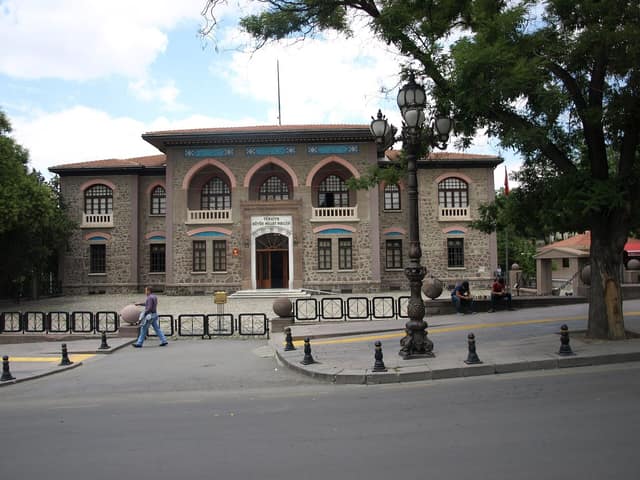
Republic Museum: A Historical Building Witnessing Turkey's Modernization Process
The Second Grand National Assembly building is on Cumhuriyet Boulevard, a few minutes' walk from the first building. It was designed in 1923 by the architect Vedat Tek as a meeting place for the Republican People's Party. When the first Assembly building proved inadequate its function was changed, and it was used as the Assembly from 18 October 1924 until the third Assembly building was built. The building thus witnessed the most critical periods of the Republic's history for 36 years. It was built at almost the same time as the Ankara Palas opposite; looking at the two buildings together helps you grasp the scale of the period.
Study the exterior first. The two-storey building is built of rough-cut stone, and its windows are arranged in harmony with the facade. The stone gate on the front facade takes the form of the crown gate of traditional Turkish architecture and recalls the Seljuk style. The palmette motif above the gate, however, is in the Ottoman style. Turquoise and dark blue tiles with traditional motifs are used on the exterior. Once inside, look up at the ceilings; the ceilings with Ottoman and Seljuk decoration and the rectangular rooms recall the layout of traditional Turkish houses.
The General Assembly Hall opposite the entrance served as the Assembly's plenary hall between 1924 and 1960. Depending on the election period, the number of deputies rose as high as 610, and the hall held 116 benches for them. Atatürk delivered the Nutuk speech in this hall over six days between 15 and 20 October 1927. The museum displays the microphone he used while reading the Nutuk, its record and Ottoman and Turkish editions of the text. Items relating to decisions such as the abolition of the sultanate and the proclamation of the Republic are also in this section.
On the ground floor are exhibition halls named after Mustafa Kemal Atatürk, Mustafa İsmet İnönü and Mahmut Celal Bayar, along with a hall telling the history of the Second Assembly building. These halls display the personal belongings, clothes and medals of the three presidents. On the first floor you can visit the President's study and reception hall, the Prime Minister's study, the Speaker's office and the ambassadors' boxes. There is also a temporary exhibition hall. As you walk through the rooms, notice how the furniture and the ceiling decoration were designed to match each other.
The building opened to visitors on 30 October 1981 as the Republic Museum and still serves the same purpose today. After leaving the museum, walk to the Ulus metro station and take the metro to Kızılay.
Source: Kültür Varlıkları ve Müzeler Genel Müdürlüğü, Cumhuriyet Müzesi broşürü; SALT Araştırma, TBMM Yapıları.
The Republic Museum, located in the Ulus district of Ankara, is one of the important buildings where the foundations of the Republic of Turkey were laid. The building, which was used as the Grand National Assembly of Turkey from 1924 to 1960, became a center where the most critical decisions of the Republic period were made.
The building was constructed in 1923 as Turkey's second TBMM building. Designed due to the inadequacy of the first assembly building, the structure is made of cut stone, notable for its Taşhan architecture, featuring a large hall and rooms that preserve the historical atmosphere. The Grand National Assembly of Turkey, which operated here from 1924 to 1960, witnessed significant developments such as the transition to a multi-party system, revolutions, and constitutional amendments.
Today, the building serves as a museum and houses many valuable artifacts reflecting the history of the Republic. The museum's collection includes Atatürk's personal belongings, documents belonging to the deputies of the period, the old assembly podium, meeting rooms, and documents of important decisions made after the proclamation of the Republic. In particular, the podium from which Atatürk read his Nutuk and the original documents related to the Treaty of Lausanne are among the most striking sections of the museum.
The Republic Museum not only offers its visitors a historical building but also holds great significance as a memory space that illuminates Turkey's modernization process and journey towards democratization. It is a must-visit museum for anyone who wants to witness the history of the Republic and closely observe the reforms shaped under Atatürk's leadership.
Güvenpark and Kızılay Square
When you come out of the metro at Kızılay, walk to Güvenpark. The park is a Republican-era city park in Kızılay. The Ministry of Culture and Tourism registered the park twice, on 13 July 1994 and on 17 November 1997. As you take a short break here, think of it as crossing a threshold on the route. Ulus, which you toured in the morning, was the centre of the old city, while Bakanlıklar to the south was the new government district of the Republic. Hermann Jansen's city plan of 1932 gathered the state buildings in this southern area, the Government Quarter.
Walk up to the Security Monument in the middle of the park. The monument is also known as the Güvenpark Monument, the Police Monument and the Trust Monument. It is dedicated to Türkiye's security forces, that is, the police and the gendarmerie. The design belongs to Clemens Holzmeister, who was also the architect of the Assembly building at the last stop of the route. The reliefs on the front were made by the Austrian sculptor Anton Hanak. After Hanak's sudden death the sculptor Josef Thorak completed the reliefs on the back. So study the two faces of the monument separately and compare the work of the two sculptors.
The monument is surrounded by parkland and pools. By walking around the edge of the pools you can look at the monument from different angles. Archive photographs show the monument under construction in the mid-1930s. Looking south from the front of the monument, you can follow the axis that runs towards Bakanlıklar. In this way you will spend the rest of the day walking between two works by the same architect. Sitting in the park and watching the crowds around you is also a good way to get to know everyday life in Kızılay.
When the break is over, go out to Atatürk Boulevard and walk south along it. The Assembly grounds are on the boulevard, in Bakanlıklar. As you walk, keep in mind that the boulevard is the main axis running from Ulus through Kızılay to the Assembly.
Source: Kültür Envanteri, Güvenpark ve Güvenlik Anıtı; SALT Araştırma, TBMM Yapıları.
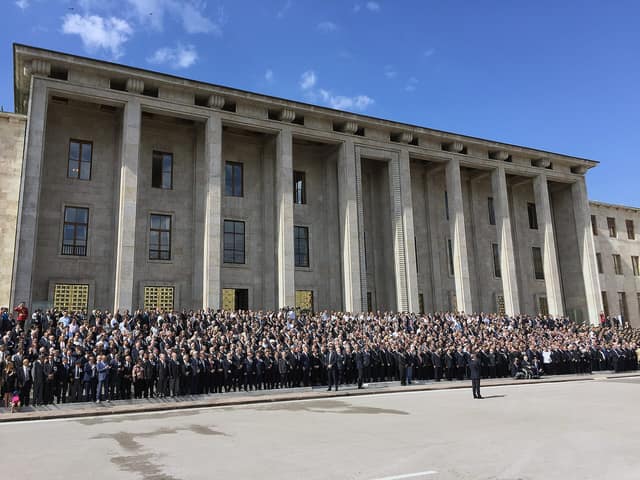
Grand National Assembly of Turkey Building
When you reach the Assembly grounds in Bakanlıklar, at the southern end of Atatürk Boulevard, you are standing in front of the third building of the route, the one still in use today. A new Assembly building was decided by law in 1937, and an international competition was opened for a parliament palace. The competition jury included Ivar Tengbom from Sweden, Willem M. Dudok from the Netherlands and Howard Robertson from England. Teams from various countries submitted a total of 14 projects. In the result announced on 28 January 1938, first prize was shared between the proposals of Clemens Holzmeister from Austria, Albert Laprade from France and Alois Mezara from Hungary. Holzmeister's project was chosen for construction.
The location of the grounds is a deliberate choice. In line with Hermann Jansen's 1932 plan, the Assembly was placed in the Government Quarter at the highest point of the area, and Holzmeister also drew up the site plan. Look from the far pavement of the boulevard to see how the building makes use of this rise. Construction began on 6 October 1939. Because of the Second World War and economic constraints, work continued intermittently. The architect Ziya Payzın finally completed the building, and it came into service in January 1961. About twenty-three years passed between the competition result and the opening.
This date links to the other two stops of the route. From 1924 until the opening of this building, the Assembly worked in the second building in Ulus. So the two museums you saw in the morning and the building you are standing in front of form the three stops of the Assembly's journey in Ankara. The first building on Ulus Square also serves today as a museum under the Speaker's Office of the Grand National Assembly. The difference in scale between the small stone building in Ulus and the grounds here makes visible how the young state grew in forty years.
The grounds are a working state institution, and there are security measures around them. It is always possible to see the building from outside, from the far side of the boulevard. If you want to see the interior, follow the Assembly's open day programme and check the days and entry conditions on the official website of the Grand National Assembly. Ask the officers before taking photographs at security points. After finishing the route, you can walk back north along the same boulevard to return to Kızılay.
Source: SALT Araştırma, TBMM Yapıları; Kültür Portalı, Kurtuluş Savaşı Müzesi.
Comments
Loading...
