

From Carpets to Marbled Paper, Following Traditional Crafts in Ankara
Sign in to like and rate
This route reads Ankara through handicraft. Over four stops you see traditional arts ranging from carpets and kilims to tiles, from wood carving to marbled paper and illumination, and from the Karagöz shadow screen to folk songs, both in the examples preserved in museums and in the places where they are still kept alive today. The first two stops of the route highlight the objects of these arts, the last two the people and practices that keep them alive.
The day begins at the Ankara Museum of Foundation Works on Atatürk Boulevard. The museum of the General Directorate of Foundations displays carpets, kilims and works in wood, metal, tile and manuscript donated to mosques and foundations, in a sequence running from the 13th to the 20th century. A short walk takes you to the Ethnography Museum on Namazgah Hill. In one of the first museum buildings of the Republic, the halls for carpets and kilims, tiles and porcelain, woodwork and the Ankara house show how daily life was interwoven with craft.
In the afternoon you go down towards Hamamönü. The Museum of Intangible Cultural Heritage is the first museum of its kind in Türkiye, and it keeps traditions such as Karagöz and Hacivat, the meddah storyteller, marbling and linden block printing alive through hands-on events. The route ends in Hamamönü with its restored 19th-century houses. The Ankara Provincial Directorate of Culture and Tourism describes the district as the centre of traditional craft workshops; in the houses on the Art Street you can see masters at work and get to know local production at the handicraft market.
The order runs deliberately from object to person. First, in the museums, you look closely at the knots of a carpet, the colour of a tile panel and the carving of a wooden door leaf. Then you see in whose hands the same techniques continue today. This makes it easier to connect the work you saw in the museum with the work done in the workshop. Two of the stops are also early Republican buildings: the Museum of Foundation Works building served as the Law School from 1928 to 1941, and the Ethnography Museum building was built in 1925-1926. So the buildings that house the works offer a slice of the city's history just as much as the works inside them. As a time plan, allow about an hour for each museum and at least an hour and a half for Hamamönü.
The four stops are within walking distance of each other and the route fits comfortably into half a day. The Museum of Foundation Works is closed on Mondays. The programme of performances at the Museum of Intangible Cultural Heritage and of the workshops in Hamamönü may change. Check the museums' visiting hours and the events calendar on their official pages before you go. Wear comfortable shoes, as you will walk between the stops.
Sources
- Vakıflar Genel Müdürlüğü, Ankara Vakıf Eserleri Müzesi, Müzemize Tarihi Yolculuk, https://avem.vgm.gov.tr/muzemiz/muzemize-tarihi-yolculuk
- Vakıflar Genel Müdürlüğü, Ankara Vakıf Eserleri Müzesi, Eser Konservasyonu, https://avem.vgm.gov.tr/eser-ve-bilgiler/eser-konservasyonu
- Vakıflar Genel Müdürlüğü, Ankara Vakıf Eserleri Müzesi, Ziyaret, https://avem.vgm.gov.tr/ziyaret
- Kültür Portalı, Ankara Vakıf Eserleri Müzesi, https://www.kulturportali.gov.tr/turkiye/ankara/gezilecekyer/ankara-vakif-eserler-muzes
- Kültür Portalı, Etnografya Müzesi, https://www.kulturportali.gov.tr/turkiye/ankara/gezilecekyer/etnografya-muzes
- Kültür Portalı, Somut Olmayan Kültürel Miras Müzesi, https://www.kulturportali.gov.tr/turkiye/ankara/gezilecekyer/somut-olmayan-kulturel-mras-muzes
- Kültür Portalı, Hamamönü, https://www.kulturportali.gov.tr/turkiye/ankara/gezilecekyer/hamamonu
- Ankara İl Kültür ve Turizm Müdürlüğü, Somut Olmayan Kültürel Miras, https://ankara.ktb.gov.tr/TR-394872/somut-olmayan-kulturel-miras.html
- Ankara İl Kültür ve Turizm Müdürlüğü, Türk Süsleme ve Geleneksel El Sanatları, https://ankara.ktb.gov.tr/TR-257755/turk-susleme-ve-geleneksel-el-sanatlari.html
Route Stops
Ankara Foundation Works Museum - Ottoman Heritage
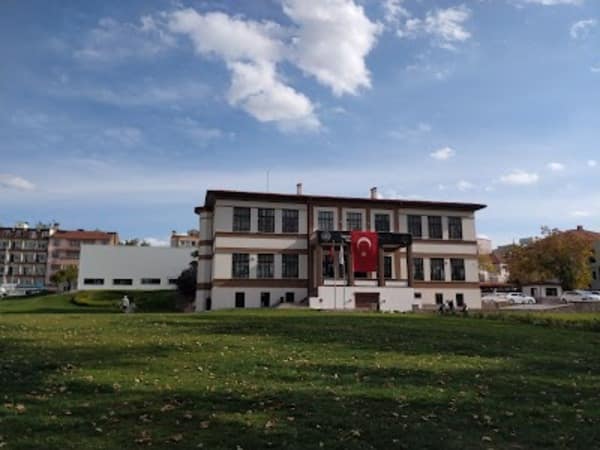
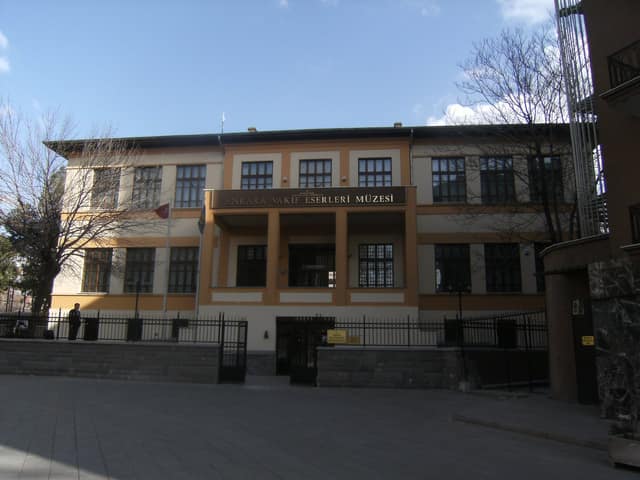
Begin the route at the Ankara Museum of Foundation Works on Atatürk Boulevard. Construction of the museum building began at the end of 1927 as a large primary school built by the General Directorate of Foundations, and at the end of 1928 it was allocated to the Law School. The building served as the Law School from 1928 to 1941 and in later years took on different roles such as a girls' vocational school and a student dormitory. The General Directorate of Foundations restored the building and opened it as a museum on 7 May 2007. Before entering, take a look at the symmetrical and very plain facade of the masonry building with two storeys above a basement.
The museum's collection is a product of the culture of pious foundations. Carpets, kilims and works of wood, metal, tile, textile, leather and manuscript are on display. The works date from the 13th to the 20th century. According to the museum, the collection holds a total of 2,669 works, of which 236 are on display. So each piece has been carefully chosen; tour the halls without hurrying.
When you stand in front of the carpets and kilims, notice the repetition of the motifs and the border bands. These weavings, donated to foundations, were used for centuries, wore out and are now under protection. The museum has a separate pool for washing carpets and kilims and a conservation laboratory where works are repaired. The gallery of woodwork holds wooden pieces from the 13th and 14th centuries, and the gallery of metalwork holds examples of metal craft.
In the upper-floor hall, look in particular at a tile panel made up of 24 pieces. The panel, which belongs to the Valide-i Atik Mosque in Üsküdar, was found abroad and brought back, and it reached the laboratory in 41 pieces because of breakages. Conservators cleaned and joined the pieces and fixed them onto a new backing to prepare the panel for display. This panel shows that the works in the museum are not only displayed but also repaired here.
The museum has handheld computers giving information in five languages, information kiosks and a lift for disabled visitors. According to the Culture Portal the museum is closed on Mondays and entry is free; check the hours before you go. When you leave the museum, walk towards the Opera and climb Namazgah Hill to the Ethnography Museum.
Source: Vakıflar Genel Müdürlüğü, Ankara Vakıf Eserleri Müzesi (Tarihi Yolculuk, Eser Konservasyonu, Ziyaret, Galeriler); Kültür Portalı.
One of the most important museums reflecting Ankara's cultural heritage, the Ankara Foundation Works Museum, was opened to visitors in 2007. The museum aims to promote Turkey's foundation culture by showcasing rare foundation works that have survived from the Ottoman and Seljuk periods to the present day.
The museum building was constructed between 1927 and 1928 as the Turkish Hearths Central Building and is a historical structure notable for its stone craftsmanship and architecture. It was later restored and transformed into a museum by the General Directorate of Foundations. Located close to Ulus Square, the museum serves as an easily accessible cultural stop for both local and foreign visitors.
The museum exhibits carpets and kilims collected from different regions of Anatolia, examples of calligraphy art, handwritten Qurans, doors and chests notable for their woodwork, ceramic decorations, historical candlesticks, and metal art pieces. Especially, the carpets from the Ottoman period showcase the deep-rooted weaving art of Anatolia.
Visitors can see the reflections of foundation culture in art within the museum's rich collection and examine the most exquisite examples of calligraphy art. The museum holds great value both visually and historically for those interested in traditional arts.
Ethnography Museum
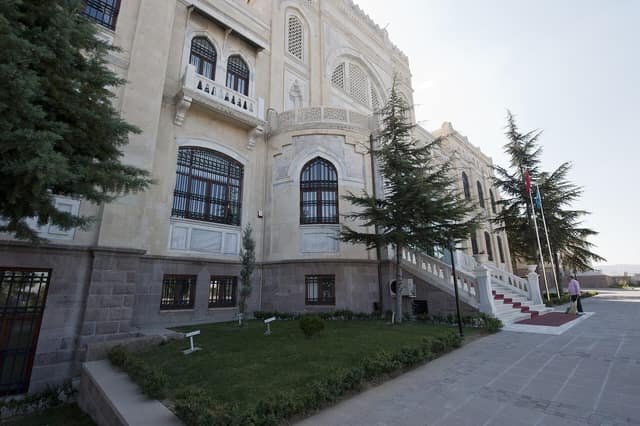
When you reach the Ethnography Museum on Namazgah Hill, look first at the building itself. Construction of the museum building began in 1925 and was completed in 1926. Its architect was Arif Hikmet Koyunoğlu, its contractor Nafiz Kotan from Erzurum and its engineer Bahri Bey. The marble master was Hüseyin Avni Efendi, and the caster of the moulds for the bronze reliefs on the dome was Hakkı Usta. These names are a reminder that the building itself is also a product of craft.
The museum's history is closely tied to the history of the Republic. The visit of the Afghan King Amanullah Khan on 27 May 1928 is regarded as the museum's first opening; the museum opened to visitors on 18 July 1930. The area in the entrance hall served as Atatürk's temporary tomb for 15 years, from 21 November 1938 to 10 November 1953, and no museum activity took place during this period. After his remains were moved to Anıtkabir, the museum reopened on International Museum Day, 18 May 1956. Stop for a few minutes as you pass this area at the entrance.
Today the museum has ten halls, nine permanent and one temporary. For the theme of this route, go first to the Carpet and Kilim Hall. Compare the colours and motifs of the weavings with the examples you saw at the Museum of Foundation Works. Then move on to the Tile and Porcelain Hall; study the colour of the glazed surfaces and the arrangement of the patterns. The Woodwork Hall displays door leaves and other examples of woodwork from the Beylik, Seljuk and Ottoman periods. Look closely at the depth of the carving and at how the geometric patterns repeat.
The Hall of Metal, Glass and Terracotta Works and the Hall of Elegance and Aesthetics show items from the culture of jewellery and dress. The Ankara House Hall recreates the interior of a traditional house and lets you see together the crafts by which everyday objects were made. This hall is a good preparation for the Hamamönü houses you will visit at the end of the route. The Manuscripts Hall holds handwritten works and calligraphic panels.
The museum can also be reached by public transport running along Talatpaşa Boulevard. Check the visiting hours before you go. After leaving the museum, walk east along Talatpaşa Boulevard towards Hamamönü.
Source: Kültür Portalı, Etnografya Müzesi (Ankara İl Kültür ve Turizm Müdürlüğü arşivi).
Ankara Museum of Intangible Cultural Heritage
~50 min hereJust before going down into Hamamönü, stop at the Museum of Intangible Cultural Heritage. The museum is on Öz Street, which opens onto Talatpaşa Boulevard. Opened on 15 June 2013, it is the first museum of its kind in Türkiye. It was set up through the work of faculty members in Turkish Folklore at Gazi University and with financial support from the Ankara Development Agency. Intangible cultural heritage means the practices, expressions, knowledge and skills that communities pass down from generation to generation.
At the previous two stops you looked at objects; here the knowledge and skill that produce those objects come to the fore. The museum keeps the traditions it presents alive through hands-on events. Karagöz and Hacivat, the orta oyunu theatre, meddah storytelling, village folk plays and children's games are among the traditional performances the museum presents. Crafts such as linden block printing and marbling are also among the museum's activities. Stand by a marbling tray or in front of a printing block and follow the steps of the technique.
The museum also brings Ankara's own oral culture to life. Tales, folk songs, stories, lullabies and rhymes particular to Ankara are among the traditions kept alive here. Customs such as traditional conversation gatherings, a staged henna night, the first-tooth celebration and the henna night for soldiers are also re-enacted. The Ankara Provincial Directorate of Culture and Tourism counts folk songs and dance tunes such as Ayaş Yolları, Misket and Fidayda among the city's well-known oral heritage. The Seymen tradition is also listed in Türkiye's National Inventory of Intangible Cultural Heritage. Keep these names in mind as you listen to the presentations in the museum.
The Provincial Directorate of Culture and Tourism notes that carpet weaving, felt making, coppersmithing and stonework continue in Kalecik and Ayaş through the master and apprentice relationship. This shows that the weavings and metalwork you saw at the first two stops still have a living counterpart today. The museum's programme of performances and workshops changes with the season; ask about the events calendar before you go. If you are coming with children, try to coincide with the traditional games events. When you leave the museum, walk for a few minutes into the historic streets of Hamamönü.
Source: Kültür Portalı, Somut Olmayan Kültürel Miras Müzesi; Ankara İl Kültür ve Turizm Müdürlüğü, Somut Olmayan Kültürel Miras.
Hamamönü
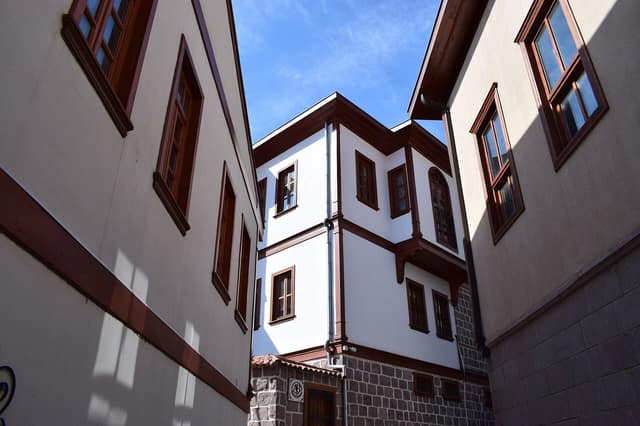
End the route in Hamamönü, in the streets where traditional crafts live on today. Hamamönü is a historic district of Altındağ where houses that are examples of 19th-century civil architecture have been restored and brought back to life. The district takes its name from the double bathhouse built by Karacabey, one of the lords of the Bayındır tribe. The historic Karacabey Bathhouse is in this district. The Mehmet Akif Ersoy House Museum and Mehmet Akif Ersoy Park are also among the important stops in Hamamönü.
The Ankara Provincial Directorate of Culture and Tourism describes Hamamönü as the centre of traditional crafts and workshops. In the workshops in restored mansions, visitors can watch the masters and also take part in hands-on courses. Decorative arts such as illumination, marbling and calligraphy are taught here in particular. In the historic houses on the Art Street you can see the work of artists who practise traditional crafts. At the handicraft market you can get to know the handmade products of local people.
As you pass the workshops, try to connect them with the techniques you saw in the museums. The decoration of illumination recalls the border ornaments of the manuscripts at the Museum of Foundation Works. The marbling master's tray is the everyday form of the practice you watched at the Museum of Intangible Cultural Heritage. The Provincial Directorate of Culture and Tourism notes that besides illumination, marbling, calligraphy, miniature and tile work, coppersmithing, needle lace, felt making, wood carving and carpet and kilim weaving also continue in the city. If you get the chance to talk to a master, ask which stage of the work takes the longest.
Look at the houses themselves too. These restored 19th-century houses are the street-side counterpart of the traditional houses whose interior layout you saw in the Ankara House Hall of the Ethnography Museum. In the summer months handicraft markets are set up in Hamamönü. The district also hosts events such as live music and film screenings. Since the days and hours when the workshops are open may change, ask before you go. Hamamönü is also a short distance from the intercity bus terminal and the railway station. After finishing the day you can walk towards Ulus to reach the metro.
Source: Kültür Portalı, Hamamönü; Ankara İl Kültür ve Turizm Müdürlüğü, Türk Süsleme ve Geleneksel El Sanatları.
Comments
Loading...
