

A Bank, a Post Office, a Foundation and a Parachute Tower, the Institutional Museums of Ulus
Sign in to like and rate
Ulus is the district where the new state raised the first buildings of its institutions in the early years of the Republic. Most of these institutions later moved to other buildings or were transformed, but their buildings stayed where they were and have now become museums telling their own histories. This route visits, in order, four museums of four institutions along the short stretch of Atatürk Boulevard between Ulus and the Opera: the museums of a bank, a postal administration, a foundations authority and an aviation association. Each one means both a collection and a building from early Republican architecture.
The route is walked on foot and begins just south of Ulus Square. The first stop is the Ziraat Bank Museum in the Ziraat Bank Head Office Building, designed by Giulio Mongeri and opened in 1929; this museum, opened in 1981, is presented as the first bank museum in Turkey. A few steps further on, in the former Emlak ve Eytam Bank building, is the PTT Stamp Museum, opened in 2013. Walking south along the boulevard to the building opposite the Opera, you reach the Ankara Museum of Foundation Works, in a building whose construction began in 1927 and which long served as the Law School. For the final stop you head west from the Opera towards Ankara Station; the Turkish Aeronautical Association Museum on Hipodrom Street ends the route in the open air with its historic Parachute Tower and a garden where aircraft stand.
There is a logic to the order. The first three stops are a few hundred metres from one another on the same boulevard, so it is convenient to spend the morning hours indoors and leave the open-air part of the day for the end. Because the route ends at the station, it also becomes easy to take Başkentray or the metro for the return.
The route can also be read as a lesson in architecture. The Ziraat Bank building represents the First National Architecture Period, nourished by Seljuk and Ottoman ornament; the former Emlak ve Eytam Bank building designed by Holzmeister represents a plainer monumentality; and the building of the Museum of Foundation Works represents a simple school building stripped of ornament. At the end of this sequence, the Parachute Tower shows an entirely different engineering language with its reinforced concrete body.
The route fits into half a day, but not all of the museums are small. The vault department in the basement of the Ziraat Bank Museum, the floors of the PTT Stamp Museum and the woodwork of the Museum of Foundation Works each need time of their own. The visiting days of the museums are set by different institutions; the Ziraat Bank and Foundation Works museums are closed on Mondays. Check the entry conditions and current hours on each institution's own page before you go. The pavements of the boulevard are wide, but the traffic is heavy; cross only at signalled crossings.
Sources
- Ziraat Bankası, Ziraat Bankası Müzesi, https://www.ziraatbank.com.tr/tr/bankamiz/kultur-sanat/ziraat-bankasi-muzesi
- Kültür Portalı, Ziraat Bankası Müzesi, https://www.kulturportali.gov.tr/turkiye/ankara/gezilecekyer/tc-zraat-bankasi-muzes
- Kültür Portalı, PTT Pul Müzesi, https://www.kulturportali.gov.tr/turkiye/ankara/gezilecekyer/ptt-pul-muzes
- Vakıflar Genel Müdürlüğü, Ankara Vakıf Eserleri Müzesi, Müzemize Tarihi Yolculuk, https://avem.vgm.gov.tr/muzemiz/muzemize-tarihi-yolculuk
- Kültür Portalı, Ankara Vakıf Eserleri Müzesi, https://www.kulturportali.gov.tr/turkiye/ankara/gezilecekyer/ankara-vakif-eserler-muzes
- Kültür Portalı, Türk Hava Kurumu Müzesi, https://www.kulturportali.gov.tr/turkiye/ankara/gezilecekyer/turk-hava-kurumu-muzes
- Kültür Envanteri, Ankara Paraşüt Kulesi, https://kulturenvanteri.com/yer/?p=23855
- Wikipedia, PTT Pul Müzesi, https://tr.wikipedia.org/wiki/PTT_Pul_Müzesi
- Wikipedia, Ankara Vakıf Eserleri Müzesi, https://tr.wikipedia.org/wiki/Ankara_Vakıf_Eserleri_Müzesi
- Wikipedia, Türk Hava Kurumu Müzesi, https://tr.wikipedia.org/wiki/Türk_Hava_Kurumu_Müzesi
- Wikipedia, Ankara Paraşüt Kulesi, https://tr.wikipedia.org/wiki/Ankara_Paraşüt_Kulesi
Route Stops
Ziraat Bank Museum
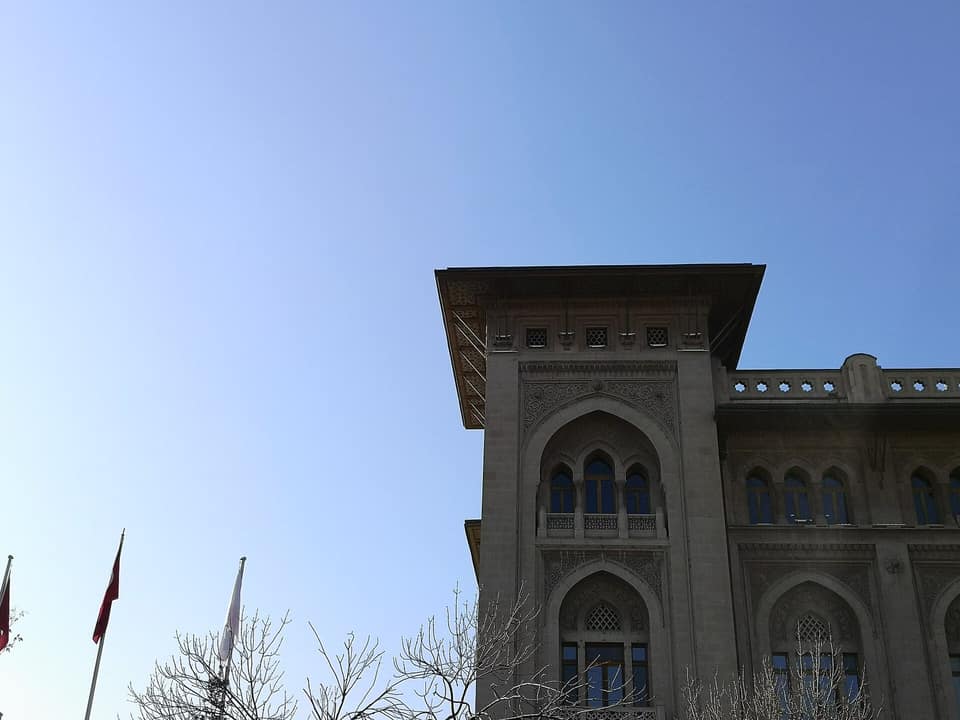
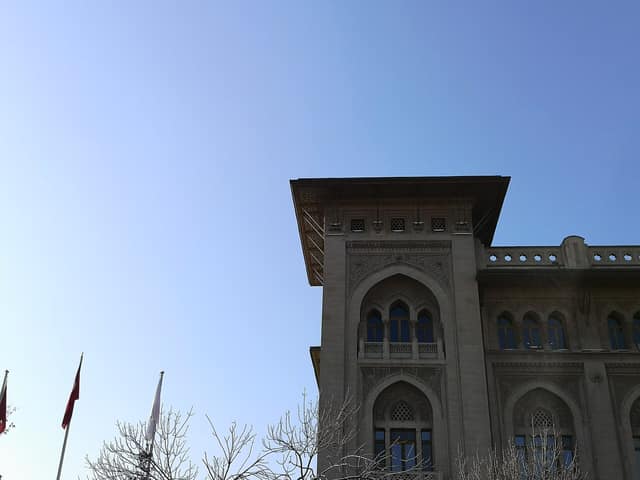
Leave Ulus metro station and walk to number 8 on Atatürk Boulevard; the imposing building in front of you is the Ziraat Bank Head Office Building. Its architect was the Italian Giulio Mongeri, who was born in Istanbul and trained in Italy. The project began in 1925, the plot was handed over on 26 February 1926 and the building was completed at the end of 1929. The opening ceremony took place on 26 November 1929. The building belongs to the First National Architecture Period, and its decoration shows the influence of Seljuk and Ottoman ornamental art.
Before going inside, look at the facade and the area under the eaves. The Seljuk motifs under the eaves are the work of Mahmut Akok; the wooden joinery and carpentry are by Selahattin Refik, and the plaster patterns on the ground floor are by the architect Vahan Bey. The building of about 10,000 square metres has a basement, ground floor, mezzanine, first and second floors and an attic floor. According to the bank's record, cement and plaster were brought from Germany and brick and timber from Romania, while the marble was supplied from within the country.
The museum opened in the Hall of Honour on the ground floor on 20 November 1981, the 118th anniversary of the bank's founding. With the restoration that began in 2017, the basement was added to the museum, and it reopened to visitors in November 2019. In the Hall of Honour, first raise your head: the marble-clad hall, the high ceilings, the arches, the crystal glass and the tile decoration are seen together. The sheaf of wheat at the centre of the coloured stained glass made in Milan symbolises the bank. The chronological display on the ground floor includes an original Memleket Sandığı, a local credit fund, dated 1863, and the letters in which Mithat Pasha explained why such funds should be established. The first journal ledger of 1889, cash books, seals, savings books and typewriters show the everyday tools of banking. İbrahim Çallı's 1928 painting Harvest is also on this floor.
Then go down to the basement and make for the main vault department. The vaults were built together with the basement of the building; vault doors and steel safes made by a French firm can be seen here. The safe deposit section has safes number 1 and 2, in which belongings of Atatürk were kept. The radio room introduces the bank's radio programmes of the 1960s and 1970s, and the Events of the Month section presents cinema newsreels from 1967 to 1989. The wheat-sheaf emblem chosen in a 1961 competition and the Ziraat Postası magazine, distributed free between 1964 and 1981, are also explained in the corporate identity section.
If you are coming with children, the children's activity area in the basement has animations and mechanical games about the history of money and banking. The museum is closed on Mondays and public holidays; reservations are required for school and group visits. Check the current visiting hours on the bank's museum page. When you come out, walk a few steps south on the same side of the boulevard; the second stop is close by.
Source: Ziraat Bankası, Ziraat Bankası Müzesi; Kültür Portalı, Ziraat Bankası Müzesi.
PTT Stamp Museum
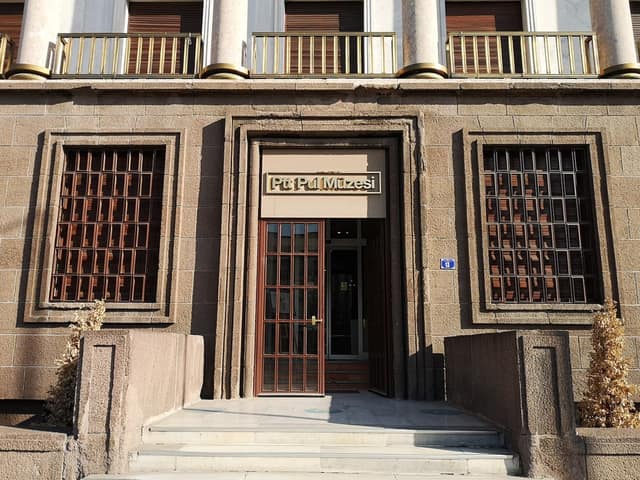
The second stop is the PTT Stamp Museum at number 13 Atatürk Boulevard. The museum is in the former Milli Emlak ve Eytam Bank building in Ulus. The building is the work of the Austrian architect Clemens Holzmeister, who designed many public buildings in Ankara in the Republican period. Having stood empty for a long time, the building was renovated by PTT and opened as a stamp museum in 2013. Pause for a moment in front of the facade and compare it with the Ziraat Bank building; one represents an ornate national style, the other a plainer and more monumental order.
Inside, the museum spreads over several floors, and it is natural to begin on the ground floor. The ground floor is devoted to the history of communication and to the past of the postal administration. Here you see postal staff uniforms from different periods and materials once used in the post. Looking at how the postmen's uniforms changed from period to period tells how the institution modernised along with the state. The cinema hall and the multi-purpose halls make up the living side of the museum as well.
The stamp collections are displayed on the upper floors. Ottoman and Republican stamps are presented in chronological order, starting from the first years of the stamp in these lands. In the display cases, look closely at the printing techniques, the colours and the designs with imperial monograms or portraits. The thematic stamps section has series divided into themes such as Atatürk, history, tourism, nature, sport, vehicles and cultural heritage. This section is a good place to see how a country presents itself through its stamps. World stamps, postcards, and first day and special day covers are also part of the collection.
The top floor is devoted to the stamps of member countries of the Universal Postal Union. On this floor you can follow how much the sizes, colours and subjects of stamps change as you move from one country to the next. If you are coming with children, be sure to stop at the game screens for children and the section where children's stamps are displayed. The museum also has a workshop for interactive activities. Temporary exhibitions are held from time to time in exhibition halls open to institutions and individuals.
The museum's stamp sales section is for those who want to buy a stamp or a cover at the end of the visit. The building is large, and seeing all the floors takes time; if your time is limited, give priority to the floor of chronological Turkish stamps. Check the museum's opening days and entry conditions before you go. When you leave, walk south along the boulevard towards the Opera building. The third stop is directly opposite the Opera building.
Source: Kültür Portalı, PTT Pul Müzesi; Wikipedia, PTT Pul Müzesi.
Ankara Foundation Works Museum - Ottoman Heritage
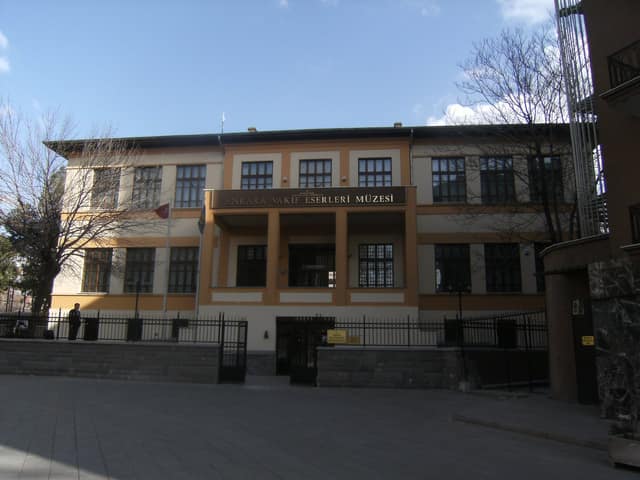
Opposite the Opera building, the plain building with a symmetrical facade at number 23 Atatürk Boulevard is the Ankara Museum of Foundation Works. Construction of the building as a large primary school was begun by the General Directorate of Foundations at the end of 1927. At the end of 1928 it was allocated to the Law School. The Ankara Law School, which had opened in the Telegraph Office building in 1925, used this building from 1928 to 1941. In the following years the building became in turn the Ankara Girls' Art School, a dormitory for female students and for a time a dormitory for male students.
The upper floors were later rented by the Ankara Mufti's Office, and a public soup kitchen was set up in the basement. The building was vacated in April 2004, and the General Directorate of Foundations restored it as a museum. The Ankara Museum of Foundation Works opened on 7 May 2007. As you look at the facade, remember that this is a three-storey masonry building consisting of a basement, a ground floor and a first floor. Its plan is a transverse rectangle, and both the plan and the facade are symmetrical. Its plain facade, stripped of traditional ornament, is mentioned in the Culture Portal record as one of the early examples of the First National Architecture Period.
The collection consists of works gathered from all over Turkey and kept for years in the storerooms of the General Directorate of Foundations. Carpets, kilims and woodwork, metalwork, tiles, textiles, leather and manuscripts span the 13th to the 20th centuries. According to the museum's record, 236 of the total of 2,669 works are on display. As you walk round, give your time first to the textiles; the kilims from Adana and Sivrihisar are a good chance to see differences in colour and motif side by side. Then move on to the woodwork and look for the 13th-century wooden window shutters from the Ahi Evran building in Kırşehir.
Among the wooden works there are also door leaves and wooden panels from the Great Mosque and Hospital of Divriği. Look closely at the carving technique of these pieces; the geometric order of Seljuk woodwork is seen here at eye level. The museum's collection also includes candlesticks, money pouches, clocks, metalwork, calligraphy panels, tiles and endowment deeds of the sultans. A reconstruction of a village house interior shows how textiles were used in daily life. Exhibitions of traditional and modern art are held in the Multi-Purpose Exhibition Hall in the basement.
The museum's conservation workshop and carpet washing pool are rare facilities that show how the works are preserved. Handheld devices in five languages, information kiosks and a lift for disabled visitors are also among the visitor services. The museum is closed on Mondays and is close to the Opera stop. Check the visiting conditions on the museum's website before you go. On the way out, walk west past the Opera building along Talatpaşa Boulevard towards Ankara Station. The last stop is at the start of Hipodrom Street, north of the station.
Source: Vakıflar Genel Müdürlüğü, Ankara Vakıf Eserleri Müzesi; Kültür Portalı; Wikipedia.
One of the most important museums reflecting Ankara's cultural heritage, the Ankara Foundation Works Museum, was opened to visitors in 2007. The museum aims to promote Turkey's foundation culture by showcasing rare foundation works that have survived from the Ottoman and Seljuk periods to the present day.
The museum building was constructed between 1927 and 1928 as the Turkish Hearths Central Building and is a historical structure notable for its stone craftsmanship and architecture. It was later restored and transformed into a museum by the General Directorate of Foundations. Located close to Ulus Square, the museum serves as an easily accessible cultural stop for both local and foreign visitors.
The museum exhibits carpets and kilims collected from different regions of Anatolia, examples of calligraphy art, handwritten Qurans, doors and chests notable for their woodwork, ceramic decorations, historical candlesticks, and metal art pieces. Especially, the carpets from the Ottoman period showcase the deep-rooted weaving art of Anatolia.
Visitors can see the reflections of foundation culture in art within the museum's rich collection and examine the most exquisite examples of calligraphy art. The museum holds great value both visually and historically for those interested in traditional arts.
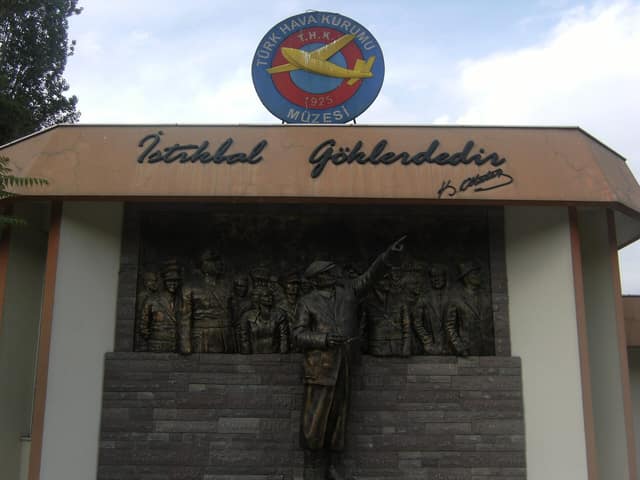
Turkish Aeronautical Association Museum: A Journey Through Turkey's Aviation History
The last stop of the route is the Turkish Aeronautical Association Museum at number 2 Hipodrom Street. The museum opened to visitors on 19 May 2002. It has 287 square metres of indoor space and 5,294 square metres of open space, so most of the visit takes place outdoors. The site has three parts: the historic Parachute Tower, a registered monument, the garden where original aircraft are displayed, and the museum building where documents are shown. After the indoor halls of the previous three stops, this is where the route takes a breath.
As soon as you enter the garden your eye will go to the Parachute Tower. The tower opened in 1937 and is among the towers built in Turkey for parachute training. Notice the balconies on the upper part of its reinforced concrete body and the winch mechanism at the top; jumps are made with this mechanism. According to the Culture Portal record, a jump can be experienced from the tower under the supervision of parachute instructors. Since the conditions and season for jumps are set by the institution, ask about the details in advance.
The museum building has display cases telling the history of aviation in the world and in Turkey through documents and photographs. Some 747 documents and photographs on the history of the Turkish Aeronautical Association and Turkish civil aviation are displayed in this section. In the cases you also see the uniforms, medals and wings badges used by the association. The models of the Türkkuşu Directorate General and the İnönü Training Centre are a good start for getting to know the association's training facilities. Images of TOMTAŞ, the first aircraft factory in Kayseri, also recall the first steps of aircraft production in Turkey.
The museum's two most popular models recreate two flight attempts of the 17th century. One shows Hezarfen Ahmed Çelebi's flight from the Galata Tower to Üsküdar, and the other Lagari Hasan Çelebi rising off Sarayburnu with his seven-armed rocket. These two scenes are like an introduction telling how far back the idea of flight goes in these lands. In the garden stand examples of the aircraft the association produced; the THK-15 is one of them. You can examine the cockpit of the helicopter in the garden from inside; the Culture Portal record mentions this opportunity specifically.
The best angle for photographs is one that shows the tower in the same frame as the aircraft in the garden; for this, move to the corner of the garden on the side of the aircraft. Check the museum's visiting days and hours on the association's website before you go. After the visit you can reach Ankara Station in a few minutes on foot. From the station you can move on to other districts of the city by Başkentray or the M4 metro line, or rest in Gençlik Park if you are not too tired. In this way the route completes in half a day a history of institutions reaching from a bank vault to the top of a parachute tower.
Source: Kültür Portalı, Türk Hava Kurumu Müzesi; Wikipedia, Türk Hava Kurumu Müzesi ve Ankara Paraşüt Kulesi.
Turkish Aeronautical Association (THK) Museum is one of the most important museums that sheds light on the history of aviation in Turkey. This museum, opened in 2002, showcases the development of the Turkish aviation industry and the significant roles undertaken by the Turkish Aeronautical Association throughout history.
In the museum's collection, old and modern airplanes, gliders, engines, parachutes, aviation equipment, and pilot uniforms are exhibited. One of the most striking sections of the museum is the training aircraft and fighter planes used in the early years of the Republic. Here, aircraft from World War II and the aircraft used by THK over time can also be seen.
Additionally, the museum provides detailed information about the Turkish Aeronautical Association's firefighting activities, aviation training, and work in the field of sports aviation. Parachuting, model airplane construction, and documents, photos, and objects related to civil aviation are part of the museum's archive.
The museum features interactive areas and educational workshops, hosting events that particularly attract the interest of young people and aviation enthusiasts. THK Museum offers a rich content for those who want to closely observe the development of aviation history and technology, making it a must-visit place for anyone interested in Turkish aviation history.
Comments
Loading...
