

Two Thousand Years of Hot Water in Sarıkaya
Sign in to like and rate
Anyone heading southeast from Yozgat sees little for a long while but wheat fields, gentle ridges and a wide sky. Then the road drops into a valley and the houses of Sarıkaya appear.
About Trip
Anyone heading southeast from Yozgat sees little for a long while but wheat fields, gentle ridges and a wide sky. Then the road drops into a valley and the houses of Sarıkaya appear. Right in the middle of this town, a few metres below the street, hot water still fills the pool of a bath built in the Roman period. This trip follows that water for a day: its legend, its names, who drew on it over the centuries and how the town grew up exactly on top of the spring. The architecture of the bath is described in detail on the Sarıkaya Roman Bath page in Keşfet; here the focus is on the story of the water and of the town.
A valley on the Bozok plateau
The Governorship of Yozgat writes that the provincial centre was founded at the foot of one of the high hills of the Bozok plateau, and that the province is enclosed by the Akdağlar range to the east, the Delice River valley to the south and west, and the Deveci mountains to the north. According to the general information on Yozgat in Kültür Portalı, the name Bozok comes from the Bozok Turkmens who began settling the region in the 16th century, and the provincial centre enters the records under that name in the 1560s. Sarıkaya lies on the southern slope of this plateau, on the side that faces Kayseri.
A study published in 2022 by Emine Saka Akın and Alperen Erdoğan of Yozgat Bozok University notes that Sarıkaya stands 1170 metres above sea level on a plateau dominated by broad, rolling plains. The same study stresses that its many thermal springs and its land suited to farming and herding made this spot a place of continuous settlement throughout history. Turkish Wikipedia likewise reports that the bath was built in the deepest part of a large valley on the Bozok Plateau, directly over the thermal spring. In other words, the water chose the site and the town took shape around it.
The Sarıkaya Hot Springs page of Kültür Portalı gives the district centre as 77 kilometres from Yozgat, while Turkish Wikipedia puts the distance at 79 kilometres. The whole journey is by road, and Kültür Portalı also notes that the bath is reached by road. In Roman times, too, this place lay on a route. Turkish Wikipedia states that the spring sat on the road running from Kayseri towards Kamuliana, Euaissa and Sibora, and that cities such as Tavium were nearby.
The legend of the King's Daughter
Everyone who asks about the bath in Sarıkaya first hears a story. According to the legend recorded in the Culture Atlas section of Kültür Portalı, in Roman times the daughter of a senior official living in Kayseri, the centre of Cappadocia, fell gravely ill. No physician could find a cure for the girl of this official, whom the people called a king; her knees gave way and she could no longer walk. In those days Sarıkaya was reed bed and marsh, and where the hot water rose there was a small muddy pond. As a last resort, the father sent his daughter there to find some comfort.
The girl wandered along the edge of the pond and from time to time stepped into the mud and the hot water. As the story goes, she grew better day by day, her knees loosened and at last she began to walk. Learning that his daughter had been healed, the father had a marble pool built over the spring and had it walled with large cut stones. The legend ends by telling how a large Roman settlement grew up around this pool over time, how the city later vanished and how only the bath remained.
Kültür Portalı also explains the historical frame behind the legend. In Roman times Kayseri, that is Kaisareia, was the capital of the province of Cappadocia and the region's highest officials lived there; the king of the story was most likely a provincial governor or a powerful Roman noble. The study by Akın and Erdoğan likewise reports the claim that the bath was built by one of the Roman kings because of his daughter's illness, and that it is therefore known as the King's Daughter Roman Bath. The legend even has a coincidental echo. According to Turkish Wikipedia, a bronze Roman coin found in the excavations bears a portrait of Emperor Antoninus Pius on the front and Mount Erciyes on the back. The mountain of Kayseri turned up in the same ground as the story of the girl who came from Kayseri.
Following the names
This water has had many names. Turkish Wikipedia reports that the spring appears in the 2nd century in Ptolemy's geography in the Greek form Sarouena, that Latin sources write it as Aquae Saravenae, and that the 13th century copy of the Peutinger Map reads Aquas Aravenas in corrupted Latin. In Byzantine lists the name appears as Basilikai Thermai, which Wikipedia says means the royal baths. Kültür Portalı, on the other hand, links the name Basilica Therma to a building added to the structure in the Byzantine period. Both explanations stand side by side in the sources.
In local speech other names survived: Terzili Hamam, the King's Bath, the King's Daughter's Bath. Akın and Erdoğan write that the archaeologist Kurt Bittel referred to the building as Terzili Hamam and Thermae Basilica. English Wikipedia notes that identifying the town with Aquae Saravenae is disputed and that the same name has also been proposed for Kırşehir. So caution is needed here as well: most sources give Sarıkaya's ancient name as Aquae Saravenae, but this is not a settled identification.
The story of water that never stopped
What makes Sarıkaya special is not only that it holds the remains of an old bath, but that the water has kept flowing ever since. Akın and Erdoğan describe the Sarıkaya Roman Bath as one of two buildings whose thermal water still reaches the bath as it has since the day it was built; the other, they note, is the Roman bath in the English city of Bath. The General Directorate of Cultural Heritage and Museums also writes that in later periods people continued to make use of the bath's hot springs.
Traces of this continuity show up in the finds too. Turkish Wikipedia reports that the excavations yielded a patterned Seljuk perfume flask, a double-sided wooden comb with two lion figures at its centre, and gold and silver coins from the reign of Sultan Ahmed III. So the bath remained a place for bathing long after Rome. The same article notes that, according to an Ottoman document of 1905, when the teachers of a school opened in Boğazlıyan could not be paid, it was discussed whether the revenues of the Ilısu hot spring should be assigned to them, a sign that the spring was still in operation at the beginning of the 20th century.
The spring itself is still strong today. Kültür Portalı writes that the Sarıkaya spring waters belong to the group of oligometallic waters containing fluoride, that they emerge at 48 degrees with a flow of 28 litres per second, and that the water is left to cool and used at 38 to 40 degrees. According to the same page, the Sarıkaya Hot Springs were declared a thermal tourism centre by decision of the Council of Ministers. The Governorship of Yozgat also lists Sarıkaya, together with Sorgun and Yerköy, among the province's hot spring centres. Today spa facilities operate in the town; since they are separate businesses we do not name them here, so check current information with official sources.
From bath village to district town
The present centre of the town was a village for a long time, and its name came straight from its water. As Turkish Wikipedia reports, Sarıkaya was a village attached to Akdağmadeni until 1935. That year the sub-district administration was moved from the village of Aşağısarıkaya to the present centre, known as Terzili Hamamı or the Bath village, but the sub-district kept the name Sarıkaya. The Sarıkaya sub-district, attached to Boğazlıyan, became a district in 1957. So the place marked Sarıkaya on today's maps is the village that people called by the bath's name for centuries.
As the town grew, the bath disappeared from view. Akın and Erdoğan write that the building was used as a bath until the 1970s, with additions built over its remains, and that because of these additions and the rising ground level of the town, everything except the west facade ended up underground. The site was registered as an immovable cultural property in 1987; in 2010 the fill soil began to be cleared under the supervision of the Yozgat Museum and excavations started, and in 2013 it was declared an archaeological site. The excavations continued until 2015, the surrounding buildings were expropriated and the bath was partly brought back to light. The same study adds that much of the bath is thought to lie beneath modern bath buildings that are still in operation.
The excavations have an older history as well. Akın and Erdoğan report that the French traveller Chantre drew the facade of the bath in 1893-1894, that the first photographs of the building appeared in the book of Dr. von der Osten, who directed the Alişar Höyük excavations, and that the first excavation took place in 1932 under Richard C. Haines. Anadolu Agency announced that the bath was added to the UNESCO World Heritage Tentative List on 1 June 2018, and Kültür Portalı confirms this date.
What to see
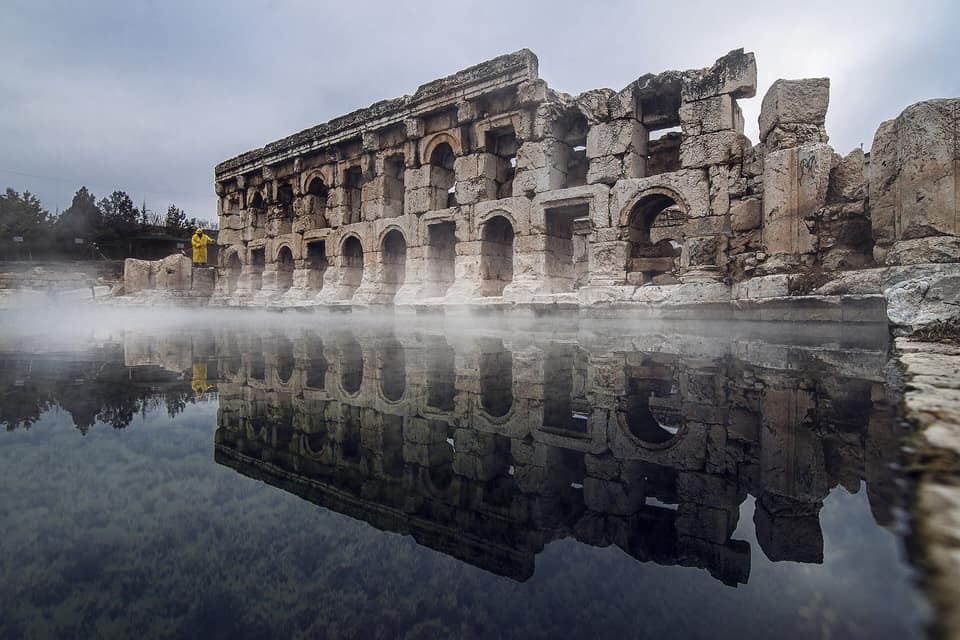
Today the bath appears as an excavation site lying in a hollow below the street. Wooden walkways and railings run around the site and let you look at the remains without harming them. The eye goes first to the west facade, the two-storey wall of arches; Kültür Portalı writes that this wall has ten bays and is about 30 metres long. The large pool in front of the facade, the inner pool behind it and the third pool to the east can be read side by side. For the details of the architecture see the bath page in Keşfet; our suggestion here is to look at the water rather than the facade. Try to find the spot in one of the pools where the water wells up at the surface; seeing where the hot water rises sums up the whole story of this place.
Look at the town as well. The apartment blocks and shopfronts rising right at the edge of the bath are the best measure of how deep the ancient building lies. The fact that the remains sit several metres below the town's present ground level is, as Wikipedia also notes, the result of the surrounding ground and roads rising over time. From the highest point of the walkway, looking down, this layering is visible at a single glance.
Season and time of day
Sarıkaya has the continental climate of the Bozok plateau. The Governorship of Yozgat writes that the average annual temperature in the provincial centre is around 9 degrees; winters are cold. That cold also decides the best time to see the hot water. The cover photograph of this trip was taken on a February morning and shows steam rising from the pool. If you come early on a cold morning, you will notice the water's heat from its vapour before you see anything else. In summer the site is open to the sun with little shade; it is more comfortable to come before the midday heat or late in the afternoon.
For photographs, the points facing the facade from the far end of the pool give the widest view. On a still day the surface of the pool reflects the row of arches. On windy days the reflection breaks up and the steam disperses quickly; the first hours of the morning are usually calmer.
Practical notes
- The bath is in the centre of Sarıkaya, on Dutluk Caddesi in Kaplıca Mahallesi; this is the address given by Kültür Portalı. It is easy to find on foot in the town centre.
- Sarıkaya is reached from Yozgat by road. For public transport options and schedules, check current information with official sources.
- Whether the site is open to visitors, its opening hours and entry conditions may change. Turkish Wikipedia writes that visitor arrangements have been made and that opening is planned; before you go, ask the Yozgat Museum or the provincial directorate of culture and tourism.
- The ancient pools are an excavation site and you may not enter them. Those who want to bathe in the hot water should head for the spa facilities in the town; check current information on the facilities with official sources.
- If you want to extend your day, the mounds towards Sorgun and the finds in the Yozgat Museum tell of older layers of the same landscape; see the Yozgat routes in Keşfet.
Sources
- Kültür Portalı, Sarıkaya Roma Hamamı, https://www.kulturportali.gov.tr/turkiye/yozgat/gezilecekyer/sarikaya-roma-hamami
- Kültür Portalı, Sarıkaya Kaplıcalarının Efsanesi (Kral Kızı Hamamı), https://www.kulturportali.gov.tr/turkiye/yozgat/kulturatlasi/sarikaya-kaplicalarinin-efsanesi-kral-kizi-hamami
- Kültür Portalı, Sarıkaya Kaplıcaları, https://www.kulturportali.gov.tr/turkiye/yozgat/gezilecekyer/sarikaya-kaplicalari
- Kültür Portalı, Yozgat Genel Bilgiler, https://www.kulturportali.gov.tr/turkiye/yozgat/genelbilgiler
- General Directorate of Cultural Heritage and Museums, Sarıkaya Roma Hamamı (Yozgat) [2018], https://kvmgm.ktb.gov.tr/TR-210804/sarikaya-roma-hamami-yozgat-2018.html
- Akın, E. S. and Erdoğan, A., Documentation in Archaeological Sites with Unmanned Aerial Vehicles, The Case of Sarıkaya Roman Bath, SDÜ Journal of Natural and Applied Sciences, 2022, https://dergipark.org.tr/en/download/article-file/2139305
- Governorship of Yozgat, Yozgat Genel Bilgiler, https://www.yozgat.gov.tr/yozgat-genel-bilgiler
- Anadolu Agency, Kral kızı UNESCO'nun geçici listesinde, https://www.aa.com.tr/tr/kultur-sanat/kral-kizi-unesconun-gecici-listesinde/1162468
- Turkish Wikipedia, Basilica Therma, https://tr.wikipedia.org/wiki/Basilica_Therma
- Turkish Wikipedia, Sarıkaya, Yozgat, https://tr.wikipedia.org/wiki/Sar%C4%B1kaya,_Yozgat
- Wikipedia, Basilica Therma, https://en.wikipedia.org/wiki/Basilica_Therma
Comments
Loading...
Location - Two Thousand Years of Hot Water in Sarıkaya
 AuthorRadar TürkiyeVisit SourceGet Directions