

Sürmene's Knife Makers, the Memiş Ağa Mansion and the Çamburnu Coast
Sign in to like and rate
The coastal road that runs east from Trabzon towards Rize squeezes into a narrow strip between the mountains and the sea at Sürmene.
About Trip
The coastal road that runs east from Trabzon towards Rize squeezes into a narrow strip between the mountains and the sea at Sürmene. The Trabzon Provincial Directorate of Culture and Tourism explains that the mountains running parallel to the coast in the Eastern Black Sea drop ever more steeply to the sea as one goes east, that there is almost no flat land suitable for settlement along the shore, and that the way inland is provided by the valleys the streams have cut. Sürmene is a typical coastal town of this landscape. On a day trip you can see three distinct layers here one after another: knife making passed down from generation to generation, an agha's mansion that combines stone and timber, and a small nature park where Scots pines reach right down to the shore.
Getting there
The provincial directorate places Sürmene 36 kilometres east of Trabzon, on the Trabzon-Rize highway. To the east of the district lies Of, to the west Araklı, and to the south the district of Köprübaşı and the province of Gümüşhane. Because the road follows the coast all the way, the town is easy to reach by the eastbound minibuses and buses that leave central Trabzon. The other two stops on this trip also lie on the same highway or right beside it. Even so, coming in your own car is more comfortable if you want to see everything without rushing the day or waiting between stops. Routes and timetables change with the season, so check the current situation before setting out.
From Hyssilime to Sürmene
The name Sürmene is tied less to a single town than to the history of a whole area. According to the provincial directorate, the Roman road guide known as the Tabula Peutingeriana lists a military station called Hyssilime between Trapezus and Opiunte, that is, between Trabzon and Of, and this name is thought to correspond to today's Sürmene. Procopius, who sailed east from Trabzon in the middle of the 6th century, also mentions the village of Susurmena in his travel notes. The name Sürmene itself enters the records as the name of a nahiye, a sub-district, after Trabzon was taken by Mehmed the Conqueror in 1461.
The present district centre is more recent. According to the provincial directorate, the old market at Halanik, today's Zeytinli quarter, burned and was abandoned during the unrest of 1832-1834. After that, a weekly market began to be held at the village of Humurgan at the mouth of the valley for the villages of the Manahos stream valley. Sürmene was reorganised in 1854 as a nahiye with 69 villages, became a kaza, or district, in 1873, and opened its municipality in 1876. The Trabzon provincial yearbooks of 1903-1905 count 29 inns, 163 mills and 318 ovens across the whole district. These figures show how lively the trade between the coast and the valleys once was.
The knife makers' quarter
In many parts of Turkey the name Sürmene is first associated with knives. The Trabzon Provincial Directorate of Culture and Tourism traces the history of the Sürmene knife back to the Ottoman period and presents it as known for its quality steel, its handwork and its elegant form. A study by Doğanay and Çavuş published in the Eastern Geographical Review states that knife making has continued in the district for about 150 years. According to the same study, the Trabzon provincial yearbook of 1872 records that blacksmithing and arms making were important in Sürmene and that the rifles and pistols made here were sent to Istanbul, Anatolia and Rumelia. Exactly how knife making began is not known, but it is thought to have developed as a companion to firearms.
The craft's last century was not an easy one. According to the study, production came to a near standstill in 1952, when the Sürmene knife was placed in the firearms category and banned. Most of the masters who had worked until then in some 50 home workshops moved to cities such as Istanbul, Bursa and Kocaeli. By 1990 the number of masters in the district had fallen below 10. Courses run by public education centres raised the number again, and in 2011, when the research was carried out, 15 masters were recorded, the youngest aged 27 and the oldest 80.
The centre of traditional production is the Soğuksu quarter, and Kayalı and Orta are among the other quarters where knives are made. The workshops are usually set up in annexes of houses or right next to them, and the blade, the handle and the sheath all come from the same master's hands. The provincial directorate sums up production in five steps: choosing the steel, heating it and shaping it with a hammer, sharpening it, fitting the handle, which is usually made of wood, and putting every knife through a final check one by one. Doğanay and Çavuş note that quenching the steel in fish oil is a practice specific to Sürmene knife making. Stopping outside a workshop where you hear a hammer while walking the quarter's streets in the morning is the easiest way to see that this work is still done by hand.
The Sürmene knife is registered as a geographical indication in the register of the Turkish Patent and Trademark Office. Following an application by the Sürmene Municipality in 2017, it was registered as a designation of origin under number 329 on 22 February 2018. The provincial directorate advises buyers to pay attention to authenticity and quality. Since the workshops are also the masters' places of work, ask for permission before taking photographs inside.
The Memiş Ağa Mansion
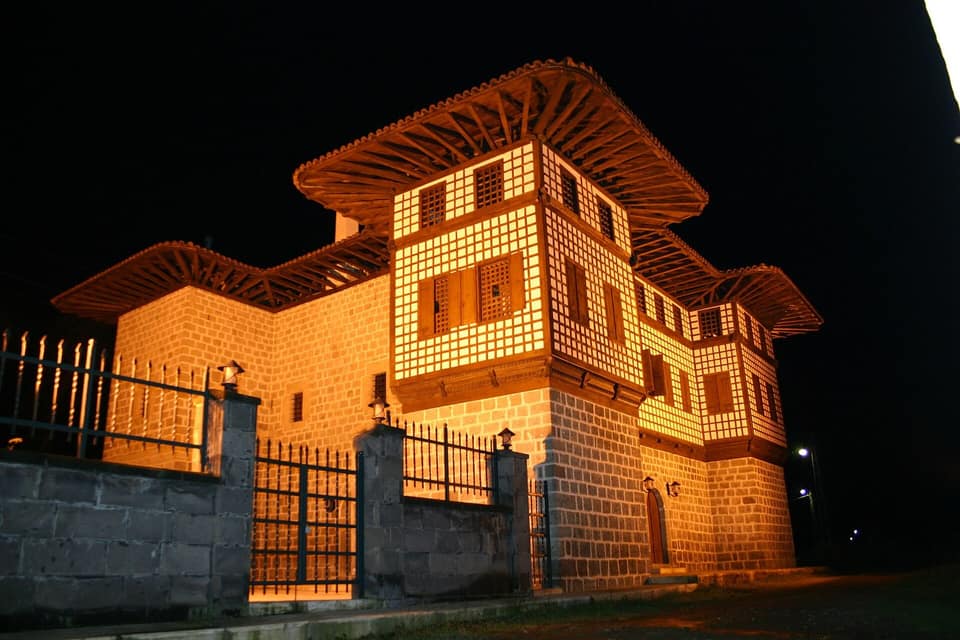
If you follow the coastal road east from the district centre, the Memişoğlu Mansion appears at the place called Balıklı after about 4 kilometres, according to the provincial directorate's description. Locally the building is also known as the Memiş Ağa Mansion and the Yakupoğlu Memiş Ağa Mansion. The provincial directorate counts it among the finest examples of civil architecture. It is a building made largely of stone, with a stepped facade and wide eaves, and it is known in the region for its stonework and above all for its woodwork. Its door leaves and ceilings display the best examples of woodcraft. Its construction date is given differently in the sources. The provincial directorate writes that it is thought to have been built in the 18th century, while other sources date the building to the middle of the 19th century.
The most often told detail of the mansion is the ceiling of the west room on the upper floor. According to the provincial directorate, in the middle of this room there is a piece that can turn around a shaft. The piece works both as a ventilator and as a weather vane, and for this reason the mansion is popularly called the Mansion with the Turning Ceiling. Crossing to the other side of the road gives a good angle for seeing the stone body, the timber facade of the upper floor and the wide eaves around the roof together. Conditions for visiting the interior can change over time, so check with the provincial directorate before you go.
Çamburnu Nature Park
The last stop of the trip is Çamburnu, reached by continuing east along the coastal road. A study by Oruç, Keleş, Uzun and Kaya published in the Journal of Fungus describes Çamburnu Nature Park as an area of 51 decares lying about 8 kilometres from the centre of Sürmene, 7 from Of and 1 from the settlement of Çamburnu. A 2017 report by the Faculty of Forestry of Karadeniz Technical University sets out clearly why the area matters. Çamburnu is one of the few places in Turkey where the Scots pine can descend all the way to sea level, and for this reason it draws the interest of scientists from Turkey and abroad.
The report states that the area with nature park status stretches from the sea up to 50 metres above sea level, that spruce and Scots pine grow together here, and that maquis-like plants live in the lower layer. According to the same report, a study in the area identified 153 plant taxa belonging to 62 families and 123 genera. The study in the Journal of Fungus also recorded 109 species of macrofungi in the park and its immediate surroundings. Seeing the two conifers side by side on the same slope on a short walk, and catching traces of a mountain forest a few steps from the shore, is the real reward of this stop.
The Scots pine forest to the south of the park went through a fire on 7-8 January 2017. The KTÜ report states that the nature park was not affected by the fire and points out that most forest fires in the area break out on winter and spring days when dry southerly winds blow. So never light a fire in the park in any season, and leave no cigarettes or litter behind.
Çamburnu is known not only for its forest but also for its shore. Doğanay and Çavuş list the boat and shipbuilding industry at Çamburnu among Sürmene's main economic activities, alongside tea and hazelnut growing. The provincial directorate's list of beaches also includes the Çamburnu Public Beach in Sürmene. In summer it is possible to end the day here with a swim. Ask locally about sea and beach conditions before you go.
The flow of the day
Leaving Trabzon early in the morning and heading to the Soğuksu quarter in central Sürmene lets you catch the hours when the workshops are open. Towards noon you can move along the coastal road to Balıklı to look at the mansion, and devote the afternoon to Çamburnu's pine-covered slope and its shore. In the evening, the return west along the same coastal road is short. Those who want to extend the day can continue to the neighbouring district of Of to the east, but in that case the return time needs to be planned in advance.
Season and weather
The provincial directorate stresses that the region receives plenty of rain and that the mountains are covered with dense vegetation. So carry a raincoat in every season. Summer is best for the beach, while clear days in spring and autumn are the most suitable for walking and taking photographs in the nature park. Remember that on dry days in winter and spring, when the southerly wind blows, the risk of fire in the forest rises.
Practical notes
- Workshop hours vary from master to master, so ask about visiting times in advance.
- If you buy a knife, choose a product with the geographical indication and the master's own workshop.
- For conditions of entry to the mansion, check with the provincial directorate for current information.
- The nature park is a protected area, so do not collect plants or mushrooms.
- The coastal road is a busy highway, so use pavements and crossings when walking.
Sources
- Trabzon İl Kültür ve Turizm Müdürlüğü, Sürmene, https://trabzon.ktb.gov.tr/TR-57625/surmene.html
- Trabzon İl Kültür ve Turizm Müdürlüğü, Konaklar, https://trabzon.ktb.gov.tr/TR-365536/konaklar.html
- Trabzon İl Kültür ve Turizm Müdürlüğü, Sürmene Bıçakçılığı, https://trabzon.ktb.gov.tr/TR-365448/surmene-bicakciligi.html
- Trabzon İl Kültür ve Turizm Müdürlüğü, Plajlarımız ve Sahil Tesisleri, https://trabzon.ktb.gov.tr/TR-57705/plajlarimiz-ve-sahil-tesisleri.html
- Türk Patent ve Marka Kurumu, Sürmene Bıçağı coğrafi işaret kaydı, https://ci.turkpatent.gov.tr/cografi-isaretler/detay/38340
- Doğanay ve Çavuş, Geleneksel El Sanatlarına Bir Örnek, Sürmene Bıçağı Üretimi, Doğu Coğrafya Dergisi, https://dergipark.org.tr/tr/download/article-file/27007
- KTÜ Orman Fakültesi, Çamburnu Mevkiinde Çıkan Orman Yangını Hakkında Rapor (2017), https://ktu.edu.tr/dosyalar/ormanmuhendisligi_51cd9.pdf
- Oruç, Keleş, Uzun ve Kaya, Çamburnu Tabiat Parkı ve Yakın Çevresinde Belirlenen Makromantarlar, Mantar Dergisi, https://dergipark.org.tr/tr/pub/mantar/article/857729
- Vikipedi, Sürmene, https://tr.wikipedia.org/wiki/S%C3%BCrmene
Comments
Loading...
Location - Sürmene's Knife Makers, the Memiş Ağa Mansion and the Çamburnu Coast
 AuthorRadar TürkiyeVisit SourceGet Directions