

On the Trail of the Amisos Treasure
Sign in to like and rate
A few neighbourhoods that look ordinary in today's Samsun were, more than two thousand years ago, the cemetery of one of the busiest harbours on the Black Sea.
About Trip
A few neighbourhoods that look ordinary in today's Samsun were, more than two thousand years ago, the cemetery of one of the busiest harbours on the Black Sea. The ground of the districts called Kalkanca, Baruthane, Karasamsun, Cedit and Selahiye opens from time to time during roadworks or foundation digging, and burial chambers cut into the rock appear beneath it. This trip follows the most famous of them: how the gold jewellery the public calls the Amisos Treasure was found, what kind of place the city it belonged to was, and how to look at it today in the display cases of the Samsun Museum. The tumuli on Amisos Hill and the museum building are described in detail on their own Keşfet pages; here the focus is the story of the treasure.
Roadworks and a collapsing ceiling
The comprehensive study published in 2021 in the Amasya University Journal of Social Sciences by Orhan Alper Şirin of the Samsun Museum Directorate and Davut Yiğitpaşa of Ondokuz Mayıs University describes the discovery clearly. In 1995, during road widening carried out by İlkadım Municipality, the ceiling of an underground tomb collapsed in a dead-end street opening onto Ebusuud Efendi Avenue in the Cedit neighbourhood. The museum was notified and the Museum Directorate carried out a rescue excavation in the tomb. It was an underground chamber carved into conglomerate, the natural rock of the area.
The Kültür Portalı page on Amisos Hill also states that the treasure came to light together with a family tomb during rescue excavations in the Cedit neighbourhood in 1995. One point that is often confused needs clarifying here. The rescue excavations that uncovered the graves in the Baruthane Tumuli on Amisos Hill began in 2004, and the work there was carried out jointly by the Samsun Museum and Istanbul University. So the treasure does not come from the tumuli on the hill but from another rock-cut tomb inside the city; both find spots are parts of the same wide cemetery of the same ancient city.
What was in the tomb
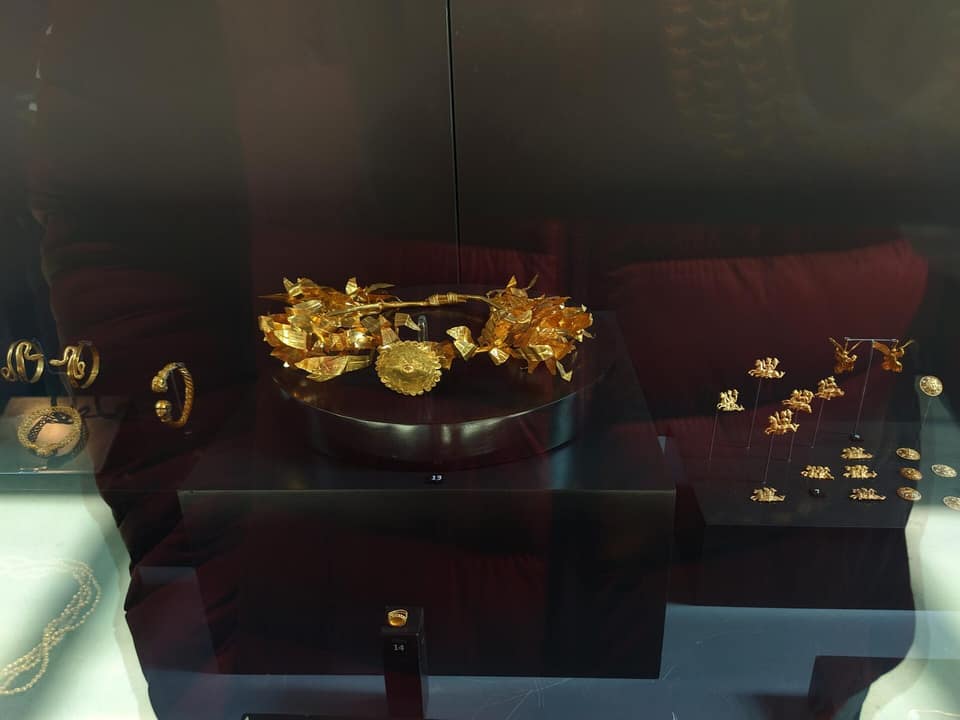
The catalogue by Şirin and Yiğitpaşa lists the gold finds of the Cedit tomb one by one. Twisted bracelets with women's heads and with lion heads, snake-shaped bracelets, earrings with figures of Nike and of Eros playing the lyre, a pin with resin beads, a ring with a bezel, wristlets, appliqués showing Nereids seated on sea horses, domed buttons and Medusa-head buttons, a wreath, a necklace pendant, diadems, necklaces, a pendant, gilded beads and drop ornaments are all on this list. Kültür Portalı notes that besides the gold jewellery, pottery, glass and marble objects were also among the grave goods.
According to the Kültür Portalı page on the Samsun Museum, the gold jewellery among the finds from the burial chamber belonged to a man, a woman and a young girl. The sources do not say the same thing about who owned the tomb. Kültür Portalı and the Samsun Provincial Directorate of Culture and Tourism write that the man's grave is thought to belong to one of the highest-ranking officials of the Kingdom of Pontus, and the others to his wife and daughter. Şirin and Yiğitpaşa say instead that, as has been suggested before, the tomb may have belonged to an aristocratic family or to an Amisos family from the merchant class that was growing rich at the time. What is certain is that it was a family tomb and that its contents reflect the finest workmanship of the period.
There is also a debate about the date. Kültür Portalı dates the finds broadly to between the 4th and the 1st century BC. Şirin and Yiğitpaşa re-evaluate the grave goods, which earlier publications had placed between the middle of the 4th and the beginning of the 3rd century BC, and place them at the end of the 4th century BC. The authors note that both the dates and the names of some pieces differ from one publication to another, which is why they re-examined the whole set.
What kind of city was Amisos
To understand the treasure you have to look at the city of the people who wore it. According to Kültür Portalı, written sources link Amisos to the Milesians who founded a colony at Sinop in the 6th century BC. The portal summarises the city's growth in four stages: the Milesians using the small settlement as the starting point of the trade route linking the Black Sea with inner Anatolia, the settlement of Cappadocians, the growth of the city after a Cappadocian leader allowed Phocaeans to settle, and in 437 BC the arrival of Athenians from Sinop, who renamed the city Peiraieos.
Şirin and Yiğitpaşa report that the earliest finds come from the Çakalca Karadoğan Mound to the west of the present city and date to the middle of the 6th century BC. According to the authors, as its political and commercial power grew, the city moved towards the end of the 4th century BC to Toraman Tepe and its surroundings, some 16 kilometres to the east, a strategically better position. Kültür Portalı writes that the Upper City on the ridge of Toraman Tepe covered an area of about 44 hectares, that the harbour lay to the east of the hill, and that behind the harbour stood a Lower City with warehouses and sailors' quarters. The eastern, western and southern slopes of the city were used as cemeteries.
The city's wealth came from the sea. Drawing on coins and inscriptions, Şirin and Yiğitpaşa report that Amisos's exports grew from the 4th century BC onwards and that its trade reached as far as Greece and the Aegean islands. Pottery, weapons and jewellery bound for the Greek cities of southern Russia, which followed Aegean fashion, were also shipped from the southern Black Sea ports where Amisos stood. The study also notes that in the 2nd and 1st centuries BC trade relations between Amisos and Delos were very good, and that grave stelae of Amisos merchants have been found on Delos. The city lived its most brilliant period under the Pontic king Mithridates VI; the authors state that in this period the city was furnished with a palace, temples and new buildings.
Not a single tomb but a cemetery
The Cedit tomb is not the only gold find from Amisos. The same study lists the rescue excavations the Samsun Museum Directorate carried out at different points in the city. In 2009, in tombs whose ceilings collapsed during earthworks in the Kalkanca neighbourhood, a large amount of gold was found, dated to between the late 2nd and early 1st century BC. In 2013 another rock-cut tomb appeared in the Baruthane neighbourhood, containing lynx-head earrings, a ring and a diadem. In 2021 gold finds were also recovered from an underground rock-cut tomb on Anadolu Avenue in the Kalkanca neighbourhood, inside an archaeological protected area.
A group of objects often met in these later tombs is thin gold discs stamped on one side only. The authors define them as symbolic Charon coins left beside the dead. Some bear the names of the cities of Amisos, Sinope and Khabakta, others portraits of Mithridates VI and Artemis. On some of the thin gold strip diadems with ivy leaves, the star and sun motif symbolising Mithridates VI is worked, and one carries the stamp of an Amisos city coin.
Was there a goldsmith in the city
This is the most intriguing question of the study. The authors think that the presence, in many tombs of the time of Mithridates VI, of diadems, Charon coins and animal-head earrings that closely resemble each other in form and workmanship may point to a goldsmith's workshop in the city. On the other hand, intensive trade with Delos and the Aegean suggests that some of these pieces may have been brought to the city by merchants. The authors state plainly that with the data at hand it is not possible to say anything definite for now. Still, the fact that a break in one of the lion-head bracelets from the Cedit tomb was joined with gold wire strengthens the idea that this bracelet may have been repaired by a goldsmith.
How to look at the treasure in the museum
Kültür Portalı writes that the Samsun Museum first opened to visitors in 1981 and has been housed since 2024 in its new building in İlkadım; the address is Atatürk Bulvarı No:105. The Samsun Provincial Directorate of Culture and Tourism states that the 15,000 square metre building, whose architecture is inspired by the waves of the Black Sea, displays 7,165 objects. According to the portal, the Amisos Treasure is one of the museum's most valuable collections and is exhibited in a special section.
When you reach the display case, look first at the wreath. According to the catalogue, 108 olive leaves cut from gold sheet are attached to its ring, and at its centre is a rosette with a stylised flower motif fixed with a pin. The density of the leaves and the central rosette are features the authors find typical of wreaths of the 4th and 3rd centuries BC; compare them with the sparse, plain workmanship of the later strip diadems in the same case and the difference becomes obvious.
Then look for the small appliqués. On ten appliqués, Nereids sitting sideways on galloping sea horses, holding a helmet in one hand and a sheathed sword in the other, are worked by hammering into a mould. One pair of earrings shows winged figures of Nike holding the ends of a cloak blowing in the wind with both hands, another pair seated Erotes playing the lyre. On the snake bracelets the scales on the head and on the coiled tail are inlaid, while the hoop of the lion-head bracelets is made of tiny rings soldered to each other, with minute granulation beads at the joins. Since these details are hard to make out with the naked eye, it helps to stand close to the case and change the angle at which the light falls.
A walking suggestion
The treasure can also be traced in the city. Begin the day on Amisos Hill; Kültür Portalı writes that the hill can be reached from Batıpark by cable car or by car. According to Kültür Portalı the ancient city covered Toraman Tepe and its slopes to the northwest of the city centre; remembering on the hill that the Upper City stood on that ridge, with the harbour and the Lower City to its east, makes it easier to place the objects in the museum. The Samsun Provincial Directorate of Culture and Tourism states that the tumuli and graves are closed to visitors because of the danger of collapse; so on the hill concentrate on the outside and the view, and check the current situation before you go. Then go down to the city centre, move on to the museum and set aside at least an hour for the display cases.
Practical notes
For the museum's opening hours, closing days and admission conditions, check the current information on the official pages of the Ministry of Culture and Tourism. The same applies to the cable car's operating schedule. Kültür Portalı writes that Amisos Hill is 6 kilometres from the bus station and 28 kilometres from Çarşamba Airport and can be reached by city public transport. Because the display glass reflects, if you take photographs bring the lens close to the glass and do not use a flash; ask about the museum's photography rule at the entrance. When walking in the Cedit, Kalkanca and Baruthane neighbourhoods remember that the ancient cemetery now lies beneath houses; there are no open remains to see in these areas, and the story is completed in the museum.
Sources
- Kültür Portalı, Amisos Tepesi, https://www.kulturportali.gov.tr/turkiye/samsun/gezilecekyer/amisos-tepesi
- Kültür Portalı, Samsun Müzesi, https://www.kulturportali.gov.tr/turkiye/samsun/gezilecekyer/samsun-muzesi
- Samsun Provincial Directorate of Culture and Tourism, Amisos Tepesi, https://samsun.ktb.gov.tr/TR-216747/amisos-tepesi.html
- Samsun Provincial Directorate of Culture and Tourism, Samsun Müzesi, https://samsun.ktb.gov.tr/TR-362749/samsun-muzesi.html
- Orhan Alper Şirin and Davut Yiğitpaşa, Yeni Veriler Işığında Amisos Altın Eserleri Üzerine Gözlemler, ASOBİD 10, 2021, https://dergipark.org.tr/en/download/article-file/2075387
Comments
Loading...
Location - On the Trail of the Amisos Treasure
 AuthorRadar TürkiyeVisit SourceGet Directions