

Marble and Clay in Karacasu, the Land of the Aphrodisias Sculpture School
Sign in to like and rate
Karacasu is a district of two materials. One is the white and bluish grey marble that comes from the slopes of Babadağ; one of the most productive sculpture workshops of the Roman world was built on this stone.
About Trip
Karacasu is a district of two materials. One is the white and bluish grey marble that comes from the slopes of Babadağ; one of the most productive sculpture workshops of the Roman world was built on this stone. The other is the red clay carried by the Dandalaz stream; the potters of Karacasu have made jugs and casseroles from it for centuries. This trip puts the two in the same day: in the morning it follows the trail of marble and its masters at Aphrodisias, in the afternoon it goes down to the district centre to see how clay is shaped today. The buildings of Aphrodisias and the general layout of its museum are covered on the Radar place page; here the focus is the stone itself, the school that worked it, and the story of how that tradition reaches today's clay craft.
Getting there
Karacasu lies in the east of Aydın Province, 87 kilometres from the provincial centre. Turkish Wikipedia explains that you reach it by turning south off the Aydın-Denizli highway at Kuyucak, and that the road climbs along the Dandalaz stream, first through olive and citrus groves, then through pines. This stream, called Marsyas in antiquity, is the district's main water. According to a 2019 article by Yardımcı and Bardak, the district sits in a valley about forty kilometres long between Karıncalı Dağı to the west and Babadağ to the east, mountainous in places. Turkish Wikipedia notes that, unlike the climate of the Menderes plain, upland conditions prevail here and the average altitude is above five hundred metres; you feel the air cool as soon as you leave the plain. Aphrodisias lies at Geyre, about thirteen kilometres from the district centre. Completing the day by public transport is difficult; coming in your own car is easier.
The marble of Babadağ
Spend the morning at Aphrodisias and pay attention to the stone under your feet. Kültür Portalı writes that the works in the museum were made from white and blue-grey marble quarried on the slopes of Babadağ. English Wikipedia says this Carian marble was quarried extensively from the adjacent slopes in the Hellenistic and Roman periods, for building façades as well as sculpture. The excavation team's website also notes that good marble quarries lie a few kilometres from the site and that a strong local tradition of marble sculpture had taken root by the late Hellenistic period. According to Kültür Portalı the city was inscribed on the World Heritage List in 2017 together with the ancient marble quarries two to three kilometres to its northeast. In other words, what UNESCO protects is not only the city but also the quarries that made it possible.
Marble left another trace in the city, its inscriptions. English Wikipedia writes that thanks to the quality of the marble an unusually large number of inscribed pieces survive here, and that many inscribed blocks reused in the late antique city walls could be read without any excavation. The excavation website explains that European travellers came here from the eighteenth century onwards precisely to copy these inscriptions, the first and most important being William Sherard in 1705. As you pass the walls, look closely at the stones; on some blocks you can make out rows of letters.
The sculpture school and the workshop
What made Aphrodisias famous were the masters who worked this stone. The Ministry's museum page writes that the rich marble beds around the city allowed an important school of sculpture to be founded here. Kültür Portalı says this school began working in the first century BC, in the late Hellenistic period, and lasted until the fifth century AD, the early Byzantine period. English Wikipedia notes that Aphrodisian sculptors and their works became famous across the Roman world, and that trial pieces and unfinished works found in the city point to a true school.
The most tangible evidence of that school is the area the excavators call the sculptor's workshop. According to the excavation website the workshop occupied two rooms of a small colonnaded hall north of the council house and the open area just south of them; that is, just north of the agora, at the very heart of the city. Excavations in the late 1960s uncovered the workshop as it must have looked when it was abandoned or destroyed. The same source says that a set of stone-carving tools was found here, together with about twenty-five well-preserved statues and 325 fragments, and several practice pieces carved by apprentice sculptors during their training. According to the source the date when the workshop was set up is uncertain, but it is unlikely to be earlier than the rebuilding of the council house in the middle or late second century AD; marble workers may first have come here to build and decorate that building, and a group may then have stayed on and established a permanent workshop. The workshop was active until at least about AD 400, as shown by the dress and style of an unfinished portrait statue in a late antique toga found in its main room.
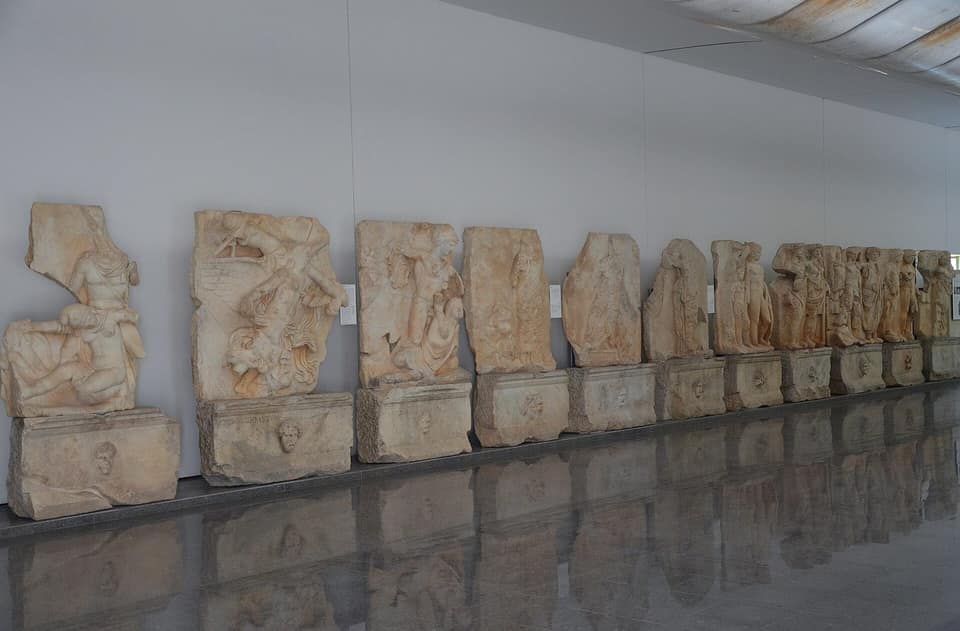
Find this area near the council house on the site and pause for a moment: here a master left a face unfinished under his chisel, and fifteen centuries later that half-done work became the school's evidence. Then go on to the museum. According to Kültür Portalı the most important part of the museum's collection consists of statues, reliefs and sarcophagi produced by this school, and each hall shows a different side of Aphrodisian sculpture. As you walk through the halls, look at the surfaces as if you were touching them: the difference in workmanship between the skin of a portrait and the garland decoration of a sarcophagus, carved from the same marble, shows how wide a range the school worked in. The excavation website notes that a new museum hall for the Sebasteion reliefs opened in 2008.
Those who introduced the city to the world
The modern story of Aphrodisias is worth telling too. According to the excavation website the first systematic and continuous excavations began in 1961 under the aegis of New York University and were directed by Kenan Erim until his death in 1990; the most important finds are displayed in the museum built on the site in 1979. Turkish Wikipedia writes that Erim's grave, just east of the Tetrapylon, is a simple tomb made of white marble from these same quarries. The photographer Ara Güler also played a part in making the city known, though the sources differ on the details. The South Aegean Development Agency book writes that Güler came upon the ruins in 1958 when he went to Karacasu to photograph the opening of a dam, while Turkish Wikipedia says he lost his way and spent the night in Geyre. According to the book there is also an exhibition on the site made up of those first photographs by Güler. The Ministry's museum page notes that nobody lives any longer in the old village of Geyre, emptied during the excavations, but that the few houses still standing are worth seeing.
The red clay of Karacasu
In the afternoon go down to the district centre. The Ministry's Aphrodisias page recommends exactly this to visitors: seeing the ceramic workshops of Karacasu. Turkish Wikipedia writes that the district is known for workshops making cups and jugs and for its leather and iron craftsmen, and is therefore introduced as the land that shapes leather, iron, dough and clay. According to the article by Yardımcı and Bardak, it is not known exactly when pottery began in Karacasu, but ceramic remains from the area found in the Aphrodisias excavations and shown in the museum indicate that production goes back a very long way. The article says the craft has come down to the present from father to son and that Karacasu is one of the rare pottery centres that has managed to keep its distinct character.
The clay itself is distinctive. The geographical indication certificate registered by the Turkish Patent and Trademark Office in 2020 states that Karacasu Pottery is made by hand from the local red clay, that the clay is dark red because it contains six to nine percent iron oxide, and that for this reason no colouring is added. According to the certificate the clay was taken until the 1990s from a place called Koşdağı, and today it is dug from pits in the village of Yazır, from alluvium left by the Dandalaz stream, and is known as Yazır clay. The article adds that until the 1990s potters filled tin cans with clay and carried them to their workshops by donkey. So, like the marble you saw in the morning, the clay you see in the afternoon comes from inside this valley.
What to see in a workshop
If you have the chance to stop at a workshop, watch the stages of the work. The certificate explains that the clay is first cleaned of stones and twigs while dry, crushed and sieved, mixed with water, and left to settle in two pools at different heights. According to the certificate the fine slurry that rises to the top is strained through muslin and used to make slip, while the rest is kneaded and divided into cylindrical lumps called künte; if jugs are to be made, rock salt is added to the clay so that the vessel keeps water cooler. The article describes the decorating methods peculiar to Karacasu: while the form is still on the wheel, bands are drawn on the shoulder, neck and belly with a tool called madana, bands are made with tools called tarak and makara, and deep vertical grooves are cut with the yarma stick. Undecorated pieces are dipped in slip made from the same clay and rubbed until they shine. According to the article the first electric potter's wheel in the district was built in the mid 1980s on the initiative of a local master and soon spread.
Firing is traditional as well. The certificate writes that most masters use cylindrical, open-topped wood-fired kilns built of brick, fired for eight to twelve hours depending on the season. The article notes that locally a jug is called a bardak and a potter a bardakçı, and that casseroles and jugs are made most of all. It also describes the bride's jug, made for about two centuries and carried by brides to their new homes, as a form peculiar to Karacasu, and says that today it is made only to order and receives little attention. Ask about this jug in the workshop; seeing it is a small contribution to keeping the craft alive.
What else is in the district
In the centre of Karacasu is the Karacasu Ethnography Museum, listed by the Ministry. According to its museum page it opened in 2007 in a five hundred square metre space owned by the municipality and allocated to the Ministry, housing ethnographic objects from the area's recent past and a display on its traditional crafts; the page currently shows the museum as closed, so be sure to check before you go. The Ministry's Aphrodisias page also mentions the Sırtlanini Cave near the district; the cave, home to bat colonies, is 348 metres long. The South Aegean Development Agency book writes that masters from Karacasu are also famous for making pide; at the end of the day, a pide fresh from a wood-fired oven in the district centre makes a fitting close to a day of clay and fire.
Season and time of day
Because Karacasu lies above the plain, it is cooler than the Menderes valley in summer and cold in winter. Spring and autumn are the best seasons both for walking on the site and for driving the mountain road. Aphrodisias is a large site with little shade; arrive in the first hours of the morning, move on to the museum before the midday heat sets in, and leave the workshop visit for the afternoon. Check the visiting hours and entry information for the site and museum on the official website before you go.
Practical notes
- The drive between Aphrodisias and central Karacasu is short; plan the day around your own car.
- Bring a hat, water and comfortable shoes to the site; marble surfaces heat up and reflect the sun.
- Check on the official website whether the ethnography museum is open before you go.
- Workshops are working businesses; ask permission before you enter and do not interrupt the potter's work.
- Fired clay is fragile; wrap anything you buy well for the journey.
Sources
- Ministry of Culture and Tourism, Afrodisias Müzesi ve Örenyeri, https://muze.gov.tr/muze-detay?SectionId=AFR01&DistId=AFR
- Kültür Portalı, Afrodisias Müzesi, https://www.kulturportali.gov.tr/turkiye/aydin/gezilecekyer/afrodisias-muzesi
- Ministry of Culture and Tourism, Karacasu Etnografya Müzesi, https://muze.gov.tr/muze-detay?SectionId=AKE01&DistId=MRK
- Aphrodisias Excavations, Sculptor's Workshop, https://aphrodisias-excavations.com/?p=6363
- Aphrodisias Excavations, Early Exploration, https://aphrodisias-excavations.com/early-exploration/
- Aphrodisias Excavations, Statues and reliefs, https://aphrodisias-excavations.com/statues-reliefs/
- Yardımcı, İ. and Bardak, M., Geleneksel Karacasu Çömlekçiliği ve Gelin Testisinin Gelişimi, Uşak Üniversitesi Sosyal Bilimler Dergisi, 2019, https://dergipark.org.tr/tr/pub/usaksosbil/article/629423
- Turkish Patent and Trademark Office, Karacasu Çömleği geographical indication certificate, https://ci.turkpatent.gov.tr/Files/GeographicalSigns/776080d0-c03d-457e-8624-786998f8a653.pdf
- South Aegean Development Agency, Bir Aydın Seyahati, https://www.geka.gov.tr/uploads/current_publications_v/5e3a6aaa8458b-bas-tr.pdf
- Turkish Wikipedia, Karacasu, https://tr.wikipedia.org/wiki/Karacasu
- Turkish Wikipedia, Afrodisias, https://tr.wikipedia.org/wiki/Afrodisias
- Wikipedia, Aphrodisias, https://en.wikipedia.org/wiki/Aphrodisias
Comments
Loading...
Location - Marble and Clay in Karacasu, the Land of the Aphrodisias Sculpture School
 AuthorRadar TürkiyeVisit SourceGet Directions