

From Ulus to Ulukaya Waterfall, the Bartın Side of the Küre Mountains
Sign in to like and rate
Bartın is usually associated with its coast, yet Ulus in the southeast of the province offers an entirely different landscape of forest, canyons and caves on the slopes of the Küre Mountains.
About Trip
Bartın is usually associated with its coast, yet Ulus in the southeast of the province offers an entirely different landscape of forest, canyons and caves on the slopes of the Küre Mountains. This day trip runs from central Bartın to Ulus, and from there to Kemerli Cave on the Bartın side of Küre Mountains National Park and to Ulukaya Waterfall on the Ulus Stream. There is no sea or beach on this route; the subject of the day is valleys carved into limestone, water that rises from a spring and dense forest.
Getting to know Ulus
Ulus Municipality describes the district as rugged land whose main vegetation is forest; its average altitude is about 200 metres and its area is 713 square kilometres. According to the municipality's history page, the area's past reaches back to around 3000 BC, and the Kaskians, contemporaries of the Hittites, lived in the region for a long time. In the Anatolian Seljuk period Ulus lay within the borders of the Candaroğlu Principality. Ulus remained a small settlement in the Ottoman period; it was a sub-district of Safranbolu until 8 August 1944, when it became a district attached to Zonguldak, and it passed to Bartın when Bartın became a province in 1991. The same source explains that the name derives from the verb "üleşmek", to share out, and refers to the portion of land given to a prince.
The area also has its own writer. In the Atlas written in the early 18th century by İbrahim Hamdi Efendi of Ulus, the forests of Uluyayla and Gökbeli are said to be enough not only for the Ottomans but for the whole world. The academic study of Ulukaya cites this line as testimony to the richness of the local forests, and it sums up well the scenery seen along the road today.
Getting there
The Bartın Provincial Directorate of Culture and Tourism states that there are regular minibus services between Bartın and Ulus; check the current times before you set off. The stops after Ulus are on village roads and are hard to reach by public transport, so planning the day by car is the most sensible choice. The municipality and the academic study give the distance from the centre of Ulus to Ulukaya Waterfall as 17 to 18 kilometres. The waterfall can also be reached from the Pınarbaşı district of Kastamonu; the Ulus side is the shorter route.
Küre Mountains National Park
The Küre Mountains are a range that starts at the Bartın Stream and runs for about 300 kilometres as far as the Kızılırmak, and they are also known as the İsfendiyar Mountains. Declared a national park in 2000, the area is shared between the provinces of Bartın and Kastamonu; the Provincial Directorate of Culture and Tourism gives its area as 37,754 hectares. Ulus Municipality notes that the Bartın section of the national park lies within the districts of Kurucaşile and Ulus. The regional directorate of the Ministry of Agriculture and Forestry describes the park as a plateau; there is no settlement inside the park boundaries and life goes on in the villages around it.
What makes the park special is limestone. According to the ministry's page the area lies within the Western Black Sea Karst Belt, and canyons, gorges, caves and sinkholes are the features of this belt worth seeing. The park is counted among the 100 forest hotspots of Europe that need protection, and with 129 bird species it is on the list of Important Bird Areas of Türkiye. The ministry's page classifies the Küre as a range of medium height; its highest summit is the 2019-metre Yaralıgöz Mountain, which lies on the Kastamonu side. The provincial directorate writes that mammals such as lynx, wildcat, otter, brown bear and red deer also live in the area. The famous canyons such as Horma, Valla and Çatak are on the Kastamonu side of the park; the Bartın side offers a quieter and lesser known entrance.
Kemerli Cave
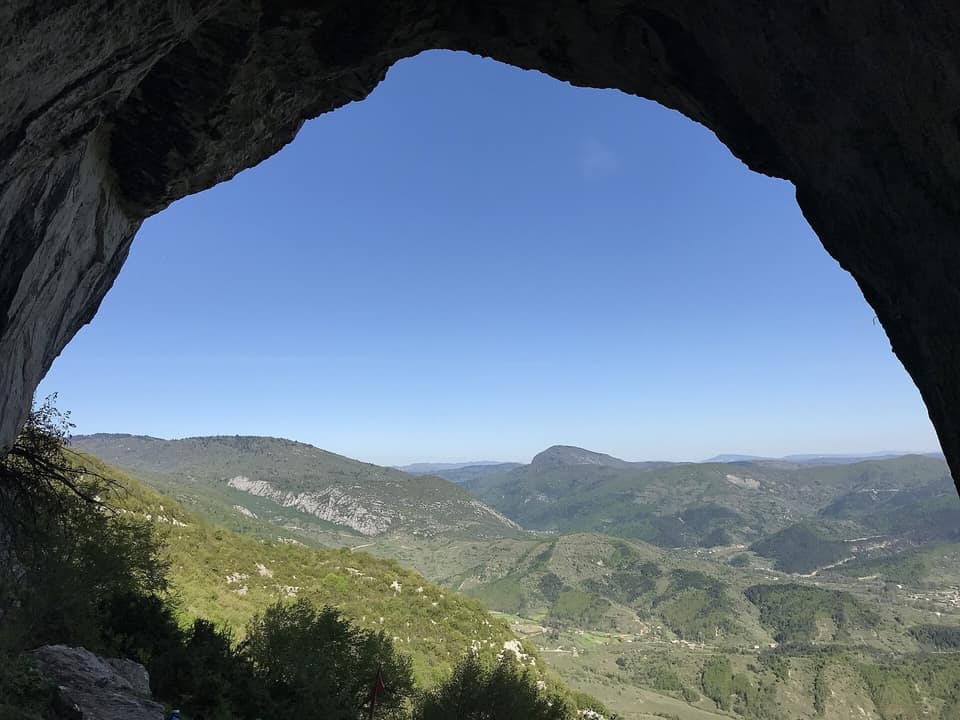
The Provincial Directorate of Culture and Tourism presents Kemerli Cave as a horizontally developed fossil cave on the Bartın-Ulus road within Küre Mountains National Park. The cave is reached by a walking path of about 1300 metres, and according to the same description the route has walking paths, a wooden viewing terrace and rain shelters. A fossil cave is a dry cave through which water no longer flows, so the most striking moment is turning around at the arched mouth and looking out over the forested valley.
The path runs through the forest and over some steep sections. Wear laced shoes with a good grip and take water with you. The rocks at the mouth are slippery on damp days; if you plan to go inside, a small torch will come in handy. Since two separate pages of the provincial directorate give different information about the length of the cave and the condition of the path, it is wise to ask the provincial directorate or the national park unit about the current situation before you go.
Ulukaya Waterfall and its canyon
The most striking stop of the day is the waterfall within the boundaries of Ulukaya village. Ulus Municipality writes that the waterfall is on the Ulus Stream, that it rises entirely from within the rocks before it falls, and that it lies at an altitude of 380 metres. The study published in the Eastern Geographical Review stresses that this formation differs from many waterfalls: the water does not pour over a ledge or a travertine terrace, but gushes out of a karst spring on the steep northwest-facing slope of the canyon and drops down. According to the same study there is a second spring 7 to 8 metres below the main one, emerging from a small cave of about 3.5 by 6.5 metres, and in dry periods, when the upper spring stops, the flow continues only from the lower one.
Sources give the height of the fall as between 20 and 25 metres; the study's own measurement on site is 25 metres, and the water pours into a pothole 1 to 1.5 metres deep. Both sources give the flow as 200 to 250 litres per second. There are also different figures for the length of the canyon: the municipality's page speaks of one to one and a half kilometres, while the academic measurement found a length of about 500 metres from the Alaattin Yazıcıoğlu pass and a depth of 65 to 70 metres.
The road through the canyon was opened in the early 1960s. The municipality's page explains that it was cut as a half tunnel by blasting the rocks and that the fish in the stream suffered in those years. Today trout, stone loach, crayfish and water snakes live in the stream. Part of the waterfall's water is carried to Ulus by a pipeline; do not be surprised to see it as you walk.
Around the waterfall the boxwood, oak, plane, hornbeam, maple, walnut and cornelian cherry listed in the academic study grow side by side. The same study recorded that a few families in Ulukaya village made spoons from boxwood and walking sticks from cornelian cherry; you can ask about this handicraft as you pass through the village. Locally the waterfall is also called "the waterfall that soothes the pain of love". According to the legend related by the municipality, Eros blessed the body of Selamnos, who had taken her own life, turning it into this waterfall and wishing that those who touched its water would be freed from heartache.
Season and a winter warning
The academic study notes that the area is suitable for visits outside winter, between April and October. Between November and March snow and ice appear on the higher parts of the Küre Mountains, village roads become slippery and the path to Kemerli Cave can be muddy. If you go in winter, choose a clear and dry day, ask about road conditions in advance and carry chains and warm clothing. Take care against ice on the canyon floor and on the bridge that crosses from the road to the slope of the waterfall. Spring and autumn are the most comfortable times; in dry summers the waterfall's flow can drop noticeably.
An extra for summer, Uluyayla
The provincial directorate presents Uluyayla, 27 kilometres from Ulus, as a 60-hectare upland pasture inside a large forest; a stream flows through the cave on the Bartın side of the plateau. According to the municipality's page, nature walks and festivities are held on the plateau in May and June. The road up to the plateau is a long climb and is not suitable in winter because of snow; keep this stop in mind for summer only.
Practical notes
- Start the day early; on short winter days you need to finish Ulukaya and Kemerli in daylight.
- There may be vehicle traffic on the road inside the canyon, so keep to the side when walking.
- Do not light fires in the national park, do not collect plants or stones, and take your rubbish back with you.
- Do not disturb wildlife; remember that brown bears live in the forest and do not leave food behind.
- For access conditions and current announcements, check the official pages of the Bartın Provincial Directorate of Culture and Tourism and the Ulus District Governorship.
The Ulus trip shows a side of Bartın that cannot be seen from the seashore. Water rising out of rock, a valley framed by an arched cave mouth and forests praised for centuries offer a calm and rewarding day for those who want to get to know the province from its mountain side as well.
Sources
- Bartın İl Kültür ve Turizm Müdürlüğü, Küre Dağları Milli Parkı, https://bartin.ktb.gov.tr/TR-69022/kure-daglari-milli-parki.html
- Bartın İl Kültür ve Turizm Müdürlüğü, Mağaralar, https://bartin.ktb.gov.tr/TR-69021/magaralar.html
- Bartın İl Kültür ve Turizm Müdürlüğü, Ulaşım, https://bartin.ktb.gov.tr/TR-68964/ulasim.html
- Tarım ve Orman Bakanlığı DKMP 10. Bölge Müdürlüğü, Küre Dağları Milli Parkı, https://bolge10.tarimorman.gov.tr/Menu/39/Kure-Daglari-Milli-Parki
- Ulus Belediyesi, Turizm, https://www.ulus.bel.tr/sayfa/turizm/
- Ulus Belediyesi, Tarihçe, https://www.ulus.bel.tr/sayfa/tarihce/
- Ulus Belediyesi, Coğrafi Konum, https://www.ulus.bel.tr/sayfa/cografi-konum/
- Özdemir, Zaman ve Sever, Rekreasyonel Açıdan Ulukaya Şelalesi ve Kanyonu, Doğu Coğrafya Dergisi 12 (DergiPark), https://dergipark.org.tr/en/download/article-file/26643
- Vikipedi, Ulus, Bartın, https://tr.wikipedia.org/wiki/Ulus,_Bart%C4%B1n
Comments
Loading...
Location - From Ulus to Ulukaya Waterfall, the Bartın Side of the Küre Mountains
 AuthorRadar TürkiyeVisit SourceGet Directions