

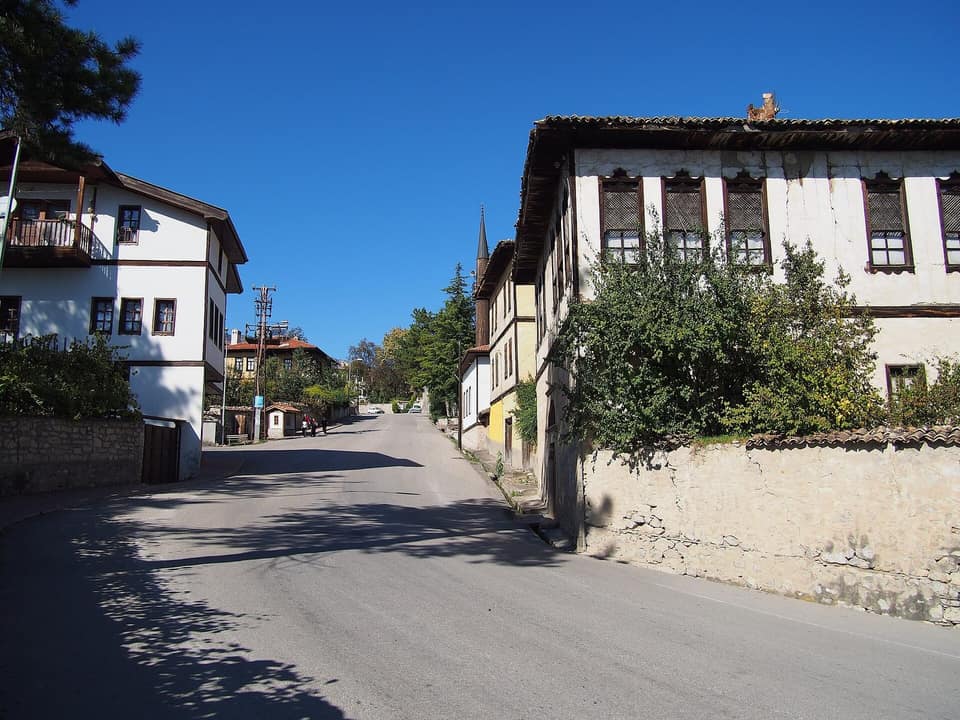
From Çarşı to Bağlar in Safranbolu, the Road of the Summer Houses
Sign in to like and rate
Most visitors to Safranbolu wander the stone streets of Çarşı and assume they have seen the whole story of the town there. Yet throughout its history Safranbolu lived not as one settlement but as two.
About Trip
Most visitors to Safranbolu wander the stone streets of Çarşı and assume they have seen the whole story of the town there. Yet throughout its history Safranbolu lived not as one settlement but as two. As the Safranbolu Tourist Information Office of the Ministry of Culture and Tourism puts it, the houses are grouped in two separate parts: the "Şehir" (Town), lived in during winter, and "Bağlar" (the Vineyards), where people moved for the summer. Almost every family had one winter house and one summer house. When the weather warmed up, the family migrated to the house among the vineyards, while production and trade in Çarşı carried on unchanged through the summer. This walk follows that double life of the town, starting in the valley of Çarşı and climbing to the ridges in the north, among the vineyard houses.
Getting there
Safranbolu lies about 8 kilometres from the centre of Karabük, and today the two settlements almost touch. According to the Ministry's transport page, the district is reached by road; the road that leaves the Ankara-Istanbul highway at Gerede arrives first in Karabük and then in Safranbolu. Most buses coming to Karabük also stop in Safranbolu. Within the district, frequent minibuses (dolmuş) run between the old town, the new town centre and the bus station. According to the Ministry's guide, Bağlar and Çarşı are about 4 kilometres apart, with a difference in altitude of around 350 metres. For most people it is therefore easier to make the uphill part of the trip by dolmuş or car and to walk the return.
A town in two parts
Both climate and economy lie behind this arrangement. The Ministry page describes the Şehir part as sitting inside two low valleys, sheltered from the harsh effects of the climate. Here the houses stand close together and the streets are narrow. The district article on Turkish Wikipedia explains the same division through climate: Çarşı, on the valley slopes, is milder and less windy and gets less snow, while Bağlar, higher up, is open to the winds, cool in summer and snowy in winter. Bağlar was built a few hundred metres higher, open to air currents and on wider plots of land.
On the economic side, Safranbolu stood on the North Anatolian caravan route linking the port of Sinop with Gerede. Nigan Bayazıt's article on the plan types of Safranbolu houses explains that this position made the town a staging point. According to the Ministry's guide, the valley of Çarşı was where leather working, yemeni shoemaking, ironworking, coppersmithing, packsaddle making, saddlery, farriery, felt making and the timber trade took place. The trades settled in separate streets according to the guild system. The summer houses, by contrast, stood in Bağlar, set among vineyards and gardens like a summer resort.
Traces of winter in Çarşı
Starting the walk in Çarşı lays good ground for comparing the two types of house. Bayazıt notes that the winter houses in the bazaar also had rooms set aside for receiving guests and holding business meetings. Since there were no commercial dealings in the summer house in the vineyards, it was shaped around basic needs. This is why the houses of Çarşı are larger, have more rooms and are more richly decorated.
Inside Çarşı, the Kaymakamlar House on Hıdırlık Yokuşu Street is one of the winter houses that can be visited. According to the Safranbolu Municipality's page, the house was probably built in the early 19th century; its owner was Hacı Mehmet Efendi, commander of the Safranbolu barracks. The house takes its name from his title "kaim-makam", the equivalent of lieutenant colonel. The Ministry of Culture expropriated and restored the house in 1979, and it opened as a training centre on 16 December 1981. Today it is used as a museum house. The Ministry page notes that in the Kaymakamlar House and in the Hacı Memişler vineyard house, the entrances to the harem and the selamlık were placed on different floors and reached from two separate streets. In other words, you can see the same detail in both a winter and a summer house.
The Ministry's description sums up well what to look at inside the house. On the ground floor is the "hayat", called the "taşlık" when it is paved with stone. Here are the lattices called "gliste", made of vertical boards, which let in light. The stables, the large cauldron hearths and the storerooms are also on this floor. The second floor is lower, and here is the kitchen, which could also serve as a bedroom when needed. Daily life took place on the middle floor because it was easier to heat on cold days. On the third floor the ceilings rise; the rooms are entered through corner doors opening from the short diagonal sides of an eight-sided hall. Each room was designed to house a nuclear family, and inside the built-in cupboards are small bathing cabinets. The principle of heating was to warm the person rather than the space; embers taken from the hearth were placed in a brazier and carried around.
After the Kaymakamlar House, if you want to see the town from above you can climb Hıdırlık Hill. The municipality recommends it as the place to take a panoramic photograph of the town. The Karabük Provincial Directorate of Culture and Tourism also writes that Çarşı can be viewed from the Castle to the north and from Hıdırlık Hill to the south.
Passing through Kıranköy
On the way from Çarşı to Bağlar your route passes through Kıranköy, built on the high plateau to the west. According to Bülent Oral's article on the civil architecture of Safranbolu, this was where the Greek population lived in large numbers. Because stone was used more in Greek houses, stone carving is also more common there. According to Wikipedia, the official name of the neighbourhood is Misak-ı Milli, while locals call it Kıranköy or Granköy. To see the stonework, look at the door surrounds and the ground floor walls.
Climbing to Bağlar
When you reach Bağlar the scene changes. The houses no longer lean against one another; each stands in the middle of its garden, separated from the street by a stone wall. The district article on Wikipedia describes Bağlar as the area where well-off families spent the summer months among vineyards and orchards. According to the same source, Turkish and Greek families lived side by side in the vineyards until 1923; after 1923 some of those living in the old town began to live permanently in the vineyards.
Today this area can be traced in and around the Bağlarbaşı neighbourhood; Oral's article mentions the area together with the names Bağlarbaşı, Ötebağlar and Bağlar. On 2 May 1985 the Ministry's High Council for Immovable Cultural Property registered 810 civil buildings and 165 monuments within the conservation boundaries in the Bağlar and Çarşı areas. So Bağlar is an area whose conservation is considered together with Çarşı. A clear warning is needed, however: the Wikivoyage guide writes that Bağlar later became a dormitory district for Karabük, that there are many new buildings in between, and that it is not as coherent as Çarşı. What you should expect here is not a single preserved street but old vineyard houses scattered among modern buildings.
Why a vineyard house is different
Bayazıt's article says that, looking at the plan types, houses with a single room on the upper floor are generally found among the summer houses. These are two-storey houses with an open outer hall that meet the needs of a small family in the simplest way. Oral also notes that a small number of outer-hall plans were used in Bağlarbaşı. Across the town as a whole, plans with inner and central halls are common.
When you stand in front of a vineyard house, look at three things. The first is the relationship between garden and house: the reason a vineyard house exists is the vineyard and orchard around it. The second is the number of floors and the decoration: since there was no need for guests and business meetings, vineyard houses are often plainer than the mansions of Çarşı. The third is orientation: according to the Ministry page, the houses of Safranbolu face the public buildings and monuments located more centrally than themselves, and no house blocks the view of another. The near facades of the houses are closed and the distant facades are open.
Another detail in Bayazıt's article suits the title of this walk: in Safranbolu the alcoves that project outward from the hall are called "yazlık", meaning "summer places", and their ceilings are lower than those of the rooms. In other words, summer determined not only where the house stood but also the names of the corners inside it.
Walking suggestions
- Start in Çarşı in the morning, visit the Kaymakamlar House and look over the town from Hıdırlık Hill.
- Wander the guild streets of Çarşı, the Demirciler bazaar and the Yemeniciler arcade; they are the heart of the winter town that kept working in summer.
- In the afternoon, go up to Bağlar by dolmuş or car by way of Kıranköy.
- In Bağlar, leave the main road and turn into the side streets lined with garden walls; read the old houses together with their gardens.
- Make the return on foot, downhill, and feel the difference in altitude between the two parts of the town in your own steps.
Season and time of day
The best time to understand the vineyard houses is the season in which they were used. In early summer the gardens are green, and it is easy to compare the coolness of Bağlar with the valley of Çarşı. In autumn the colours of the vineyards and fruit trees brighten the streets. In winter you can see with your own eyes the difference Wikipedia describes: while high Bağlar is covered in snow, Çarşı in the valley is more sheltered. For photographs, prefer the morning light; climbing the slopes at midday is tiring.
Practical notes
- For the visiting days and entry conditions of the Kaymakamlar House, check the current information on the Safranbolu Municipality website.
- Most of the houses in Bağlar are private property, and some are used today as places to stay. Do not cross a garden wall without permission; take your photographs from the street.
- The stone-paved streets can become slippery after rain; wear shoes with a good grip.
- According to the Ministry page, the stone paving was laid on a slope to reduce damp and to withstand flood water. Watching how the water runs off on a rainy day is the way to see this detail.
- If you want to end the walk with Safranbolu lokum or saffron, remember the note from the Culture Portal: the finest saffron, which gave the town its name, grows here.
Sources
- Ministry of Culture and Tourism, Safranbolu Tourist Information Office, Safranbolu Houses, https://safranboluturizmdanismaburosu.ktb.gov.tr/TR-156229/safranbolu-evleri.html
- Ministry of Culture and Tourism, Safranbolu Tourist Information Office, Museum Town Safranbolu, https://safranboluturizmdanismaburosu.ktb.gov.tr/TR-155829/muze-kent-safranbolu.html
- Ministry of Culture and Tourism, Safranbolu Tourist Information Office, Safranbolu Guide, https://safranboluturizmdanismaburosu.ktb.gov.tr/Eklenti/44621,safranbolu-rehberi-trpdf.pdf
- Ministry of Culture and Tourism, Safranbolu Tourist Information Office, Transport, https://safranboluturizmdanismaburosu.ktb.gov.tr/TR-231198/ulasim.html
- Karabük Provincial Directorate of Culture and Tourism, Tourism in Safranbolu, https://karabuk.ktb.gov.tr/TR-63747/safranbolu39da-turizm.html
- Safranbolu Municipality, Kaymakamlar Museum House, https://www.safranbolu.bel.tr/safranbolu-turizm/kaymakamlar-muze-evi
- Safranbolu Municipality, Viewing the Town from Above, https://www.safranbolu.bel.tr/safranbolu-turizm/sehri-kus-bakisi-izleme
- Culture Portal, Safranbolu Town, https://www.kulturportali.gov.tr/portal/safranbolusehri
- Nigan Bayazıt, Plan Typology of Safranbolu Houses and the Hierarchy of User Needs, Tasarım Kuram 17 (2014), https://dergipark.org.tr/en/download/article-file/208072
- Bülent Oral, Present-Day Civil Architecture of Safranbolu in the Context of Imitating Traditional Architecture, İnsan ve İnsan 6/21 (2019), https://dergipark.org.tr/tr/download/article-file/776330
- Wikipedia (Turkish), Safranbolu, https://tr.wikipedia.org/wiki/Safranbolu
- Wikivoyage, Safranbolu, https://en.wikivoyage.org/wiki/Safranbolu
Comments
Loading...
Location - From Çarşı to Bağlar in Safranbolu, the Road of the Summer Houses
 AuthorRadar TürkiyeVisit SourceGet Directions