

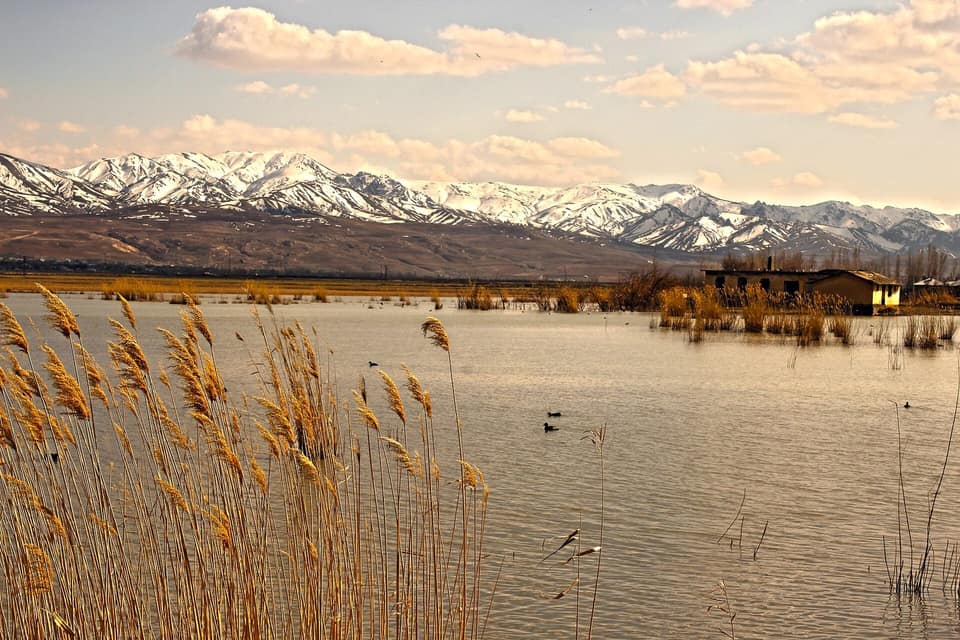
Birdwatching at Lake Erçek
Sign in to like and rate
Anyone who comes to Lake Erçek to see birds watches the movement along its shore more than the lake itself.
About Trip
Anyone who comes to Lake Erçek to see birds watches the movement along its shore more than the lake itself. A flock of ducks lifting out of the reeds, a long-legged shorebird dipping its head into the water at the edge of the mudflat, flamingos standing like a pink band in the middle of open water. Here we describe only one thing: how, when and with what care to watch the birds at the lake.
Why this lake
The protected areas page of the Van Provincial Directorate of Culture and Tourism lists Lake Erçek and its surroundings among the province's "special protection areas", the highest protection status, and calls the lake a "bird paradise". The same page writes that the lake hosts roughly half of the bird species found in Türkiye and that it is the most important stopover for flamingos. In the wetlands list of the Ministry of Agriculture and Forestry's General Directorate of Nature Conservation and National Parks, Lake Erçek is also registered as a "wetland of national importance" and appears under the ministry's fourteenth regional directorate. A 2021 article in the Şırnak University Journal of Sciences reports that this registration was made on 10 June 2016 for an area of about 22 thousand hectares.
The birdwatching page of Kültür Portalı draws attention to the lake's soda-rich water and the wetlands around it and places it on one of the world's important bird migration routes. According to the page, Erçek is not just a transit point for birds but also a breeding and feeding ground. For the birdwatcher this simply means there is something to watch at the lake in almost every part of the year; but the birds you see change from season to season.
How many species, and who counts
The lake's bird list cannot be reduced to a single number, and sources give different figures. Kültür Portalı speaks of more than 200 species. A study by Özdemir Adızel and Atilla Durmuş, published in 2009 in Scientific Research and Essays and held in the publication archive of Van Yüzüncü Yıl University, reports that monthly observations between June 2000 and June 2004 identified 177 species and 2 subspecies from 44 families. According to the same abstract, 71 of the observed species are residents, 71 migrants and 24 winter visitors, and 6 species are among those threatened on a global scale.
The article in the Şırnak University journal is by Levent Biler and Emrah Çelik. Bringing together earlier counts, the ministry's mid-winter waterfowl counts and the records of volunteer observers, the authors calculate that a total of 183 bird species have been recorded at the lake. The difference between the figures comes from the years and the methods of the counts. What remains for the birdwatcher is to write down what they see in their own notebook.
What you can see
Kültür Portalı lists among the lake's main species the flamingos, the garganey that can be seen in the reedbeds, the white-headed duck, the pied avocet and the ruddy shelduck. The table in Biler and Çelik's article gives, for each species, the highest number reached in earlier counts, and it shows which birds crowd the lake. According to the table, the black-necked grebe (Podiceps nigricollis) reached 3,700 individuals in one count, the mallard (Anas platyrhynchos) 3,450, the common teal (Anas crecca) 2,750 and the ruddy shelduck (Tadorna ferruginea) 2,100. The common coot (Fulica atra) appears with 1,750 individuals, Larus armenicus, also known as the Armenian or Van gull, with 1,759, the greater flamingo (Phoenicopterus roseus) with 1,370 and the common shelduck (Tadorna tadorna) with 700.
Shorebirds come in smaller numbers but are among the most attractive groups for the observer. The table shows a highest count of 274 for the pied avocet (Recurvirostra avosetta) and 43 for the black-winged stilt (Himantopus himantopus). The highest figure given for the globally threatened white-headed duck (Oxyura leucocephala) is 13; since this duck is scarce, seeing it takes patience. The garganey (Spatula querquedula) is recorded with 27 individuals. The same list also includes raptors such as the western marsh harrier (Circus aeruginosus), the golden eagle (Aquila chrysaetos) and the Egyptian vulture (Neophron percnopterus), as well as the small songbirds of the reedbeds. Each of these numbers is the highest value reached in different counts over the years, not on a single day; do not expect to see the same crowds on one visit.
The Armenian gull deserves a separate note. The provincial directorate's protected areas page counts the islands of Lake Van among the most important breeding grounds of this gull in the world. At Erçek, too, this gull is seen in large groups; flocks resting on the shore or on open water are a good starting point for understanding the basin as a whole.
Season and time of day
The lake's best-known sight is the flamingos. Kültür Portalı writes that flamingos are the lake's most magnificent residents especially in September and October, and notes that the Lake Erçek Flamingo Festival is held in these two months every year. Check the date and programme of the festival in the announcements of the provincial directorate of culture and tourism before you go. The lake is livelier during the migration periods; in winter, ducks and coots come to the fore. The fact that the ministry's mid-winter waterfowl counts are also carried out at this lake shows that winter is valuable for observation as well.
The best light of the day comes early in the morning and late in the afternoon. Kültür Portalı notes that the colour reflections on the lake surface at sunset offer very striking frames for photographers. Around midday, with the sun high, birds on open water turn into silhouettes on the bright surface and their colours become hard to make out. The lake lies high above sea level; Kültür Portalı gives its elevation as 1,803 metres. At this altitude, spring and autumn mornings can be cool. Dress in layers and bring a windproof top.
Getting there
According to Kültür Portalı, the lake lies about 30 kilometres from the centre of Van, on the Van-Özalp highway. The shore is a short drive from the city, and the page writes that public transport vehicles departing from the city run regular services to the area. Check current routes and timetables before setting off. The page notes that there are observation towers along the shore that allow visitors to watch the birds in their natural habitat without disturbing them, and that walking paths and shore landscaping have been built around the lake. The Karagündüz and Erçek neighbourhoods are mentioned as the settlements on the shore.
There is no accommodation on the lakeshore; Kültür Portalı writes that visitors therefore prefer day trips and that tent camping is possible in suitable areas. The most productive plan for birdwatching is to leave the city early in the morning, reach the shore before the sun is high and stay there until noon. On the same day you can come back for a second round in the late afternoon light.
Walking suggestion
Rather than waiting at a single spot, move slowly along the shore. First climb an observation tower and scan the whole lake surface with binoculars; it is easy to see from here which shore the birds are gathering on. Then walk towards the stretch of shore where the large groups are, but stay on the road or path without going down to the water's edge. Stop at the edges of the reeds and wait quietly for a few minutes; the songbirds and ducks of the reedbeds reappear once human movement stops. Binoculars may not be enough to find shorebirds such as the avocet and the stilt on the muddy flats; a telescope makes a big difference.
Kültür Portalı writes that nature walks and bicycle tours can also be done along the lakeshore. Cycling along the shore makes it easier to cover a wide area; but get off and walk when you approach groups of birds.
Observation ethics
The lake's status as a special protection area places a responsibility on the visitor too. Flushing birds is not a price worth paying for a photograph; especially for birds resting and feeding during migration, every take-off means lost energy. Use the observation towers and the marked paths. Do not run towards groups of birds, clap your hands or raise your voice. During the breeding season, keep away from nests along the reeds and the shore. Do not feed the birds, and take back every piece of waste you bring with you.
For photography, use a long lens instead of getting closer. When the birds change their behaviour, when they raise their heads and look at you or start to move away, stay where you are or step back. Do not fly drones. Park your car at the roadside without driving into the meadows and reedbeds.
Practical notes
- Bring binoculars; if possible, also bring a telescope and a bird identification guide.
- Note down your observations with species name, number and date; these records can also be entered into volunteer databases that contribute to the lake's bird list.
- On the open shore, bring a hat and sunscreen against the sun, and a windbreaker for cool mornings.
- The lake water is soda-rich; Kültür Portalı and the protected areas page present the lake as a protected area, so be content with watching instead of entering the water or digging at the shore.
- There are almost no accommodation or food options on the shore; buy your water and food in the city.
- Check the dates of the flamingo festival and public transport information from official sources before you go.
Sources
- Kültür Portalı, Kuş Gözlemciliği, Erçek Gölü, https://kulturportali.gov.tr/turkiye/van/TurizmAktiviteleri/ercek-golu-kus-gozlemciligi
- Van Provincial Directorate of Culture and Tourism, Korunan Alanlar, https://van.ktb.gov.tr/TR-437066/korunan-alanlar.html
- Ministry of Agriculture and Forestry, General Directorate of Nature Conservation and National Parks, Sulak Alanlar, https://www.tarimorman.gov.tr/DKMP/Menu/31/Sulak-Alanlar
- Biler and Çelik, The Avifauna value of Lake Erçek, Şırnak University Journal of Sciences, https://dergipark.org.tr/en/pub/sufbd/article/956202
- Van Yüzüncü Yıl University, Adızel and Durmuş, A study on bird species under threat and avifauna of Ercek Lake, https://avesis.yyu.edu.tr/yayin/c06eb72f-6e1b-4c4f-8236-4c632ab19909/a-study-on-bird-species-under-threat-and-avifauna-of-ercek-lake-van-turkey
- Wikipedia, Lake Erçek, https://en.wikipedia.org/wiki/Lake_Er%C3%A7ek
Comments
Loading...
Location - Birdwatching at Lake Erçek
 AuthorRadar TürkiyeVisit SourceGet Directions