

Ballıkayalar Canyon and the Trail of Palace Weaving in Hereke
Sign in to like and rate
The road that runs east from Istanbul towards the Gulf of İzmit is usually seen as nothing more than a route to pass through. Yet just beyond Gebze, two places about 10 kilometres apart as the crow flies offer two very different experiences that fit into a single day.
About Trip
The road that runs east from Istanbul towards the Gulf of İzmit is usually seen as nothing more than a route to pass through. Yet just beyond Gebze, two places about 10 kilometres apart as the crow flies offer two very different experiences that fit into a single day. The first is the Ballıkayalar Valley near Tavşanlı village; a narrow canyon cut into limestone, with waterfalls and a small lake, it is one of the closest nature escapes to the city. The second is Hereke on the shore of the gulf. Here the factory that wove fabrics and carpets for the Ottoman palaces, a wooden pavilion prepared for Kaiser Wilhelm II and an old castle whose restoration has been completed stand side by side in the same neighbourhood. It is possible to spend the morning walking in the valley and the afternoon in Hereke with history and craft.
According to the Kocaeli Provincial Directorate of Culture and Tourism, the Kocaeli Peninsula, where these two stops lie, has been one of the most important crossing points between Asia and Europe, leaving traces as the homeland of many peoples or as land on their route. The Directorate traces the known history of the Bithynia region, which includes Gebze, back to the 12th century BC and counts the Ballıkayalar Nature Park among the natural attractions of the district. Over the course of the day, then, you move across the traces of a natural process that shaped the limestone over a long span of time and of a history lived over centuries in this crossing region.
Getting there
The Culture Portal of the Ministry of Culture and Tourism places the Ballıkayalar Valley 8 kilometres from Gebze and 39 kilometres from İzmit, and notes that the valley is reached by road. According to the directions on the same page, visitors coming from Istanbul leave the main road at the Tavşanlı village turn-off about 4 kilometres after passing Gebze and arrive at the valley. A private car is the easiest option. Those who want to travel by public transport should check the onward connections after Gebze in the current route information of the relevant municipalities before setting out.
Hereke lies south-east of the valley on the northern shore of the Gulf of İzmit and belongs administratively to the district of Körfez. The website of the Department of National Palaces gives the address of the factory as Hacı Akif neighbourhood; the Culture Portal places Hereke Castle in the same neighbourhood, on Kale Street. The distance between the pavilion and the castle is a few hundred metres. So once you reach Hereke, you can park the car once and see both buildings on foot.
A valley inside the limestone
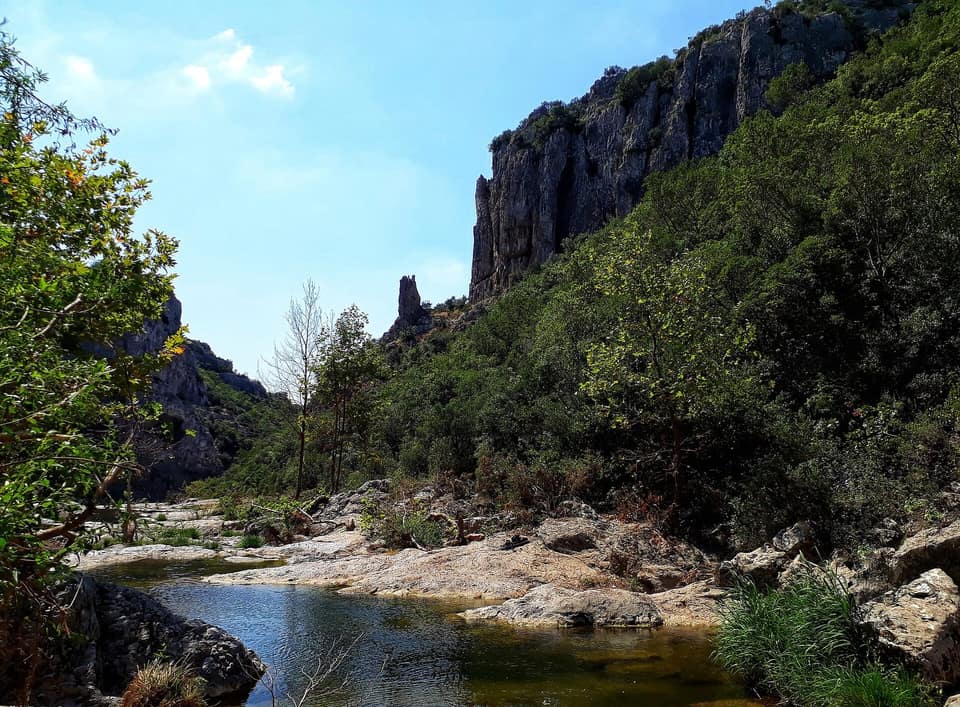
The Culture Portal presents Ballıkayalar as a valley declared a nature park and a natural protected site. According to the official description, the valley is 1.5 kilometres long and between 40 and 80 metres wide. It owes its shape to landforms that developed through the dissolution of limestone, which is why it is described in scientific language as a karstic gorge. The steep walls formed as water slowly dissolved the rock are the first thing that catches the eye as you enter the valley. The grey and white surfaces of the rocks create a strong contrast with the green vegetation between them.
The Ballıkaya Stream flows along the valley floor. The Culture Portal writes that there is a lake and there are waterfalls inside the valley, and that viewing terraces sit on the travertines that descend to the stream. Travertine is a rock formed by the layered build-up of deposits left by lime-rich water and is known for its stepped surfaces. From these terraces you can look both at the places where the water falls and at the rocky walls on either side of the canyon. The best photographs usually come from the lake shore, from angles where the rocks are reflected in the water.
The valley is also a rock climbing area. The Culture Portal mentions Ballıkayalar as a place where mountaineers abseil and climb. Climbing requires experience, training and proper equipment; those who only want to watch should not stand directly beneath climbing lines and should keep their distance from stones that may fall.
A suggested walk
The Culture Portal notes that there are walking areas on the eastern and western ridges of the canyon. This two-level layout makes it possible to see the valley from two different angles. A good order is to first walk along the floor following the stream as far as the lake and the waterfalls, and then to climb onto one of the ridges to see the canyon from above. On the floor, the rocks and travertine surfaces can be slippery when wet; for this reason, shoes with good grip that support the ankle are the best choice. After rainy days the stream may rise and crossings may become harder. On the paths along the ridges, you should stay away from cliff edges.
The fact that the valley is short is no reason to hurry. Taking time to sit by the lake, listen to the sound of the waterfall and look closely at the plants on the rocks is as enjoyable as the walk itself. The Culture Portal also writes that there are flat areas in the canyon suitable for pitching tents. Anyone thinking of camping should find out the current rules and permit conditions of the nature park in advance.
Because Ballıkayalar is a protected area, everything done here affects its future. Following the rules on lighting fires, taking rubbish back with you, not writing on the rocks and not picking plants ensures that the valley remains the same for the next visitor.
Hereke in the afternoon
After leaving the valley, the road that descends to the gulf takes you to Hereke. According to the Department of National Palaces, the factory founded in 1843 in this town on the northern shore of the Gulf of İzmit began production in 1845 under the name Hereke Fabrika-i Hümayunu, the Royal Hereke Factory. Its purpose was to meet the need for upholstery and curtain fabrics for the palaces being built in those years. The National Palaces describe Hereke as the most comprehensive factory the Ottoman State had established in the field of silk weaving up to that time. Jacquard looms and designers were brought from France for production.
Carpet weaving, which carries the factory's fame to the present day, began later. During the reign of Sultan Abdülhamid II, carpet weaving units were added to the factory, and so the foundations of the internationally renowned Hereke carpet tradition were laid. In the same period there was also a workshop inside Dolmabahçe Palace, known as the Hereke Weaving Shop, which worked as a branch of the factory. The factory's finest products were used to furnish palaces, pavilions and kiosks. Through gifts presented to members of foreign ruling families, they also reached the palaces of Europe.
In the Republican period the factory continued to operate under the umbrella of Sümerbank. In 1995 it was transferred to the National Palaces under the privatisation law. Today it continues production as a museum-factory. In work carried out with National Palaces researchers, old Hereke fabric patterns are being recovered. In this way, lost patterns are produced again and used to renew the palaces in keeping with their original textiles.
The Kaiser Wilhelm Pavilion
The factory itself is closed to visitors, but the wooden pavilion right next to it can be visited as a museum-pavilion. According to the National Palaces, this building is a prefabricated pavilion prepared at Yıldız Palace for the visit of the German Emperor Kaiser Wilhelm II. Its reception rooms open onto both the sea side and the land side. This layout makes it possible to see the gulf and the slopes behind at the same time from inside the wooden building. As you tour the pavilion, do not forget to look out of the windows; the relationship the building forms with the shore is as interesting as the furnishings inside. Since visiting days, ticket office hours and ticket conditions can change, it is necessary to check the official website of the National Palaces before going.
Hereke Castle
You can reach Hereke Castle by walking a few hundred metres from the pavilion. According to the Culture Portal page, which draws on information from the Governorship of Kocaeli, the castle is thought to have been built in the 640s. The same source relates that during the conquest of İzmit, those fleeing the city took refuge in this castle and held out. Orhan Gazi sent Ali Bey as commander against Hereke. Although Ali Bey lost an eye to an arrow during the siege, he took the castle. The capture of Hereke completed the conquests in the İzmit region, and the area became part of the Ottoman Beylik.
According to the source, the castle was completely destroyed in a great earthquake that lasted 45 days during the reign of Sultan Bayezid II. Evliya Çelebi also mentions the castle in his Seyahatname, the Book of Travels. Restoration work was completed in 2023 and the castle was opened to visitors again. Looking out over the gulf and the Hereke shoreline from the height of the castle makes a calm end to the day.
Season and timing
The most comfortable times for walking in the valley are spring and autumn. In these months the weather is suited to walking for long stretches. In summer the heat rises; it is best to walk in the cooler hours of the day and to carry plenty of water. In winter and after heavy rain, the rocks become slippery and the paths may be muddy. Setting off early in the morning lets you find the valley quieter and see the pavilion in Hereke before the ticket office closes.
Practical notes
- For the walk, bring water, a light snack, a hat and a rain jacket; bear in mind that services inside the valley may be limited.
- Rock climbing should only be done with experienced people and proper equipment.
- Camping and fire rules are set by the nature park management; find out the current situation before you go.
- For the visiting days, hours and ticket information of the Kaiser Wilhelm Pavilion, see the official website of the National Palaces.
- As the factory in Hereke is a working facility, it cannot be entered; the visit is limited to the pavilion.
- Plan your return bearing in mind that traffic towards Istanbul may become heavy in the evening hours.
Sources
- Culture Portal, Ballıkayalar Vadisi - Gebze, https://www.kulturportali.gov.tr/turkiye/kocaeli/gezilecekyer/ballikayalar-vadisi---gebze
- Culture Portal, Hereke Kalesi, https://www.kulturportali.gov.tr/turkiye/kocaeli/gezilecekyer/hereke-kalesi
- Department of National Palaces, Hereke Carpet and Silk Fabric Weaving Factory, https://www.millisaraylar.gov.tr/Lokasyon/19/hereke-hali-ve-ipekli-dokuma-fabrikasi
- Kocaeli Provincial Directorate of Culture and Tourism, Gebze, https://kocaeli.ktb.gov.tr/TR-174620/gebze.html
- Wikipedia, Ballıkayalar, https://tr.wikipedia.org/wiki/Ball%C4%B1kayalar
Comments
Loading...
Location - Ballıkayalar Canyon and the Trail of Palace Weaving in Hereke
 AuthorRadar TürkiyeVisit SourceGet Directions