

Arykanda, the Terraced City Beneath Şahinkaya
Sign in to like and rate
The road between Finike and Elmalı leaves the coast and climbs towards the slopes south of the Bey Mountains. On this road, near the village of Arif, an ancient city descends step by step from the foot of a sheer rock wall: Arykanda.
About Trip
The road between Finike and Elmalı leaves the coast and climbs towards the slopes south of the Bey Mountains. On this road, near the village of Arif, an ancient city descends step by step from the foot of a sheer rock wall: Arykanda. The city is considered one of the oldest settlements in Lycia, and with its terraces overlooking the valley it is one of the most impressive archaeological sites in the region. For anyone who sets off early from Antalya, Arykanda is a long but rewarding day trip.
Its name and setting
The Türkiye Culture Portal writes that Arykanda lies in the Finike district of Antalya, within the boundaries of the village of Arif. The portal notes that the name of the city appears in the Lycian language as Ary-ka-wanda and means "the place near the high rock". The fact that the name comes from a native Anatolian language points to Arykanda being one of the oldest settlements in the region. The name also describes the setting well: Arykanda was built on ground that begins at the foot of a sheer rock face known as Şahinkaya and slopes down towards the south.
The excavation page of the Department of Archaeology at Yozgat Bozok University places Arykanda in the east of the Lycian region, on an important route linking the port of Phoinikos to the Kabalia plain and the region of Pisidia. It also states that the city lies on the highway between Elmalı and Finike, northeast of the village of Arif. This position as a passage between the coast and the interior makes it easier to understand why Arykanda was an important stop throughout history.
The story of the city
According to the Culture Portal, Late Chalcolithic and Early Bronze Age axes found in the region show that this area was densely settled from early times. The portal adds, however, that apart from a stone axe dated to the 2nd millennium BC, the finds make it difficult to take the city's history back before the 5th century BC. Coins minted in the 5th century BC in the name of the local lords Kuprili and Aquwami reflect Arykanda during the period of Persian rule. These are followed by coins of Pericles, the lord of Limyra, dated to the 4th century BC; accordingly, Arykanda remained under the rule of Limyra for a time.
After Alexander the Great, the city passed, like the other cities of the region, first to the Ptolemies and then to the Seleucids. The Culture Portal writes that after the Peace of Apamea, Arykanda came under the control of Rhodes. In the 2nd century BC the city minted coins as a member of the Lycian League. In AD 43, Lycia was made a province attached to Rome together with Pamphylia. The portal notes that the 2nd century AD is the period in which the name of Arykanda is most often mentioned in various sources.
The Ministry's museums portal writes that the city was especially busy in the Hellenistic and Roman periods, and that thanks to its timber trade and water resources it became a safe stopping place on the main roads of eastern Lycia. According to the same source, the city's heyday was in the 2nd and 3rd centuries AD. The Culture Portal relates that the city was partly repaired after the great earthquake of the year 240 and, according to Byzantine sources, continued to exist until the 11th century. After that date, the settlement may have moved south of today's highway.
Rediscovery and excavations
The Ministry's museums portal writes that the ruins were identified in 1838 by the British traveller Charles Fellows, through the tomb inscriptions and coins he found on the surface. According to the excavation page of Bozok University, the first systematic excavations in the city were carried out between 1971 and 2010 by Prof. Dr. Cevdet Bayburtluoğlu. Since 2011 the excavations have continued under the direction of Assoc. Prof. Dr. V. Macit Tekinalp of Hacettepe University. The terraces visited today have become readable as a result of this work, which spans more than half a century.
Getting there
The Culture Portal states that Arykanda is on the road between Finike and Elmalı and can be reached by the minibuses running from Finike to Elmalı or by private car. For those coming from Antalya, the easiest way is to follow the coastal highway to Finike and turn from there towards Elmalı. Because the journey is long, setting off early in the morning gives you enough time to wander the site without hurrying. If you are travelling by public transport, find out the return times of the minibuses in Finike in advance.
The Ministry's museums portal gives the address of the site as Arif Köyü, Finike. Opening and closing hours and admission conditions can change over time; before you go, check the current information on the museum pages of the Ministry of Culture and Tourism.
What to see
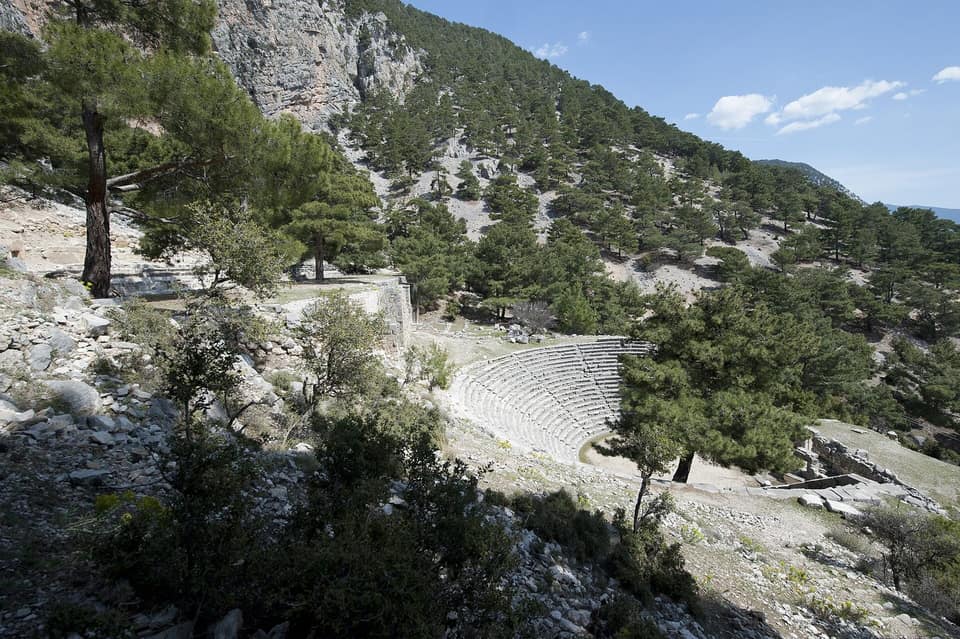
Visiting Arykanda really means reading a hillside layer by layer, from bottom to top or from top to bottom. The Ministry's museums portal notes that the city is bounded by steep slopes to the east and west, and that the settlement on the hillside was supported by terrace walls rather than fortification walls. The Culture Portal also writes that, because of its position, the site is arranged in stepped terraces and enjoys a panoramic view over the whole valley.
The highest terraces
According to the Culture Portal, at the highest level of the city, at the southwestern foot of Şahinkaya, there is a watchtower. The triangular acropolis south of the tower is thought to have been the city's first settlement. To the east of this area stands the bouleuterion, that is, the council building. The excavation page of Bozok University lists buildings on the acropolis such as the great cistern, the commercial agora, the prytaneion and the bouleuterion, as well as houses. In this upper area, buildings connected with the administration and daily life of the city can be seen side by side.
The stadium and the theatre
According to the Culture Portal, the highest building after the watchtower is the stadium, built in the 1st century AD. The stadium has seating on only one of its long sides, while the other long side opens onto the slope. On the terrace below stands the building that the portal describes as the small but best preserved theatre in the region. Sitting on the theatre's rows and looking at the valley opposite and the rock wall behind is the best way to grasp the setting of Arykanda. For photography, the views from the upper part of the theatre towards the stadium and the valley are especially rewarding.
The agora and the odeon
On one of the lowest terraces, according to the Culture Portal, are the agora and the odeon, which also served as a council building. This part was where the public life of the city came together. As you go up and down between the terraces, pay attention to the stairways and the workmanship of the terrace walls; every level surface on the hillside was won thanks to these walls.
The baths and the eastern necropolis
The Culture Portal writes that the gymnasium in the southeast of the city stands right next to the bath, and that the two buildings together give the appearance of a bath-gymnasium. In the burial area known as the Eastern Necropolis, monumental tombs that serve as terraces for one another, most of them still standing, catch the eye. The portal dates all of these monumental tombs to the 2nd century AD. On the terrace below the tombs, the bath that still stands up to roof level is one of the best preserved buildings of the city. With its arched facade, this great bath clearly shows, when seen from below, how ambitious the city's architecture was.
Water engineering
The Culture Portal notes that Arykanda's water needs were met by installations requiring great skill. Channels cut into sheer rock faces on four separate levels at the source of the Aykırıçay form the main lines of the system that brought water to the city. As the Ministry's museums portal also emphasises, the city's water resources were one of the main foundations of its prosperity. The size of the baths is the most tangible sign of how plentifully this water was used in the city.
Suggested walk
Because the site lies on a steep slope, planning your visit around the gradient makes things easier. First see the great bath and the eastern necropolis below, then climb to the terrace with the agora and the odeon. From here, climb to the theatre and the stadium, and if you have the energy, continue to the acropolis and the upper part with the watchtower. On the way back, instead of following the same route, you can use different paths between the terraces to see other corners of the city. The whole walk, including time for breaks and photographs, can take several hours.
Season and time of day
For Arykanda, which requires a long walk on a slope, spring and autumn are the most suitable seasons. In summer it is best to visit early in the morning to avoid the midday heat and to rest in shaded areas. In winter the weather can be changeable, so check the forecast before setting off.
Practical notes
- The site is steep and stony; wear non-slip shoes that support your ankles.
- Bring enough water and snacks, and keep a hat with you.
- Do not climb on the terrace walls or the ruins.
- According to the Culture Portal, Arykanda is among the Ancient Cities of the Lycian Civilization proposed for the UNESCO World Heritage List in 2009; visit the site with this in mind.
- Those who want to extend the day can add the other Lycian cities near Finike to their programme on the way back; still, Arykanda alone is rich enough to fill a whole day.
Arykanda offers a different experience from the famous coastal cities of Lycia. Here there is a rocky mountain instead of the sea and terraces instead of a harbour, and the city reveals one of the finest examples from antiquity of how to settle on a hillside.
Sources
- Türkiye Culture Portal, Arykanda, https://www.kulturportali.gov.tr/turkiye/antalya/gezilecekyer/arykanda
- Ministry of Culture and Tourism of the Republic of Türkiye, Turkish Museums, Antalya Arykanda Archaeological Site, https://turkishmuseums.com/museum/detail/1962-antalya-arykanda-archaeological-site/1962/4
- Yozgat Bozok University, Department of Archaeology, Excavation Projects, https://bozok.edu.tr/okul/fas/bolum/arkeoloji-bolumu/sayfa/excavation-projects/6065
- Wikipedia (Turkish), Arikanda, https://tr.wikipedia.org/wiki/Arikanda
Comments
Loading...
Location - Arykanda, the Terraced City Beneath Şahinkaya
 AuthorRadar TürkiyeVisit SourceGet Directions