

A Walk Through Karaman's Castle, Madrasa and Museum
Sign in to like and rate
Karaman is a quiet Central Anatolian city on the highway between Konya and Mersin. According to the governorate's tourism page, travellers heading to Adana, Mersin and Antalya often stop in Karaman. This article describes how to spend a half day in the city.
About Trip
Karaman is a quiet Central Anatolian city on the highway between Konya and Mersin. According to the governorate's tourism page, travellers heading to Adana, Mersin and Antalya often stop in Karaman. This article describes how to spend a half day in the city. The route starts at the mound of the castle, continues to the stone facade of the Hatuniye Madrasa, and ends in the garden of the Karaman Museum. What the three stops share is stone. The castle speaks through its mass, the madrasa through its carving, and the museum through its stone artefacts. You can find a general introduction to each building on its own place page. Here we focus on the order and manner in which to look.
Getting there
All three stops are in the city centre and can be linked on foot. The castle is in Hisar Neighbourhood, while the madrasa and the museum are in İmaret Neighbourhood, on Turgut Özal Avenue. The Culture Portal notes that the madrasa is easily reached by city minibuses and municipal buses. If you arrive from another province, boarding these lines from the bus station is the easiest way. If you come by car, starting from the castle makes sense, because the route then flows steadily toward the madrasa and the museum. There are no steep climbs. Still, the ground around the mound can be uneven, so comfortable shoes help.
A castle on a mound
Begin with Karaman Castle. The Culture Portal says the castle is thought to have been built in the late eleventh or early twelfth century. It consists of three nested walls known as the outer, middle and inner castle. The best preserved part is the inner castle on the mound. This mound carries traces of the Bronze Age, Roman and Byzantine periods. In other words, the ground you walk on is the upper layer of a settlement far older than the walls. The castle has nine towers, four round and five square. The difference in their shapes is the first detail your eye catches when you walk around the outside of the wall.
The castle gate may not always be open, and the official page gives no entry condition. So do not assume you can go inside. For visiting conditions, check the current information from the Karaman Provincial Directorate of Culture and Tourism. Looking from outside has its own pleasure. As you walk along the wall you notice that the stones are not the same everywhere. The Culture Portal writes that during the repair of 1465, inscriptions and architectural pieces of earlier ruined buildings were reused in the body walls. Looking closely at the wall for carved fragments is therefore a rewarding game. Part of the middle castle walls also survives. The castle was renewed in the Seljuk period, and when the city came under the Karamanoğulları, the walls were repaired once more.
From the castle to the madrasa
After leaving the castle, walk toward İmaret Neighbourhood. This transition starts the real story of the walk. The castle carries the city's defensive memory. The madrasa shows the same city's tradition of education and charity. The time between the two buildings falls within the period when the Karamanoğulları built Karaman as a principality centre. The stone work of this period stays close to the Seljuk heritage. Along the way, take your time to stop and watch the old neighbourhood fabric and the stone details beside the avenue.
The portal and the language of ornament
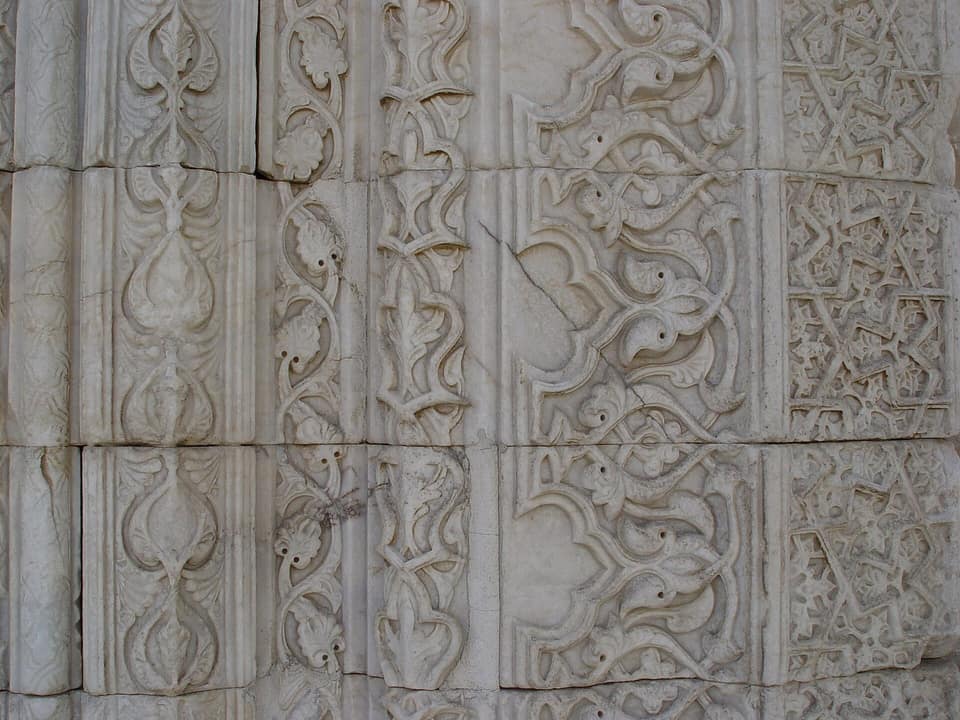
When you arrive at the Hatuniye Madrasa, first look at the facade from a distance. The Culture Portal writes that the building was commissioned in 1382 by Nefise Sultan, daughter of the Ottoman Sultan Murat Hüdavendigar and wife of Karamanoğlu Alaaddin Bey. It is built of cut stone. The decoration is densest at the crown portal, the arch of the iwan and the entrances of the corner rooms. Approach the portal and read the general composition first. There is a stalactite-vaulted hood at the top, surrounded by bands of inscription and borders. Then bring your eyes closer and pick out the motifs one by one. According to the source, geometric motifs, plant motifs, rumi and palmettes, and inscription bands form the main scheme of the decoration.
If you want to take photographs, the best light for the portal is the side light that appears while the facade receives direct sun. Side light brings out the depth of the carving. Midday sun flattens the reliefs. Standing under the doorway and raising your head, you can see the layers of the stalactite arch. This portal is one of the most frequently mentioned examples of stone carving in Karaman.
The courtyard and the iwan inside
To understand the plan of the madrasa you need to enter the courtyard. The Culture Portal describes the building as having an open courtyard and a single iwan. The sources diverge on this point, so we stay with the description in the official source without going into detail. The courtyard is surrounded by arcades. Student cells line the eastern and western sides. Walk slowly in the courtyard and observe the rhythm of the arcades, the columns, the iwan arch and the cell doors as a whole. This was once an educational building. Today it still feels like a calm, shaded place to pause.
Because a current business operates inside the madrasa, the visiting arrangement may change over time. Ask the Karaman Museum or the provincial directorate for current information about which parts of the courtyard can be entered. It is therefore wise to check the calendar before your visit.
The museum garden and stone artefacts
The transition from the madrasa to the museum is very short. The address of the Karaman Museum is recorded as İmaret Neighbourhood, Turgut Özal Avenue No 3. It was built so that the rich archaeological and ethnographic works of Karaman and its surroundings could be preserved and displayed in place. Before entering the building, walk around the garden. The Culture Portal says archaeological and ethnographic stone works are displayed in the garden. Visiting the garden first helps you grasp the scale of stone and objects before the showcases inside. After the fine carving of the madrasa, the large and roughly worked stones here offer a good comparison.
Whether the museum is open and its visiting conditions can change from time to time. Check the official pages before you go.
The periods of the collection
Inside there are two exhibition halls, one archaeological and one ethnographic. The Culture Portal states that the halls contain works from the Epipalaeolithic, Neolithic, Chalcolithic, Bronze Age, Classical, Roman, Byzantine, Seljuk, Anatolian Principalities, Karamanoğulları, Ottoman and Republican periods. So within a single building you can walk back thousands of years. Proceed in chronological order and follow the change in material. Clay vessels, idols, jewellery of bone and metal, tear bottles and weapons are displayed. The ethnographic section presents products of local life.
According to the governorate page, the museum holds 4,827 archaeological and 1,902 ethnographic works and 6,709 coins, a total of 13,438 items. This figure shows that coins are one of the largest items in the collection. The coin showcases display Hellenistic, Venetian, Roman, Byzantine, Anatolian Principalities, Karamanoğulları, Ottoman and Republican period coins. When looking at coins, do not be put off by the small scale. The writing and figures on their surfaces show the trade network and the administrative language of each period. The contrast in scale between the large stones in the garden and the coin showcases is the most striking contrast of this visit.
A suggested walk
Think of the route in three parts. The first part is the castle surroundings, devoted to watching the towers, the walls and the reused stones. The second part is the madrasa, focusing on the portal, the courtyard and the arcades. The third part is the museum, where you visit the garden first and then the halls. Leave time for rest in each part. In the madrasa courtyard and the museum garden you can sit in a shaded corner and review your notes. Half a day is enough for these three stops. If you go without rushing, there is time left for a light walk on your way back in the evening.
Season and time of day
Spring and autumn are the most comfortable seasons for walking. In midsummer, leave the outdoor sections, namely the castle surroundings and the museum garden, to early morning or late afternoon. For the portal photograph, choose hours that give side light. In winter, start early because of the short days. The museum halls offer a shelter independent of the weather.
Practical notes
Find out in advance whether entry to the castle is possible. The visiting arrangement in the madrasa and the museum may change. For tickets and hours, rely only on official pages. The museum and the madrasa are separate buildings, so do not confuse them. The interior arrangement of the madrasa may have changed over time. Follow the museum management's rules for photography. If you want to spend a longer day in Karaman, the governorate page lists the city's protected sites, registered buildings and natural areas. The number of registered cultural assets across the province is given on this page as 456.
Sources
- Kültür Portalı, Hatuniye Medresesi, https://www.kulturportali.gov.tr/turkiye/karaman/gezilecekyer/hatuniye-medresesi
- Kültür Portalı, Karaman Müzesi, https://www.kulturportali.gov.tr/turkiye/karaman/gezilecekyer/karaman-muzesi-1
- Kültür Portalı, Karaman Kalesi, https://www.kulturportali.gov.tr/turkiye/karaman/gezilecekyer/karaman-kalesi
- Karaman Valiliği, Kültür ve Turizm, https://www.karaman.gov.tr/kultur-ve-turizm
- Vikipedi, Hatuniye Medresesi (Karaman), https://tr.wikipedia.org/wiki/Hatuniye_Medresesi_(Karaman)
Comments
Loading...
Location - A Walk Through Karaman's Castle, Madrasa and Museum
 AuthorRadar TürkiyeVisit SourceGet Directions