

A Nature Walk at Lake Boraboy
Sign in to like and rate
Amasya's city centre tells its story through stone bridges, riverside houses and rock-cut structures squeezed into the narrow strip of the Yeşilırmak valley. Lake Boraboy offers the opposite.
About Trip
Amasya's city centre tells its story through stone bridges, riverside houses and rock-cut structures squeezed into the narrow strip of the Yeşilırmak valley. Lake Boraboy offers the opposite. As you travel north toward the forested slopes of the Taşova district, the valley widens, buildings thin out and trees take over. This article treats the lake not as a roadside viewpoint but as a nature-walking area whose paths deserve some time. The formation and general introduction of the lake are covered on the place page; here we focus on walking, vegetation, wildlife and etiquette in nature.
Getting there
Boraboy Lake Nature Park lies within the Taşova district of Amasya. The tourism activity page of the Culture Portal says the park is 62 kilometres from the provincial centre and that the area is reached by an asphalt road. The place page of the same portal gives the distance to the provincial centre as 63 kilometres. The safe statement is therefore that the park is more than 60 kilometres from the city centre. The distance to the Taşova town centre is also written differently on the two pages, with figures ranging between fifteen and twenty-two kilometres. When planning your trip, confirm the route with a current map application.
The Culture Portal notes that the lake is reached by turning off the Amasya-Erzincan road, and that you can drive right up to the lakeshore. The same page gives the distance from Amasya Merzifon Airport to the park as 91 kilometres. The official pages list no regular public transport service to the area, so it is wise to plan on a private vehicle or a pre-arranged transfer. If you set out from the city centre, start early because of the length of the road and keep the daylight in mind for the return.
Once at the park entrance, using the car park is the most sensible choice. The Culture Portal says the park has day-use facilities including a car park, a fountain, picnic tables, children's play areas and walking paths. Fill your water bottle at the fountain or at home before you start walking. Bring a bag for your rubbish and take it back with you at the end of the day. In a forest park, this small habit is the most lasting contribution you can make.
What a nature park means
Lake Boraboy Nature Park was registered in 2013. The Culture Portal's tourism activity page gives this information as coming from the General Directorate of Nature Conservation and National Parks. Nature park status means that the natural values of an area are protected while it is opened for recreation and nature observation. On one hand this status gives you walking paths, picnic areas and an organised park; on the other, it expects visitors to behave with care toward nature. Because facility and operating details can change over time, you are advised to check the official page of the Amasya Provincial Directorate of Culture and Tourism before your visit and learn the current conditions.
What to see in the forest and plant cover
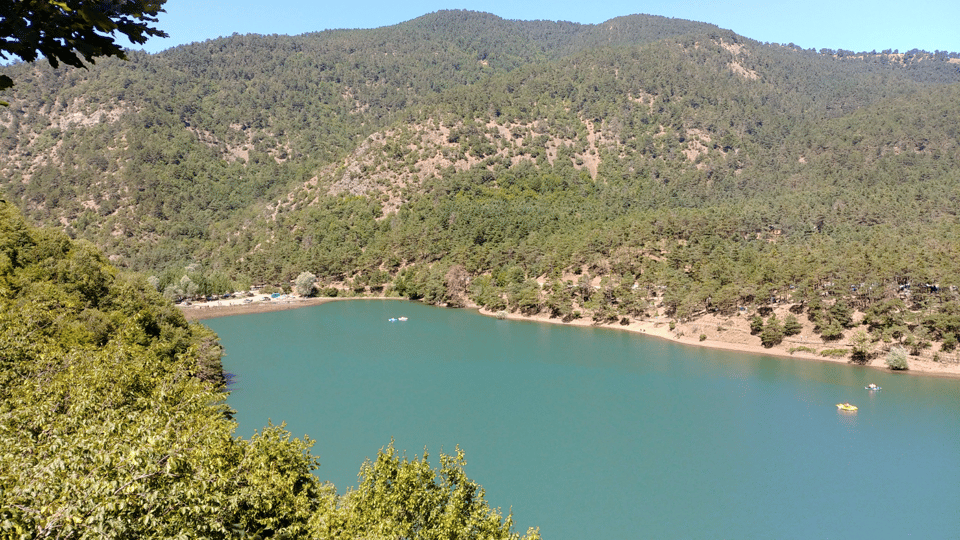
As you walk around the lake, the first thing you will notice is the difference in vegetation between the two slopes. According to the Culture Portal, the northern slopes are dominated by oriental beech, black pine, Scots pine and oak. On the southern slopes, Scots pine, black pine and mixed shrub communities stand out. The Amasya Provincial Directorate of Culture and Tourism lists beech, Scots pine, cedar and chestnut among the trees surrounding the lake. The two lists do not match exactly, so while walking it is more honest to observe the general variety on the slopes than to label tree species with certainty.
The real scientific importance of this area lies in its endemic plants. The Culture Portal states that the Amasya region is one of the important areas for endemic plants, and that Lake Boraboy and its surroundings form the province's most important endemic plant area. According to the same page, recent assessments found 245 endemic taxa within the provincial borders of Amasya, of which 29 endemic species are distributed around Amasya, Akdağ and Lake Boraboy. An endemic plant is one that grows naturally only in a particular region of the world. Leaving the path, picking flowers or tearing off plants can therefore threaten not just a view but a species found nowhere else. Taking photographs and notes is the gentlest form of attention a visitor can pay to these plants.
Wildlife and observation
The official pages list the wild animals known to be present in the park. Among mammals they name roe deer, hare, wolf, fox, wild boar, squirrel, hedgehog, weasel and badger. Most of these animals keep away from people; for someone walking quietly and slowly, squirrels and birds are the most likely sightings. Even so, keep in mind the chance of meeting larger mammals, do not approach animals, do not feed them, and do not leave food waste lying around.
The bird list is rich. The source says the area hosts many resident and migratory birds and names species such as quail, rock partridge, chukar, woodcock, collared dove, rock dove, blackbird, nightingale, cormorant, grey heron, bittern, stork, black stork, falcon, sparrowhawk, vulture, lanner falcon, eagle owl and great spotted woodpecker. Tits, nuthatch and robin also appear on the list. If you bring binoculars, your chances of observing birds are better in the early morning along the water's edge and the forest margins. It is unrealistic to expect to see every listed species in a single visit; the aim should be to listen to the sound of the place rather than to tick off species.
Among reptiles, the list includes land tortoise, freshwater turtle, lizards and snakes. While walking, look at the ground before stepping among grass and stones, and do not lift stones or logs. In the lake itself, the Culture Portal notes freshwater fish such as carp and wels catfish. The same page states that the lake makes the most important contribution to aquatic life in the area.
A walking suggestion
The official sources say that walking paths exist in the area, but the length, duration or difficulty of the routes does not appear on the pages. My suggestion is to start from the lakeshore, walk around the lake at a slow pace and stop along the way. The Culture Portal writes that the southern shore of the lake is steep and sheer. Watch for slippery ground at the water's edge and on steep slopes, and do not go too close to the edge.
Use the viewing points on the lakeshore as your first stop. From there you see the emerald-green colour of the lake framed by beech and pine. Then move onto the forest paths and observe the difference in vegetation between the northern and southern slopes. Early morning hours are both quieter and better for birdwatching. When the light softens in the afternoon, a second chance for photography arises. During the walk, use only marked paths, do not look for shortcuts and keep the forest quiet.
For other activities in and around the lake, the Culture Portal lists picnicking, photography, plant and wildlife observation, pedal boating and camping. For camping and picnics, use only designated areas, and learn the park's rules before lighting any fire. Fire in a forest is the most sensitive issue because of the risk of wildfire. Instead of lighting a fire, it is safer to bring ready-to-eat food.
Season and time of day
The official pages make no seasonal recommendation, so the following is general advice for nature walks. The Culture Portal states that the lake lies at an elevation of 1050 metres. In forested high-altitude areas the weather can be cooler and more changeable than in the city centre. Check the weather forecast before setting out, bring layers and wear shoes suited to slippery ground. After rain the paths can become slippery. Because deciduous and evergreen species grow together in the forest, the area looks different throughout the year; still, rather than claiming that one season is the best, I suggest you decide from your own observation.
In seasons with limited daylight, start the walk early and return to your vehicle before dark. Hours close to sunset in the forest also call for care because wildlife becomes more active. If you are visiting with children, do not take your eyes off them near the water.
Practical notes
According to the Culture Portal, the park contains a day-use country restaurant, a snack bar, a fountain and a car park, together with country houses and bungalow-type facilities suitable for family stays. Because the operating schedule and conditions of these facilities may change, it is wise to carry enough water and food and to get current information from the official page when needed. Mobile phone coverage can vary in the forest; before setting out, tell someone close to you your route and your return time.
Nature etiquette can be summarised briefly. Do not leave the marked paths. Do not pick plants, do not approach animals and do not feed them. Take your rubbish back. Be extremely careful with fire in the forest. Stay away from steep and slippery parts of the lakeshore. Do not make noise, because silence protects both birdwatching and the experience of other visitors.
As part of your Amasya trip
Lake Boraboy shows a different face of Amasya from its historic centre. After a day in the city along the Yeşilırmak, between the castle and the rock tombs, walking under trees around the lake the next day makes a good balance. Because of the length of the road, it makes sense to plan the lake as a full day, or at least to set aside half a day for it. Rather than a short stop, a visit with a slow walk to watch plants and birds reflects the value of this area best.
Sources
- Culture Portal, Nature Walk - Lake Boraboy, https://www.kulturportali.gov.tr/turkiye/amasya/TurizmAktiviteleri/borabay-golu
- Culture Portal, Lake Boraboy, https://www.kulturportali.gov.tr/turkiye/amasya/gezilecekyer/boraboy-golu
- Amasya Provincial Directorate of Culture and Tourism, Boraboy Lake and Nature Park, https://amasya.ktb.gov.tr/TR-59552/boraboy-golu-ve-tabiat-parki.html
Comments
Loading...
Location - A Nature Walk at Lake Boraboy
 AuthorRadar TürkiyeVisit SourceGet Directions