

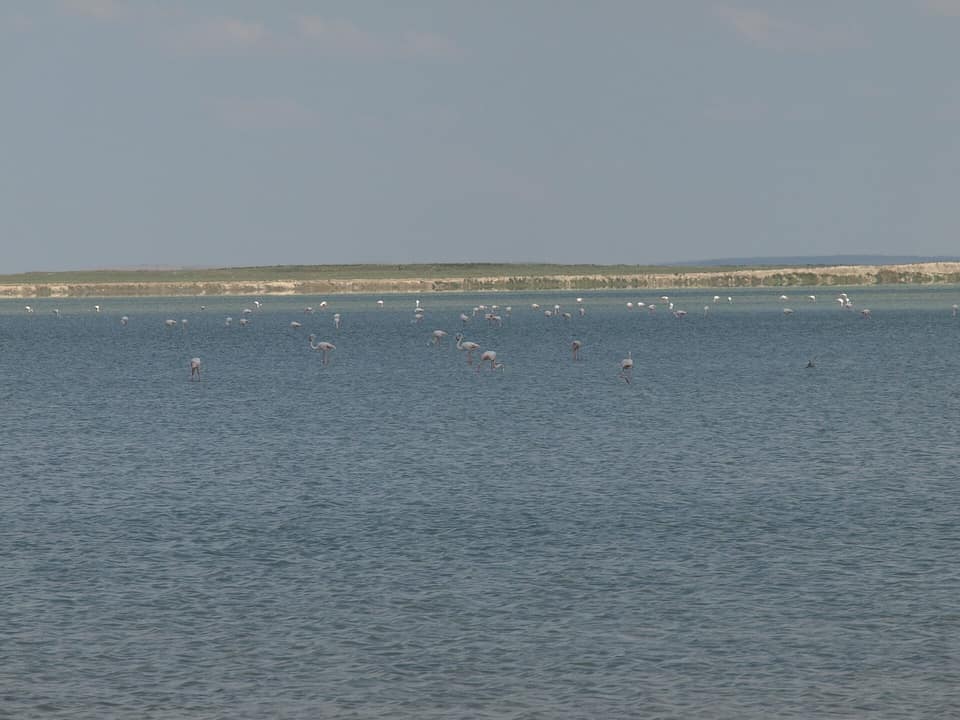
A Flamingo Day at Lake Seyfe
Sign in to like and rate
To see a pink line stretched across the steppe, you only need to drive to the broad plain north-east of Kırşehir, between Mucur and Boztepe. Lake Seyfe is not a coastal lagoon but a shallow, salty lake in a closed basin of Central Anatolia, fed by rain and spring water.
About Trip
To see a pink line stretched across the steppe, you only need to drive to the broad plain north-east of Kırşehir, between Mucur and Boztepe. Lake Seyfe is not a coastal lagoon but a shallow, salty lake in a closed basin of Central Anatolia, fed by rain and spring water. This piece is less an introduction to the lake than a plan for a day of birdwatching there: which season to go, where to watch from, how to observe without disturbing the birds and how to shape the day.
Why Seyfe
The lake and the 10,700 hectares around it were declared a Nature Conservation Area in 1990, the lake became a first degree natural site in 1989, and the same area entered the Ramsar Convention list of wetlands of international importance on 13 July 1994 as site number 659. The Ramsar information sheet describes the lake as a staging area for internationally important numbers of waterbirds and a crucial feeding habitat for breeding birds. An article on the basin published by researchers from Kırşehir Ahi Evran University and Gazi University writes that Seyfe counts among Türkiye's class A wetlands because it regularly holds more than twenty-five thousand waterbirds. The same study names the lake's position on two migration routes and its closeness to Sultan Sazlığı and Lake Tuz among the reasons for this importance.
The sources differ slightly on the number of species. The Kırşehir Governorship's page and the Ramsar information sheet speak of 187 species including songbirds, while GoTürkiye, the ministry's promotion portal, writes that observation and research have identified 186. More than the exact figure, it is enough to know this: the lake and its surroundings are a place where well over a hundred bird species cross paths, and the mix changes from season to season.
Getting there
The Governorship's page places the lake sixteen kilometres from Mucur, and the university article also notes that the lake lies north of Mucur. For the distance from central Kırşehir the Ramsar sheet gives thirty and GoTürkiye thirty-six kilometres, while both put the distance from Ankara at around two hundred and twenty kilometres. The provincial centre can be reached by intercity coach; the Provincial Directorate of Culture and Tourism writes that the bus terminal is about two kilometres from the city centre and is served by municipal buses and minibuses. Official promotion pages mention no public transport line running to the lakeshore, so you will need your own vehicle to move around the lake.
The lake is not a place you look at from a single point. According to the university article, the villages of Seyfe, Gümüşkümbet, Yazıkınık, Budak, Kızıldağ and Eskidoğanlı lie around it, and most of its shores are muddy. Drawing your route on a map in advance and knowing from which village you will approach the shore makes the day much easier.
The lake's calendar
The key to understanding Seyfe is the way its water breathes. The Ramsar sheet writes that the depth of the permanent lake is between one metre and one metre thirty centimetres and that it drops to sixty or seventy centimetres in summer. In winter and spring the water surface can spread to seven thousand eight hundred hectares, while in dry months it shrinks to around one and a half thousand hectares. When the water retreats, broad mudflats open up, especially on the east side of the lake, and this shoreline strip is exactly where the birds feed.
Spring is the breeding season. According to the Governorship's page, thousands of birds of various species nest at this time on the islets formed from reedbeds on the east side of the lake. Key Biodiversity Areas records state that the lake holds twelve islands covered with scrub and grass and that fifteen hundred hectares of brackish and freshwater marsh stretch east of Kızıldağyeniyapan village. In practice this means that in spring the birds should be watched patiently and from a distance.
Summer is when flamingos are easiest to see. The Governorship notes that in the summer months flamingos can be watched from many parts of the lake. As the water becomes shallower the birds can feed closer to the shore, but in the hot hours the heat shimmer over the steppe blurs distant flocks, so the cool early morning is the more rewarding time for both visibility and light.
Autumn is the migration season. The Governorship writes that in autumn the lake is a resting place for hundreds of thousands of ducks and that its surroundings are an important gathering area for storks. The Ramsar sheet adds that at migration time the number of storks can reach thirteen hundred.
Winter is the season most visitors overlook. According to the Ramsar sheet, the lake water is so salty that it does not freeze in winter and offers birds an ideal feeding area; the sheet also states that flamingos regularly use the lake for wintering. A steppe climate dominates the area; the same sheet gives an average annual temperature of eleven degrees and an average low of minus seven degrees. Dress warmly for winter watching.
Which birds to look for
Because the water is salty, the Ramsar sheet says that no fish live in the lake itself; only small species are found where the feeding streams enter it. In return, small shrimp-like crustaceans, worms and abundant plankton in the water build a rich food chain, and the flamingos come precisely for this food. The sheet records a 1987 observation in which thirty-two thousand flamingos were counted at once; in 1986 more than three hundred and twenty thousand birds in total were counted on the lake.
The university article writes that Seyfe meets the Important Bird Area criteria because of the great white pelican, Eurasian spoonbill, flamingo, greater white-fronted goose, ruddy shelduck, lesser kestrel, great bustard, pied avocet, spur-winged lapwing, Mediterranean gull, gull-billed tern and little tern. The Governorship's page adds teals, herons, plovers, geese and gulls, and notes that large birds such as the great bustard and the crane live on the farmland north of the lake. The Ramsar sheet lists twenty-seven species on an international bird protection list that live at the lake. When you spot a pink line on the horizon, sweep the surroundings before lowering your binoculars; the small shorebirds feeding at the edge of the flock are often the real surprise of the day.
Where to watch from
The Governorship's promotion page writes that the finest views of the lake are seen from the mound near Seyfe village. From that height the water, the islets and the flocks along the shore can be read at a single glance; choosing a position that faces east in the morning and west in the afternoon makes photography easier. The same page says it is possible to go down to the lakeshore from the Badıllı quarter of Seyfe and watch the flamingos. The Governorship's text notes that there is no observation hide on the lakeshore and that this limits close viewing; see the present situation for yourself on site.
The mounds themselves are part of the view. According to the university article there are twenty Bronze Age mounds around the lake, and it is thought that the people who settled on its shores farmed the land while also hunting migrating birds for food. Just south of the lake, Yazıkınık Höyüğü stands out easily on the plain with its conical shape and its height of twenty-two metres. Thousands of years ago the people living on this shore looked at the same flocks of birds, and knowing this makes the horizon read differently.
Watching ethics
The Ramsar record states that only scientific and educational activities are permitted in the area and that no activity other than birdwatching takes place on the lake. It is a reminder that the visitor is a guest here. A few simple rules protect both the birds and the watching itself.
- Do not drive onto the mudflats or the shoreline; stay on the existing village roads and on rises away from the shore.
- In spring, do not approach the islets and reedbeds; a bird that leaves its nest leaves its eggs or chicks unprotected.
- Instead of walking towards a flock, stop and wait; when flamingos take off they waste energy and abandon their feeding ground.
- Do not talk loudly, sound the horn or make noise to flush the birds.
- Do not feed the birds, and take back everything you brought with you.
- To see far, get closer with binoculars and a long lens, not with your feet.
A plan for the day
Start early and make the mound near Seyfe village your first stop; seeing the overall picture from above decides where you will go for the rest of the day. Spend the first hours of the morning there, watching how the flocks are spread out and where the water has retreated. Then approach the shore from the Badıllı side and watch the flock from a lower angle. Towards noon, when the light hardens, explore the steppe and farmland along the village roads around the lake; the large birds the Governorship mentions, such as the great bustard and the crane, are sought in this open country. The Ramsar sheet writes that salt-tolerant plants grow around the lake, that steppe grasses turn green in spring and dry out in summer, and that groups of poplar, willow and walnut grow along the streams feeding the lake; this shifting vegetation adds depth to photographs. In the afternoon, when the light softens, return to the shore once more; the flocks keep feeding at this time of day too.
On the way back to Mucur or central Kırşehir you can spend the evening in the provincial centre.
Practical notes
- The water level changes greatly from year to year. The university article writes that the lake dried up completely in 2005 and 2008, held water again after the humid winter of 2009, and that many bird species returned. Before you go, check the current state of the lake with local official sources.
- Do not expect shade or service areas on the shore; bring water, a hat, sunscreen and a light jacket for cool mornings even in summer.
- Walking on the muddy shores is hard going; boots or waterproof shoes help.
- Binoculars are indispensable on this trip; for distant flocks a spotting scope on a tripod is even better.
- As the area is protected, follow the visiting and observation rules of the official institutions and check current information on the Governorship and provincial directorate pages.
- You will be out in open country all day; wind cools quickly on the steppe, so dress in layers.
Sources
- Ramsar Sites Information Service, Lake Seyfe, https://rsis.ramsar.org/ris/659
- Ramsar, Information Sheet on Ramsar Wetlands, Lake Seyfe, https://rsis.ramsar.org/RISapp/files/RISrep/TR659RIS.pdf
- Kırşehir Governorship, Seyfe Gölü ve Kuş Cennetimiz, https://www.kirsehir.gov.tr/seyfe-golu-ve-kus-cennetimiz
- GoTürkiye, Kırşehir, https://goturkiye.com/kirsehir/see
- Kırşehir Provincial Directorate of Culture and Tourism, Nasıl Gidilir, https://kirsehir.ktb.gov.tr/TR-64771/nasil-gidilir.html
- Çiftçi, Günek and Nazik, Natural Environment Characteristics in Seyfe Lake Basin, Black Sea Journal of Public and Social Science, 2021, https://dergipark.org.tr/en/download/article-file/1372340
- Key Biodiversity Areas, Seyfe Lake, https://www.keybiodiversityareas.org/site/factsheet/754
- Wikipedia, Seyfe Gölü, https://tr.wikipedia.org/wiki/Seyfe_G%C3%B6l%C3%BC
Comments
Loading...
Location - A Flamingo Day at Lake Seyfe
 AuthorRadar TürkiyeVisit SourceGet Directions