

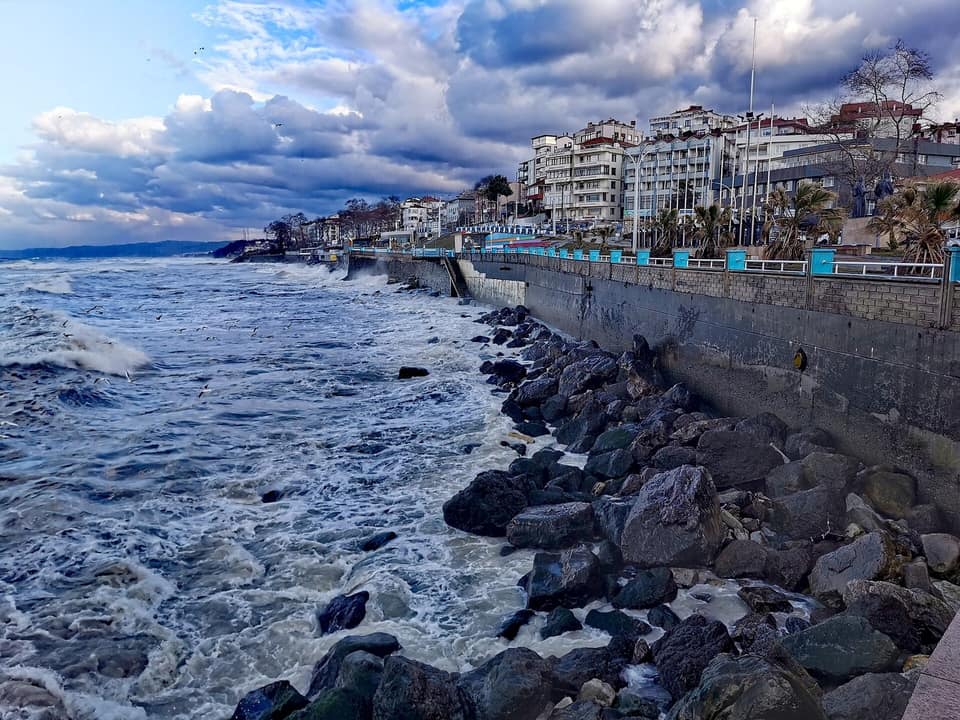
A Day on the Akçakoca Shore
Sign in to like and rate
Akçakoca is Düzce's only door to the sea. The Düzce Provincial Directorate of Culture and Tourism, part of the Ministry of Culture and Tourism, writes that the country's first movements of sea and caravan tourism began on this shore in the 1950s.
About Trip
Akçakoca is Düzce's only door to the sea. The Düzce Provincial Directorate of Culture and Tourism, part of the Ministry of Culture and Tourism, writes that the country's first movements of sea and caravan tourism began on this shore in the 1950s. The town's pages list, in a single sentence, the sea and the sand, the fishing shelter, fish that change with the season, the sunset, civil architecture, chestnut honey and hazelnuts. This trip spreads that list over a single day: spending the morning among the wooden houses of Yukarı Mahalle, moving on to the fishing shelter and the seafront road towards noon, looking at the coastal cliffs to the west in the afternoon, and ending the day on the shore at the hour when the sun sinks into the sea. The Genoese Castle is only a landmark in this article; the castle has its own page.
Getting there
According to the transport page of the Düzce Provincial Directorate of Culture and Tourism, Akçakoca lies 38 kilometres from the provincial centre. The district page of the Düzce Governorship gives distances of 243 kilometres to Istanbul and 275 kilometres to Ankara, and explains that from either direction you reach Düzce on the motorway and then descend to the coast on a divided road. The Akçakoca District Governorate also notes that whichever way you come, you leave the motorway at the Düzce toll booths, take the Akçakoca road and reach the shore at the end of this road through green countryside. Once you arrive, you can leave your car in the centre and spend most of the day on foot; for the castle and the cliffs to the west, Kültür Portalı writes that they can be reached by urban public transport.
A short history of the coastal town
The history page of the provincial directorate explains that Akçakoca was one of the colony towns on the western Black Sea coast, known in antiquity as Dia or Diospolis. According to the district governorate's history, in the thirteenth century the Genoese settled on this coast, set up trading posts and repaired the damaged castles. Local official sources write that the district joined the Ottoman lands in 1319. After passing under Turkish rule the place was known in turn as Akçaşar and Akçaşehir. The district governorate relates that Evliya Çelebi, in his Seyahatname, described it as the landing place of Bolu and counted seventy storehouses on the seashore; the provincial directorate quotes the same work to say that the storehouses were full of timber and pine planks. The town became a district in 1934 and took its name from Akça Koca, one of the frontier lords of the early Ottoman years. The TDV Encyclopedia of Islam also records that today's district bears this lord's name. According to the district governorate, after the war of 1877-1878 Circassian, Georgian, Abkhaz, Laz and Hemşinli families coming from the Caucasus and the eastern Black Sea settled on these shores and founded villages; the district's present cultural diversity carries the traces of these migrations.
Morning, Yukarı Mahalle
Begin the day in Yukarı Mahalle. The Provincial Directorate of Culture and Tourism presents it as one of the oldest settlements in the district and writes that most of the historic houses are in this neighbourhood. According to the directorate, 160 historic houses are protected as a conservation site and some have been restored; this is why the neighbourhood is compared to an open-air museum. The houses are roughly 150 to 200 years old and fall into three groups. Houses of the first type are single-storey and rectangular in plan, with large kitchens and narrow rooms. Houses of the second type are two-storey and nearly square in plan, with many but narrow windows. They were built on stone foundations with a timber frame and lath-and-plaster technique; the outer face of the ground floor is plastered, the upper floor is clad in wood, and they have wide wooden balconies. In the more recent third type the windows grow wider, the ceilings lower and the outer walls are plastered. As you walk the streets, try to tell the three types apart: the balcony, the density of windows and an upper floor that is either plastered or clad in timber are the easiest clues to read.
Another reason to come here in the morning is the local market. The provincial directorate writes that in the shade of the historic houses with their bay windows there is a market where local people display and sell their handiwork. The stalls hold a regional cuisine that runs from melengücceği dessert to mancarlı pide, from village bread to homemade pasta and keş. Beside them, crafts such as rolling pins, low floor tables, the şalvar trousers worn in women's local dress, printed headscarves and embroidery are also on show. According to the directorate's record, Akçakoca Mancarlı Pide, which holds a geographical indication, is made with greens such as chard or spinach; it is baked in a stone oven or on a griddle over a wood fire, and butter is spread on top as soon as it comes out of the oven. Check the days the market is held with local sources before you go.
In Orhangazi Mahallesi, where the provincial directorate says examples of civil architecture are dense, stands the Historic Orhangazi Primary School. According to the provincial directorate, the school was built in 1928, is one of the first schools built by the state and still teaches after its restoration. The writer Rıfat Ilgaz taught here and wrote his work Karadeniz'in Kıyıcığı during this period. Since lessons continue, it is better to look at the building from the outside rather than go in. For those who love timber architecture, the Orhan Gazi Mosque in the district is another example: the directorate writes that it was built without nails in the çantı technique, in which long logs are interlocked, and that it was restored by the General Directorate of Foundations in 2007.
Towards noon, the fishing shelter and hazelnuts
When you move on from the neighbourhood to the shore, the fishing shelter greets you. According to the district page of the Düzce Governorship, the fish most often seen in Akçakoca's waters are anchovy, whiting, red mullet, young bluefish, horse mackerel, turbot, bonito, shad and grey mullet; trout farming is also carried out in the district. Looking at the boats' gear, the preparation of the nets and the boats pulled up on the shore is the scene that best conveys the town's everyday bond with the sea. The district governorate's history reminds us that this bond is old: throughout its history the district has been a harbour living side by side with the sea.
The Governorship writes that hazelnut growing holds the most important place in the district's economy, followed by tourism, fishing and beekeeping. Akçakoca Yellow Hazelnut is registered with a geographical indication, and its geographical boundary is the district of Akçakoca alone; according to the provincial directorate's record, the plant grows vigorously and in this way differs from the other hazelnuts of the area. For lunch, looking for the fish of the season around the shelter is the most natural choice on this coast.
Afternoon, along the shore
The district governorate writes that Akçakoca's coastline runs for about 35 kilometres and that there are many sandy beaches along it. The provincial directorate's beaches page speaks of black pearl-grained sand on the beaches and presents the town as the nearest window to the sea for Central Anatolia. The district governorate also notes that there are options for diving, surfing, sailing and line fishing enthusiasts. In the town centre stands the Central Mosque, which the provincial directorate presents for its unusual appearance. According to the directorate, the foundation of the building was laid in 1989 and it opened in 2004; its dome rises 31 metres and its minaret 58 metres, and instead of a classic single dome its roof is built on a system resting on octagonal corners and inspired by the Turkish ceremonial tent.
West, towards the cliffs
Give the second half of the afternoon to the west. The tourism page of the district governorate writes that along the coast there are cliffs carved by the Black Sea waves, and that the highest of them are the Soyat cliffs between the Genoese Castle and Değirmenağzı, reaching about 30 metres in height. Because of the caves lined up along the shore, this stretch is also called the seal rocks. Kültür Portalı notes that the castle is 2.5 kilometres from the town centre and that there are two separate beaches to its east and west; you can use the castle surroundings as a viewpoint for watching the cliffs. On rough days do not go near the edges of the slopes and do not leave the marked paths.
For those looking for a shadier extension, the provincial directorate suggests the Cumayanı picnic and recreation area, about 3 kilometres southwest of the town within the boundaries of Göktepe Köyü. Centuries-old plane trees and the stream beside them turn the area into a cool resting place. According to the directorate, the remains of a bathhouse from the Seljuk period are also found in the area.
Sunset
The best way to end the day in Akçakoca is to return to the shore. The provincial directorate presents the town's sunset under a heading of its own: it counts watching the sky shift from one colour to another, and following the view until darkness covers the whole town, among the defining experiences of this coast. Do not hurry; choose a bench on the seafront road and wait for the last light of the sun.
Season and time of day
Summer is the best period for the sea and the beaches. Walking the seafront road, wandering the streets of Yukarı Mahalle and watching the sunset are possible in every season. Morning hours are calmer both for the market and for photography in the neighbourhood; the timber facades read better in soft light. On stormy winter days the scenes of waves striking the seafront road are impressive, but take care at the water's edge.
Practical notes
- Most of the houses in Yukarı Mahalle are homes; walk around without entering gardens or doorways and respect the residents' privacy.
- The historic school still teaches; see the building from outside.
- Market days, sea conditions and the service status of the beaches may change; check current information with local official sources.
- The Genoese Castle and its surroundings are an archaeological and natural conservation site; do not climb on the stones and leave the area clean.
- If you want to combine Akçakoca with Konuralp in Düzce Merkez on the same trip, set aside a separate day for the ancient city and the museum.
Sources
- Düzce Provincial Directorate of Culture and Tourism, Akçakoca, https://duzce.ktb.gov.tr/TR-211375/akcakoca.html
- Düzce Provincial Directorate of Culture and Tourism, Sivil Mimari, https://duzce.ktb.gov.tr/TR-211427/sivil-mimari.html
- Düzce Provincial Directorate of Culture and Tourism, Akçakoca Yukarı Mahalle Yöresel Pazarı, https://duzce.ktb.gov.tr/TR-283477/akcakoca-yukari-mahalle-yoresel-pazari.html
- Düzce Provincial Directorate of Culture and Tourism, Tarihi Orhangazi İlköğretim Okulu, https://duzce.ktb.gov.tr/TR-211453/tarihi-orhangazi-ilkogretim-okulu.html
- Düzce Provincial Directorate of Culture and Tourism, Orhangazi Camii, https://duzce.ktb.gov.tr/TR-216211/orhangazi-camii.html
- Düzce Provincial Directorate of Culture and Tourism, Akçakoca Merkez Camii, https://duzce.ktb.gov.tr/TR-216213/akcakoca-merkez-camii.html
- Düzce Provincial Directorate of Culture and Tourism, Plajlar, https://duzce.ktb.gov.tr/TR-216205/plajlar.html
- Düzce Provincial Directorate of Culture and Tourism, Akçakoca'da Gün Batımı, https://duzce.ktb.gov.tr/TR-283473/akcakoca39da-gun-batimi.html
- Düzce Provincial Directorate of Culture and Tourism, Cumayanı Piknik ve Mesire Alanı, https://duzce.ktb.gov.tr/TR-243802/cumayani-piknik-ve-mesire-alani.html
- Düzce Provincial Directorate of Culture and Tourism, Akçakoca Mancarlı Pide, https://duzce.ktb.gov.tr/TR-249199/akcakoca-mancarli-pide.html
- Düzce Provincial Directorate of Culture and Tourism, Akçakoca Sarı Fındığı, https://duzce.ktb.gov.tr/TR-249200/akcakoca-sari-findigi.html
- Düzce Provincial Directorate of Culture and Tourism, Tarihçe, https://duzce.ktb.gov.tr/TR-70707/tarihce.html
- Düzce Provincial Directorate of Culture and Tourism, Ulaşım, https://duzce.ktb.gov.tr/TR-211332/ulasim.html
- Akçakoca District Governorate, Tarihçe, https://www.akcakoca.gov.tr/tarihce
- Akçakoca District Governorate, Genel Turizm, https://www.akcakoca.gov.tr/genel-turizm
- Düzce Governorship, Akçakoca, https://www.duzce.gov.tr/akcakoca
- Kültür Portalı, Akçakoca Ceneviz Kalesi, https://www.kulturportali.gov.tr/turkiye/duzce/gezilecekyer/akcakoca-ceneviz-kalesi
- TDV Encyclopedia of Islam, Akça Koca, https://islamansiklopedisi.org.tr/akca-koca
Comments
Loading...
Location - A Day on the Akçakoca Shore
 AuthorRadar TürkiyeVisit SourceGet Directions