

A Day at the Döngel Caves and the Direkli Valley
Sign in to like and rate
The road leading from Kahramanmaraş towards Göksun and Kayseri leaves the city's plain and climbs into the foothills of the Taurus, passing through the Döngel neighbourhood of the Onikişubat district.
About Trip
The road leading from Kahramanmaraş towards Göksun and Kayseri leaves the city's plain and climbs into the foothills of the Taurus, passing through the Döngel neighbourhood of the Onikişubat district. Here, on the slope of a valley shaded by walnut and plane trees, there are three caves stacked one above the other and, close by, one of the longest-running cave excavations in Anatolia. A trip to Döngel is on the one hand a nature day full of water, rock and trees, and on the other a reading of history that reaches back to the hunter-gatherers of the region thousands of years ago.
Getting there
The Culture Portal gives the address of Döngel Cave as Döngel Mahallesi, Göksun Yolu 50th kilometre, Onikişubat, and places the caves at the 50th kilometre of the Kahramanmaraş-Kayseri highway. The Kahramanmaraş Provincial Directorate of Culture and Tourism writes that the cave is on the same road and that its distance from the city centre is 58 kilometres. Allowing for this difference between the sources, it is enough to set aside a little more than half a day from the city. The road is easily driven by private car; for the short access road branching off the main road to the cave area, Kahramanmaraş Metropolitan Municipality announced in 2021 that it had resurfaced a route of about 1 kilometre. Those who want to travel by public transport should ask in advance whether the lines heading towards Göksun stop at Döngel.
The geography of the valley
Erek and Samii describe the surroundings of Direkli as a landscape of steep mountains with a typically Mediterranean appearance. According to the article, Kahramanmaraş shows features of Southeastern Anatolia, of the Mediterranean and partly of Eastern Anatolia, and Direkli Cave lies almost exactly in the middle of the Taurus range, at a point where many ecological zones intersect. The Governorship likewise lists Ahır Dağı, Berit, Engizek, Binboğa and Nur Dağı among the province's main heights, notes that the Ceyhan River rises within the provincial boundaries and states that the province is rich in streams and springs. The road to Döngel advances into this mountainous belt.
The structure of the caves
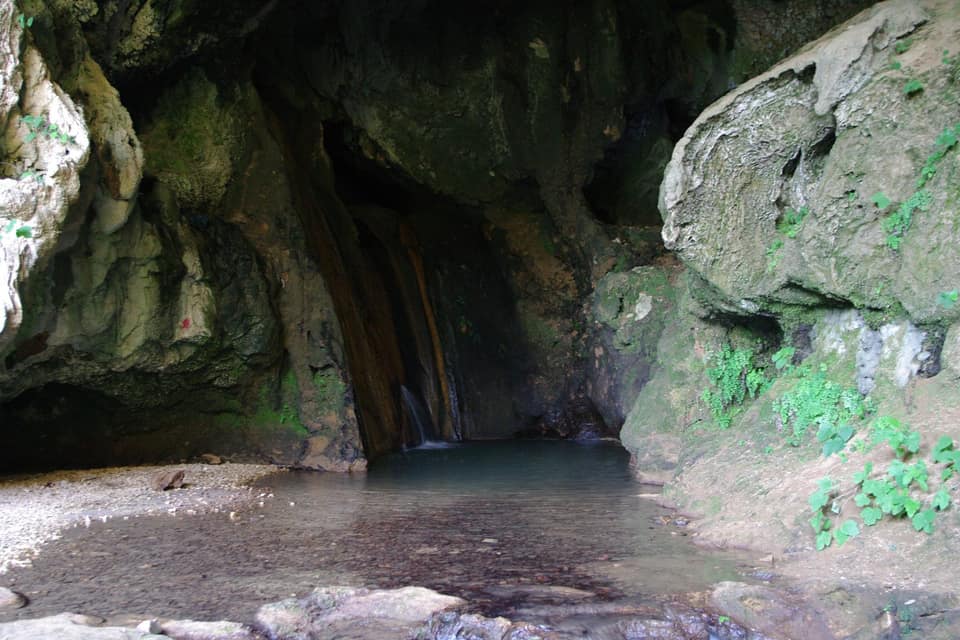
According to the Culture Portal, Döngel consists of three caves stacked one on top of the other and connected to each other, and it counts among the most important caves of the region. The height of the cave from floor to ceiling is 102 metres. The Ministry of Culture and Tourism's 2025 promotional booklet on Kahramanmaraş also speaks of three connected caves whose height reaches 100 metres, and invites visitors to spend a day among plane and walnut trees. The foot of the cave is a green resting and picnic area. Seen from the valley below, the openings that rise one above the other look like a structure climbing through the rock in storeys.
The history of the caves
Döngel is mentioned together with the oldest traces of settlement in Kahramanmaraş. The Provincial Directorate of Culture and Tourism and the Governorship of Kahramanmaraş write that the finds recovered during research in the cave show that human settlement in the area began in the Upper Palaeolithic and continued in the Neolithic and Early Bronze Ages. The Culture Portal places this first settlement in the Palaeolithic, in the range of 40,000-10,000 BC, while the ministry's booklet speaks of human settlement reaching back to around 10,000 BC. Although the dates vary from source to source, they all meet at the same point: the Döngel valley is one of the oldest known shelters of people in the lands of Kahramanmaraş. The Governorship adds that in the Middle Bronze Age, that is between 2000 and 1500 BC, the area lay at the junction of caravan routes linking Syria and Mesopotamia with Cappadocia and other parts of Anatolia.
Direkli Cave and the excavations
Direkli Cave, within the boundaries of Döngel, is the place that tells the past of the valley in the greatest detail. According to the article by the excavation director Erek and by Samii, published in the journal Höyük in 2025, the cave lies about 45 kilometres northwest of the provincial centre, inside a valley on the southeastern slopes of Höbek Dağı. The abundant water sources around it have allowed the area to be inhabited without interruption from the end of the Palaeolithic to the present day. The cave was discovered in 1959 by Kılıç Kökten, who carried out a short excavation. It was re-examined during a survey in 2006, and specialist teams have been excavating it since 2007. The article describes Direkli, together with Karain and Öküzini, as one of the three longest-running cave excavations in Anatolia, and highlights it as one of the easternmost excavated Epipalaeolithic cave settlements in Anatolia.
According to radiocarbon dates, Direkli Cave was used in various ways and for different purposes from 12,100 BC onwards. The excavations have yielded small crescent-shaped flint tools, bone awls, stone axes and ornaments. Beads made of marine shells, stone and bone are strikingly abundant in the Late Epipalaeolithic layers. One of the most important finds is a highly schematic female figurine, 2.6 centimetres tall, which was hardened by firing after being shaped. According to the article, wild goats make up 51 percent of the animal remains; the hunters also added tortoises, small mammals, birds and fish to their diet. A bone fish hook found as a grave good is regarded as evidence of fishing. Building remains uncovered in the 2018 excavations show that the cave was not a short-lived site but a station that was settled again and again over a long time. The article notes that the ornament tradition at Direkli resembles the practices of the Natufian culture of the Levant, despite the distance. According to the authors, the cave was a station to which its inhabitants came prepared, in certain periods, to secure food, and the finds point to three separate economic zones: the Central Taurus range in which the cave lies, the Sea of Galilee and its surroundings, and Göllü Dağ and its surroundings. These three zones linked a route of roughly 1500 kilometres and became preferred areas of human mobility in the Early Holocene. The figurine, for its part, is assessed in the article as a precursor of the distinctive form seen in Anatolia's process of Neolithisation. The ministry's booklet reports that stone beads dated to about 13,000 years ago resemble material from a quarry in Saudi Arabia.
The use of the cave continued until recent times. In the mixed fill at the very top, the excavators found an Ottoman 40 para coin dating from 1909-1910. Before the excavations began in 2007, Direkli was used as an animal shelter by the residents of Döngel village.
Suggested visit
Begin the day in the wooded area at the foot of Döngel Cave. First look from below at the valley and at the cave openings stacked one above the other; the three-storey structure is best understood from this distance. Then walk towards the mouth of the cave. The rocky ground around the cave can be slippery when wet; carry shoes with firm soles and a torch, and do not climb where you do not feel confident. Do not move any stone, bone or potsherd inside or around the cave; this is an area where prehistoric finds have come to light.
Direkli Cave is an excavation site and is not laid out to be toured like a museum. Do not enter the excavation area and do not touch the trenches or the excavation equipment. Ask the Kahramanmaraş Provincial Directorate of Culture and Tourism in advance whether the excavation is open to visitors and under what conditions it can be seen. The ministry's booklet writes that the Direkli finds are presented in the excavation and reconstruction hall of the Kahramanmaraş Museum; if you want to complete the trip with this hall in the city, check the museum's current visiting status on muze.gov.tr.
Take your lunch break in the resting area at the foot of the cave; bring your food from the city and leave the area as you found it. The nature route in the ministry's booklet lists the Döngel hot springs alongside Döngel Cave; if you have time left on the way back, you can consider this option as well.
Season and timing
The Döngel trip can also be made in the winter months, but because the road climbs north towards Göksun, allow for the possibility of snow and ice between November and March. The Governorship writes that a continental form of the Mediterranean climate prevails in the province because of its distance from the sea and its altitude, and that the province is cooler than the southern provinces. Check the weather and road conditions before setting off. Since winter days are short, reach the cave before noon and return to the city before dark. In spring and summer, when the plane and walnut trees are in leaf, the valley is shadier; in winter the cave openings are more clearly visible through the bare trees.
Practical notes
- Carry non-slip shoes with firm soles, a torch and layered clothing.
- Do not touch any find in the caves or at the excavation site, and do not pick anything up from the surface.
- Bring your own water and food; take your rubbish back with you.
- Ask the Kahramanmaraş Provincial Directorate of Culture and Tourism about the current visiting status of the excavation site and the museum.
- In winter, check the condition of the highway towards Göksun before setting off.
Sources
- Culture Portal, Döngel Mağarası, https://www.kulturportali.gov.tr/turkiye/kahramanmaras/gezilecekyer/dongel-magarasi
- Kahramanmaraş Provincial Directorate of Culture and Tourism, Caves, https://kahramanmaras.ktb.gov.tr/TR-61252/magaralar.html
- Governorship of Kahramanmaraş, History, https://www.kahramanmaras.gov.tr/tarihce1
- Ministry of Culture and Tourism, Kahramanmaraş promotional booklet (2025), https://engelsiz.ktb.gov.tr/Eklenti/135298,kahramanmarastrro26052025sonpdf.pdf
- Erek and Samii, Excavations and Finds of Direkli Cave in Anatolian Prehistory, Höyük 16, 2025, https://dergipark.org.tr/tr/pub/hoyuk/article/1828846
- Kahramanmaraş Metropolitan Municipality, Döngel Mağaralarının Ulaşım Sorunu Çözüldü (2021), https://kahramanmaras.bel.tr/haber/2021/06/28/dongel-magaralarinin-ulasim-sorunu-cozuldu
- Wikipedia, Direkli Mağarası, https://tr.wikipedia.org/wiki/Direkli_Ma%C4%9Faras%C4%B1
Comments
Loading...
Location - A Day at the Döngel Caves and the Direkli Valley
 AuthorRadar TürkiyeVisit SourceGet Directions