

From the Square to the Pine Grove, the Story of How Yozgat Was Founded
Sign in to like and rate
Unlike many Anatolian towns, Yozgat did not grow up around an ancient citadel or a medieval caravanserai, but around buildings commissioned by a single family in the eighteenth century. The TDV Encyclopaedia of Islam explains that a place recorded as a village in sixteenth-century registers became a town thanks to the building works and endowments of the Çapanoğulları, the family that governed the Bozok district. This route follows that growth in four stops, roughly in chronological order.
The first stop is the Çapanoğlu Mosque, commissioned by Çapanoğlu Mustafa Bey in 1779 and given its present form when his brother Süleyman Bey added a northern section fifteen years later. Its endowment deed listed eighty shops, an inn and a bathhouse, and the building is also the nucleus of the market quarter. The second stop, a few minutes away, is Cumhuriyet Square and its landmark, the seven-storey Clock Tower, one of the public buildings added to the town in the late Ottoman period. The third stop is the timber Nizamoğlu Mansion, completed in 1871 in the same neighbourhood; today it houses the Yozgat Museum and shows the life of a wealthy nineteenth-century household together with finds from the province's mounds. The last stop lies just south of town: the black pine forest left standing in the middle of the steppe, Yozgat Pine Grove, declared Türkiye's first national park in 1958.
The order follows both time and the walk. Only a square separates the mosque from the tower, and the museum is in the same İstanbulluoğlu neighbourhood. You visit these three stops on foot and then take a short drive up to the Pine Grove. Ending the day among the trees also explains why the stone and timber town you saw in the morning was founded on this slope; the Governorship notes that the town was built at the foot of one of the high hills of the Bozok plateau, and that the Pine Grove has long been the place where townspeople spent their summers.
Some practical notes. The mosque is a working place of worship; visit outside prayer times, dress appropriately and keep your voice low. The Yozgat Museum was closed to visitors for a period because of maintenance and repair works; before you go, check whether it is open and confirm the visiting days with official sources. If it is closed, you can look at the mansion's facade from outside and carry on with the route. An entrance fee is charged at the Pine Grove; ask the national park directorate for current information. The town centre sits at roughly one thousand three hundred metres, so evenings turn cool even in summer; bring a cardigan. In the Pine Grove wear closed shoes suitable for the walking paths and carry water.
Sources
- TDV İslam Ansiklopedisi, Çapanoğlu Camii, https://islamansiklopedisi.org.tr/capanoglu-camii
- TDV İslam Ansiklopedisi, Yozgat, https://islamansiklopedisi.org.tr/yozgat
- TDV İslam Ansiklopedisi, Çapanoğulları, https://islamansiklopedisi.org.tr/capanogullari
- Kültür Portalı, Yozgat Saat Kulesi, https://www.kulturportali.gov.tr/turkiye/yozgat/gezilecekyer/yozgat-saat-kulesi
- Kültür Portalı, Tarihin Tanıkları Saat Kuleleri, https://www.kulturportali.gov.tr/portal/tarihin-taniklari--saat-kuleleri
- Kültür Portalı, Yozgat Müzesi, https://kulturportali.gov.tr/turkiye/yozgat/gezilecekyer/yozgat-muzesi
- Turkish Museums, Yozgat Museum, https://www.turkishmuseums.com/museum/detail/2255-yozgat-museum/2255/4
- Kültür Portalı, Çamlık Milli Parkı, https://www.kulturportali.gov.tr/turkiye/yozgat/gezilecekyer/camlik-milli-parki
- Yozgat Valiliği, Çamlık Milli Parkı, https://www.yozgat.gov.tr/camlik-milli-parki
- Yozgat Valiliği, Yozgat Genel Bilgiler, https://www.yozgat.gov.tr/yozgat-genel-bilgiler
- Tarım ve Orman Bakanlığı 9. Bölge Müdürlüğü, Yozgat Çamlığı Milli Parkı, https://bolge9.tarimorman.gov.tr/Menu/83/Yozgat-Yozgat-Camligi-Milli-Parki
- Kılıç ve Kervankıran, Türk Coğrafya Dergisi 72 (2019), Yozgat Çamlığı Milli Parkı, https://dergipark.org.tr/tr/pub/tcd/issue/45055/463690
- Wikipedia, Yozgat Saat Kulesi, https://tr.wikipedia.org/wiki/Yozgat_Saat_Kulesi
- Wikipedia, Yozgat Müzesi, https://tr.wikipedia.org/wiki/Yozgat_Müzesi
Route Stops
Çapanoğlu Mosque
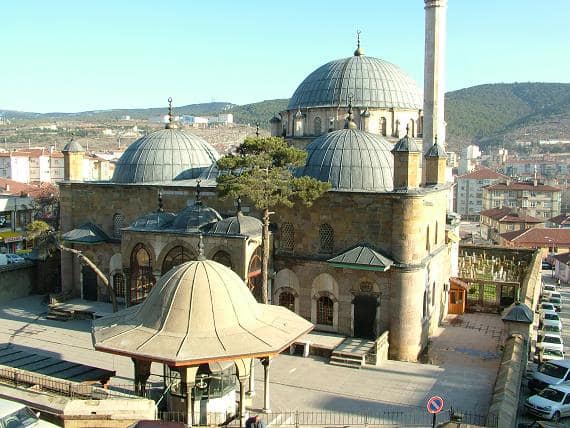
Begin the route at the oldest large building in the town centre, the Çapanoğlu Mosque, known locally as the Great Mosque or Ulucami. It stands just off Cumhuriyet Square, inside a wide courtyard enclosed by a high wall. You can enter the courtyard through the gates on the east or west side. Before going in, pause in the courtyard and try to notice that the building is made of two parts. The main southern section was commissioned in 1779 by Çapanoğlu Mustafa Bey, who governed the Bozok district. The northern section, called the outer mosque, was added by his brother Süleyman Bey in 1793-94. The single-balcony minaret now standing in the middle of the west facade is also a result of this extension; it originally belonged to the first building. The eight-columned entrance portico in front of the north facade was added at an even later date. Walk up to the main portal and look at the acanthus leaves carved in coloured marble, the shell-shaped niches and the sharp C and S scrolls. The TDV Encyclopaedia of Islam counts the building among the most important examples of Turkish Baroque in Anatolia, while finding it plainer than İstanbul buildings in the same style. The mosque is a working place of worship; enter outside prayer times, dress appropriately, take off your shoes and keep quiet. The first thing to strike you inside is the large dome, more than fifteen metres across, resting on two thick piers and three walls. Look closely at the piers and walls; you will soon see that they were painted to imitate veined marble. Look for the Baroque-influenced scrolls on the yellowish marble capitals of the paired columns. The mihrab and the minbar are made of beige, off-white and green marble; study both from a distance without disturbing anyone at prayer. The original part of the Baroque painted decoration of flowers, curling branches and leaves survives in the dome and vault of the gallery. Framed panels on the same vault show depictions of buildings and pictures of fruit; Wikipedia also draws attention to the building pictures on either side of the entrance. The fifty-four windows that light the building make the interior look quite bright around midday. On your way out, look at the ablution fountain in the north-west corner of the courtyard; it was rebuilt using old pieces so as to recall its original form. The best photograph is taken from the north of the courtyard, framing the domes and the minaret together. The fact that the endowment deed listed eighty shops, an inn and a bathhouse shows that the town's market grew up around this building. As you leave the courtyard and walk towards the market streets, you can see this relationship for yourself. From here, Cumhuriyet Square, where the Clock Tower stands, is only a few minutes' walk away.
Source: TDV İslam Ansiklopedisi, Çapanoğlu Camii; TDV İslam Ansiklopedisi, Yozgat; Wikipedia, Çapanoğlu Camii.
Yozgat Clock Tower
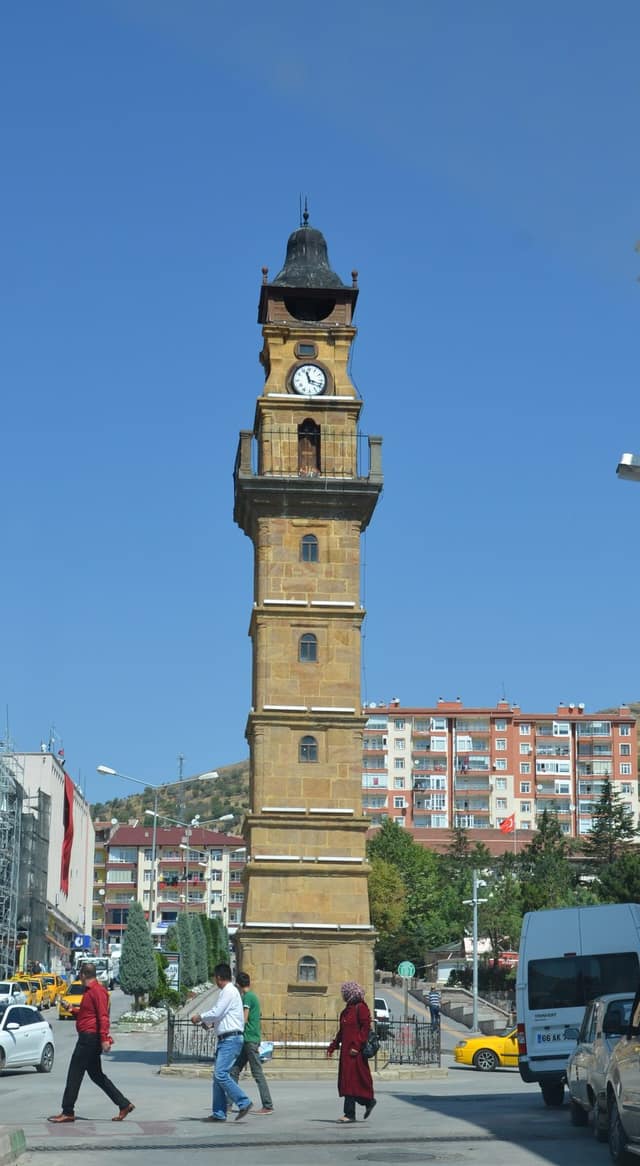
When you reach Cumhuriyet Square, do not walk straight up to the tower; first choose a spot on the far side of the square from which you can see the whole shaft. Built of cut stone, the tower has seven storeys including the ground floor and the bell section. Follow the shaft from bottom to top and count the small round-arched windows set on each floor across three levels below the balcony. The most striking part of the tower is the single balcony that projects from the shaft below the section where the clock hangs. According to Wikipedia's description, this balcony widens outwards from the shaft, has ornate brackets, railings and balusters, and was designed to command every side. Above the bell there is a clock on each of the four faces; you can see one dial from each side of the square. Kültür Portalı writes that the bells ringing on every hour were meant to be heard all over the town. Try to be in the square on the hour and listen to how the sound spreads into the surrounding streets. The tower is entered through a round-arched door on the north face and climbed by zigzag timber stairs; ask on site whether the interior is open to visitors. Sources say the ground floor was first used as a timekeeper's room and the tower itself as a fire lookout. The names of French clockmakers are written on the clocks; this detail is a small sign of the town's links with the wider world at that time. Kültür Portalı notes that the clocks are the same age as the tower. The weight figure varies by source; Kültür Portalı says the clocks' adjusting weights, and Wikipedia says the bell, weigh about 250 kilograms. Sources disagree on the date of construction. Kültür Portalı gives 1897, Wikipedia gives 1908, the Yozgat article of the TDV Encyclopaedia of Islam gives 1909, and the Governorship writes the end of the nineteenth century. What is certain is that the tower was built by Şakir Usta of Yozgat during the term of the then mayor, Tevfikzade Ahmet Bey. Kültür Portalı's article on clock towers explains that most of the towers that spread into the heart of Anatolia were linked to an imperial decree sent to governors for the twenty-fifth anniversary of Abdülhamid II's accession. The TDV encyclopaedia also lists the tower among examples of late Ottoman architecture in Yozgat, together with the armoury, the military recruitment office and the high school buildings of the same years. The square itself was laid out in the Republican period and became the town centre. The yellowish cut stone takes on its warmest colour when the sun is low; choose the side light of morning or late afternoon for photographs. If you want the tower and the domes of the mosque in the same frame, walk towards the west side of the square. You can take a short break on a bench at the edge of the square and watch town life around you. From here the way to the Nizamoğlu Mansion runs through the streets of the same İstanbulluoğlu neighbourhood and takes only a short walk.
Source: Kültür Portalı, Yozgat Saat Kulesi; Kültür Portalı, Tarihin Tanıkları Saat Kuleleri; Wikipedia, Yozgat Saat Kulesi; Yozgat Valiliği, Genel Bilgiler.
Yozgat Museum (Nizamoğlu Mansion)
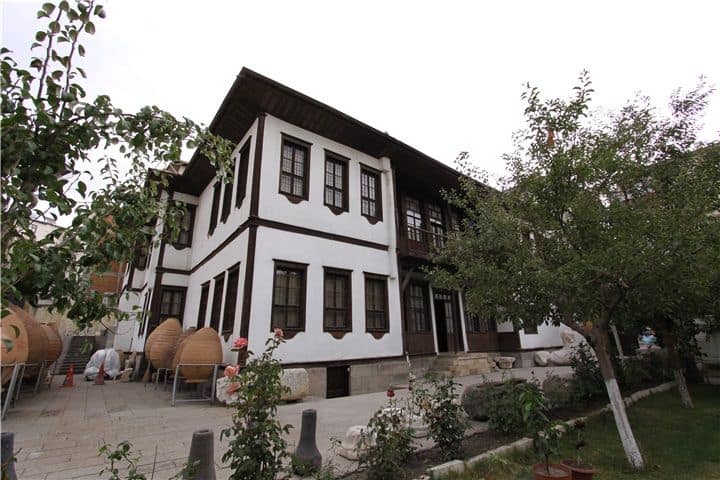
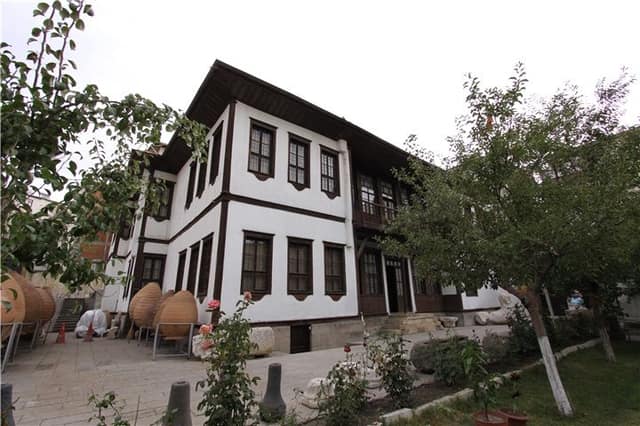
The third stop is the two-storey Nizamoğlu Mansion in the İstanbulluoğlu neighbourhood, today the Yozgat Museum. Be sure to check before you go whether the museum is open; the official promotional website of Turkish museums announced that it was closed to visitors from 11 December 2023 because of maintenance and repair works. If it is closed, get to know the mansion from outside by looking at its facade and garden wall; if it is open, follow the order below. First stop in the garden and look at the proportions of the building, whose ground floor is partly stone-walled and whose remaining parts are timber. The mansion was completed in 1871, built by a non-Muslim Ottoman citizen and later bought by the Nizamoğlu family, who lived here until the 1970s. The building was listed for protection in 1975, expropriated in 1979 and opened as a museum in 1985 after a long restoration. Terracotta pieces and large storage jars brought from Yozgat and its districts are displayed in the garden. Inside, start with the archaeology halls on the ground floor. These halls opened with the reorganisation of 2008 and show finds from Çadır Höyük, Alişar Höyüğü, Cemallı Höyük, Mercimektepe Höyüğü and the ancient city on Kerkenes Dağı. If you plan to visit the province's mounds, stay a little longer in these halls; the material from places where you will see only earthen hills in the field is gathered here together. Kültür Portalı writes that the museum holds more than a thousand archaeological pieces, most of them stone works. Then go upstairs; this is the ethnography section, and the rooms are furnished according to their original use in the mansion. In the iwan, look for the decorated timber doors and cupboard doors brought from old houses that no longer exist. The horse-drawn carriage known locally as the Aynalı Körük is one of the most looked-at pieces in this section. In the upstairs kitchen, porcelain, ceramic, copper and wooden kitchenware are lined up in display cases. The main room in the south-west corner recreates a mansion salon with its divans, cushions, brazier, large standing clock and gramophone. The room in the south-east corner holds an organ from the late nineteenth century brought from Yozgat High School. Separate rooms display flintlock rifles, swords and a bridal room with a brass bed, cradles and chests. The mansion's real treasure, however, is the ceilings of the two guest rooms on the upper floor, decorated by hand like a carpet. Scenes such as Napoleon's wars and the Yozgat fire are painted on the ceiling frieze of the first room; the date 1871, when the paintings were made, is written in the composition on the south frieze. In the second room, pictures of nature and fairy tales take centre stage. In these rooms, take time to raise your head and read the paintings one by one; because the light inside is low, ask the staff about the rules on photography. After leaving the mansion, you need a short drive from the town centre to reach the Pine Grove.
Source: Kültür Portalı, Yozgat Müzesi; Turkish Museums, Yozgat Museum; Wikipedia, Yozgat Müzesi.
Yozgat Pine Forest National Park
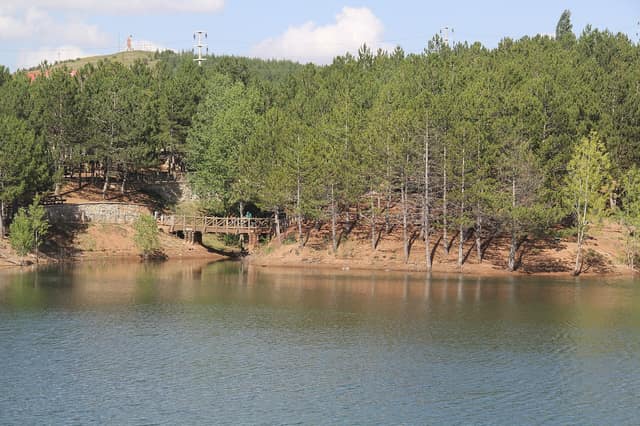
The last stop on the route is Yozgat Pine Grove National Park, about two kilometres south of the town centre. An asphalt road climbs here from town; the park has two separate entrances and charges an entrance fee, so ask the national park directorate for current information. With an average altitude of one thousand three hundred and fifty metres, the area is one of the few forests left in Central Anatolia, a region turned into steppe by human impact. As soon as you get out of the car, you will notice that the air is cooler than in the town centre and smells of resin. First walk to the park's best-known spot, the Cevdet Dündar Pond, and look at the black pines reflected in the water from the shore. Then call at the Nature Education Centre, which has a library, a herbarium, an exhibition hall, taxidermy specimens and a model of the national park. Spending a few minutes at the model lets you get to know the hills, ridges and valleys you are about to walk. The forest's main asset is the Anatolian black pine, and a black pine more than four and a half centuries old stands in the park's strict protection zone. The Ministry of Agriculture and Forestry writes that the tree was 458 years old as of 2022; ask the staff where it is and whether it can be approached. Walking and cycling paths and viewing terraces are spread across the area; walk a loop without hurrying. The vegetation consists of more than two hundred species grouped in 43 families and 144 genera, and Kültür Portalı writes that nearly thirty of them are endemic. If you are a birdwatcher, bring binoculars; the Governorship reports species such as the golden eagle, the long-legged buzzard, the sparrowhawk and the bee-eater. Foxes, hares and martens are among the mammals living here, so stay on the paths and do not feed the animals. Governorship sources also mention snow wells that local people used for years. The story of the Pine Grove is older than the national park. An 1895 report by an official serving in Yozgat noted that the land around the town had once been forest and that only some pine woodland remained to the south. According to local legend, these pines multiplied from five pines planted by Kerem as he searched for Aslı. Sabahattin Ali, who taught in the town in 1927-28, compared the forest in a letter to a patch of green velvet sewn onto a dirty grocer's apron in the middle of the steppe. The Governorship writes that the first day of Hıdırellez used to be celebrated here with festivities. The national park was declared in 1958; in 2022 its boundaries were redrawn and its area enlarged from 267 hectares to 517 hectares. The adjoining Fatih Nature Park was also placed under protection in 2013, and you can extend your walk towards its valley and lake views. End the day on a viewing terrace as the light sinks through the trees; from here you can see the rooftops of the town you walked through in the morning.
Source: Kültür Portalı, Çamlık Milli Parkı; Yozgat Valiliği, Çamlık Milli Parkı; Tarım ve Orman Bakanlığı 9. Bölge, Yozgat Çamlığı Milli Parkı; Kılıç ve Kervankıran, Türk Coğrafya Dergisi.
Comments
Loading...
