

Following the Old Roads, from Yenişehir to the İznik Obelisk
Sign in to like and rate
The plain east of Bursa and the shore of Lake İznik were for centuries a passage where roads met. This route follows one of those roads and folds two thousand years of time into four stops. The stops are a mansion, an archaeology museum, a lakeshore and a Roman monument; what links them is that each stands on a road or in front of a gate.
Begin the day at the Şemaki House Museum in the Gündoğan neighbourhood of Yenişehir, a district centre 55 kilometres from Bursa. This two-storey house built in the 18th century is a museum of the Ministry of Culture and Tourism, and it is known that no nails were used in its construction. Then cross to İznik. The İznik Municipality travel guide describes the Yenişehir Gate in the south of the town as the point where Bursa and Yenişehir connect to İznik. The second stop of the route, the İznik Museum, stands right next to this gate and tells of some 8,500 years in its new building opened in January 2023.
After the museum, walk west through the old town to the lakeshore. Lake İznik, the largest lake in the Marmara Region, was called Ascania Limne in antiquity and also appears in Homer's Iliad. End the route at the Obelisk, about seven kilometres north of the town, set up in the Roman period on the road that led from İznik to İzmit. The road leaving the town to the north passed through the İstanbul Gate, named after the road to İstanbul; the monument of a member of the Cassius family who funded this gate also stands beside that road.
The order follows the road itself: it comes from the south, from the Yenişehir plain, enters the town through the Yenişehir Gate, sees the lake and leaves to the north for the İzmit road. The Şemaki House and the İznik Museum are about 19 kilometres apart as the crow flies, and there are bus services between the two districts. From the museum to the lakeshore is a distance you can walk inside the walls. From the museum to the Obelisk it is a little over seven kilometres as the crow flies, and as there is no public transport a vehicle is needed; the easiest way is to do the whole route by car.
You will spend close to three and a half hours at the stops; allow a full day including the journey from Bursa and back and the travel between stops. Before setting out, check the Ministry's museum pages for the opening hours and closing days of the two museums, and the İznik Municipality transport page for bus services. The Obelisk is in the open air and stands among olive groves; do not climb the monument and do not enter the surrounding farmland. If you want to watch the sunset on the lakeshore, you can return to the shore after the Obelisk.
Sources
- T.C. Kültür ve Turizm Bakanlığı Müzeler, Yenişehir Şemaki Evi Müzesi, https://muze.gov.tr/muze-detay?SectionId=BYS01&DistId=MRK
- Kültür Portalı, Yenişehir Şemaki Evi Müzesi, https://www.kulturportali.gov.tr/turkiye/bursa/gezilecekyer/yenisehir-semaki-evi-muzesi
- T.C. Kültür ve Turizm Bakanlığı Müzeler, İznik Müzesi, https://muze.gov.tr/muze-detay?SectionId=BIZ01&DistId=MRK
- MEB Okul Dışı Öğrenme, İznik Müzesi, https://okuldisiogrenme.eba.gov.tr/place-detail/iznik-muzesi-770
- İznik Belediyesi Gezi Rehberi, https://gezirehberi.iznik.bel.tr/geziharita/
- İznik Belediyesi, İznik Gölü, https://iznik.bel.tr/tr/sayfa/iznik-golu-45
- İznik Belediyesi, Diğer Yapılar, https://iznik.bel.tr/tr/sayfa/diger-yapilar-61
- İznik Belediyesi, İznik'e Ulaşım, https://iznik.bel.tr/tr/sayfa/iznike-ulasim-40
- Bursa İl Kültür ve Turizm Müdürlüğü, Kuş Gözetleme, https://bursa.ktb.gov.tr/TR-70251/kus-gozetleme.html
- Kültür Envanteri, İznik Dikilitaşı, https://kulturenvanteri.com/yer/iznik-dikilitasi/
Route Stops
Newşehir Şemaki House Museum
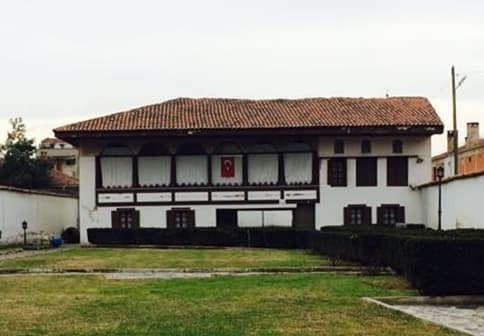
When you reach the centre of Yenişehir, find the Şemaki House Museum on Karabacak Sokak in the Gündoğan neighbourhood. The Culture Portal writes that Yenişehir is reached by buses leaving from the eastern bus station in central Bursa. The house was built in the 18th century by the Şemaki family, who migrated to Anatolia and settled in Yenişehir. The Culture Portal gives the family's place of origin as the town of Şemaki in Western Turkestan, while the Ministry's museum page gives it as the city of Şemah in Iran; both sources agree that the name comes from that place. The Culture Portal presents the house as one of the authentic examples of Ottoman architectural art. According to the Ministry's page, the house was bought by the Ministry of National Education in 1945 and converted into a museum. In 1980 it was repaired because it had worn out, furnished in the way the Şemaki family had lived, and opened to visitors in 1991. Before going in, look at the front facade from the garden; the facade opens onto the garden through arched sections, like a portico. The Ministry's page notes that there was once a bath in the garden, which no longer stands today. The house has two storeys and no basement. On the ground floor, to the right of the entrance, are the stone hall, the kitchen and the pantry, and to the left are two winter rooms. Walk through the kitchen and the pantry together to see how daily chores were organised on this floor. Climb to the upper floor by the wooden staircase beside the kitchen wall. The upper floor has a wooden floor and two rooms, one large and one small, opening onto a hall with an iwan. The walls of the large room are plastered with gypsum and horasan mortar. In this room, look closely at the cupboard doors; they are decorated with paintings of the Maiden's Tower and Sarayburnu in İstanbul. The hand-painted flower and landscape motifs of the house date to the 19th century, so the house was decorated about a century after it was built. On the upper floor, a section whose ceiling is separated by a wooden arch is called the Sergah Köşkü. The Culture Portal describes it as the place where the young girls of the house and the neighbours chatted and did needlework. No nails at all were used in building the house; keep this in mind as you look at the wooden joints. As the house is small, large groups enter in turns; do not touch the furnishings or the painted surfaces. For opening hours and closing days, see the Ministry's museum page. To move on to İznik, use the buses between Yenişehir and İznik or your own car; the two museums are about 19 kilometres apart as the crow flies.
Source: T.C. Kültür ve Turizm Bakanlığı Müzeler; Kültür Portalı.
Nicaea Museum
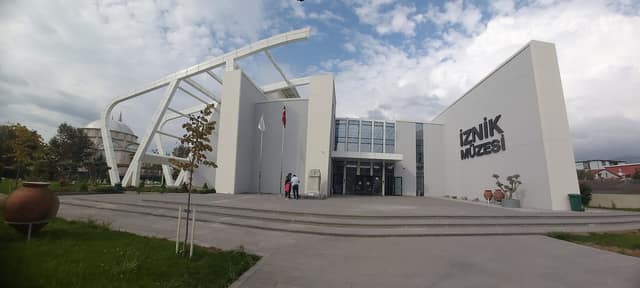
As you enter İznik from the south along the Yenişehir road, pay attention to the Yenişehir Gate. The İznik Municipality travel guide describes this gate as the point in the south of the town where Bursa and Yenişehir connect to İznik. According to the same guide, the gate was built in the time of the Roman emperor Claudius and is the gate most damaged by attacks and earthquakes. Built of Roman cut stone, the gate consists of three parts, and at its entrance stands a tower built to strengthen the defence. Of the western tower only traces of the foundations remain. The İznik Museum is near this gate, on Sultan Orhan Caddesi in the Mahmut Çelebi neighbourhood. The museum opened to visitors in this new building in January 2023. The exhibition halls are on the ground floor, and the administrative sections and storerooms are on the first floor; so your visit takes place on the ground floor. The exhibition is arranged chronologically and follows the Neolithic, Chalcolithic, Bronze Age, Hellenistic, Roman, Eastern Roman and Ottoman periods in turn. The municipality's travel guide writes that close to 1,500 works are on display, reaching us from a span of some 8,500 years beginning in 6500 BC. Keep this span in mind before entering the halls, because the first display cases tell of a time before the town was founded. The Ministry's museum page notes that finds from the Ilıpınar excavations are also included. The works come from past mound excavations and from the ongoing excavations at the İznik Roman Theatre, the Hisardere Necropolis and the İznik Tile Kilns. In the Roman hall, find the Roman-period game called the Game of Twelve Inscriptions, highlighted by the guide. Then look closely at the reliefs of the Achilles Sarcophagus, which depicts the Trojan War and Achilles, who took part in it. The sarcophagus of General Antigonos, one of the important sarcophagi of the Hisardere Necropolis, is also in the museum. The finds from the tile kiln excavations tell of İznik's tile production in the Ottoman period through pieces from the town's own soil. Do not forget to go out into the garden; according to the Ministry's out-of-school learning page, stone works are generally displayed there. Follow the museum rules when taking photographs, do not touch the exhibits and keep quiet in the halls. Groups need a reservation, and opening hours and closing days are published on the Ministry's museum page. After leaving the museum, walk west through the old town towards the lakeshore; since the main streets of the town run from the gates and meet in the centre, the way is easy to find.
Source: İznik Belediyesi Gezi Rehberi; T.C. Kültür ve Turizm Bakanlığı Müzeler; MEB Okul Dışı Öğrenme.
Lake İznik
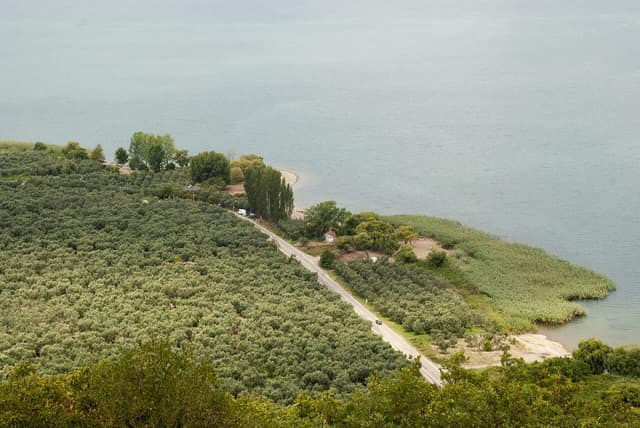
When you come out onto the lakeshore from the western end of the old town, the largest lake of the Marmara Region stretches before you. The İznik Municipality city guide gives the lake's area as 298 square kilometres and names it Türkiye's fifth largest natural lake. When you reach the shore, first look at the mountains on either side of the water; the Samanlı Mountains rise to the north of the lake and Mount Avdan to the south. The lake is of tectonic origin and formed when a basin on the Pamukova, İznik and Gulf of Gemlik depression line filled with water. The lake, shaped like an ellipse, is about 32 kilometres long from east to west and 11.5 kilometres at its widest. Although it looks shallow from the shore, the depth exceeds 30 metres over most of the lake and its deepest point reaches 65 metres. The water surface lies 85 metres above sea level. According to the municipality's page, the lake's catchment area is 1,246 square kilometres, and water is drawn from the lake to irrigate farmland. In antiquity the lake was called Ascania Limne, and it also appears in Homer's Iliad. Before going out to the shore, note the site of the Lake Gate, the western gate of the town. According to the municipality's travel guide, only a few traces of the Lake Gate remain today. Because a lost inscription said the walls here were built by Emperor Claudius Gothicus, the year 269 is considered for the gate. As you walk along the shore, watch the life of the water. The guide writes that the lake is a suitable habitat for grey mullet, carp and freshwater perch and that its reedbeds lie on the route of migratory birds. The municipality's page lists species such as the pygmy cormorant, black-crowned night heron, squacco heron, purple heron and ferruginous duck. The Bursa page of the Ministry of Culture and Tourism also names the lake an Important Bird Area and notes colonies of pygmy cormorants and night herons in the dense reedbeds. If you want to watch birds, bring binoculars and look from a distance without approaching the reedbeds. The lake was declared a protected site in 1990, and it is surrounded by farmland and olive groves. According to the municipality's page, the western shore was a marsh before the 1950s, and with the embankment built in 1963, 416 hectares of wetland were drained. Find a bench on the shore and sit for a while; the guide describes how the water takes on golden and orange tones as the sun sets. To move on to the Obelisk, return to your car and leave the town to the north, towards the İstanbul Gate.
Source: İznik Belediyesi, İznik Gölü; İznik Belediyesi Gezi Rehberi; Bursa İl Kültür ve Turizm Müdürlüğü.
Iznik Obelisk (Five Stones)
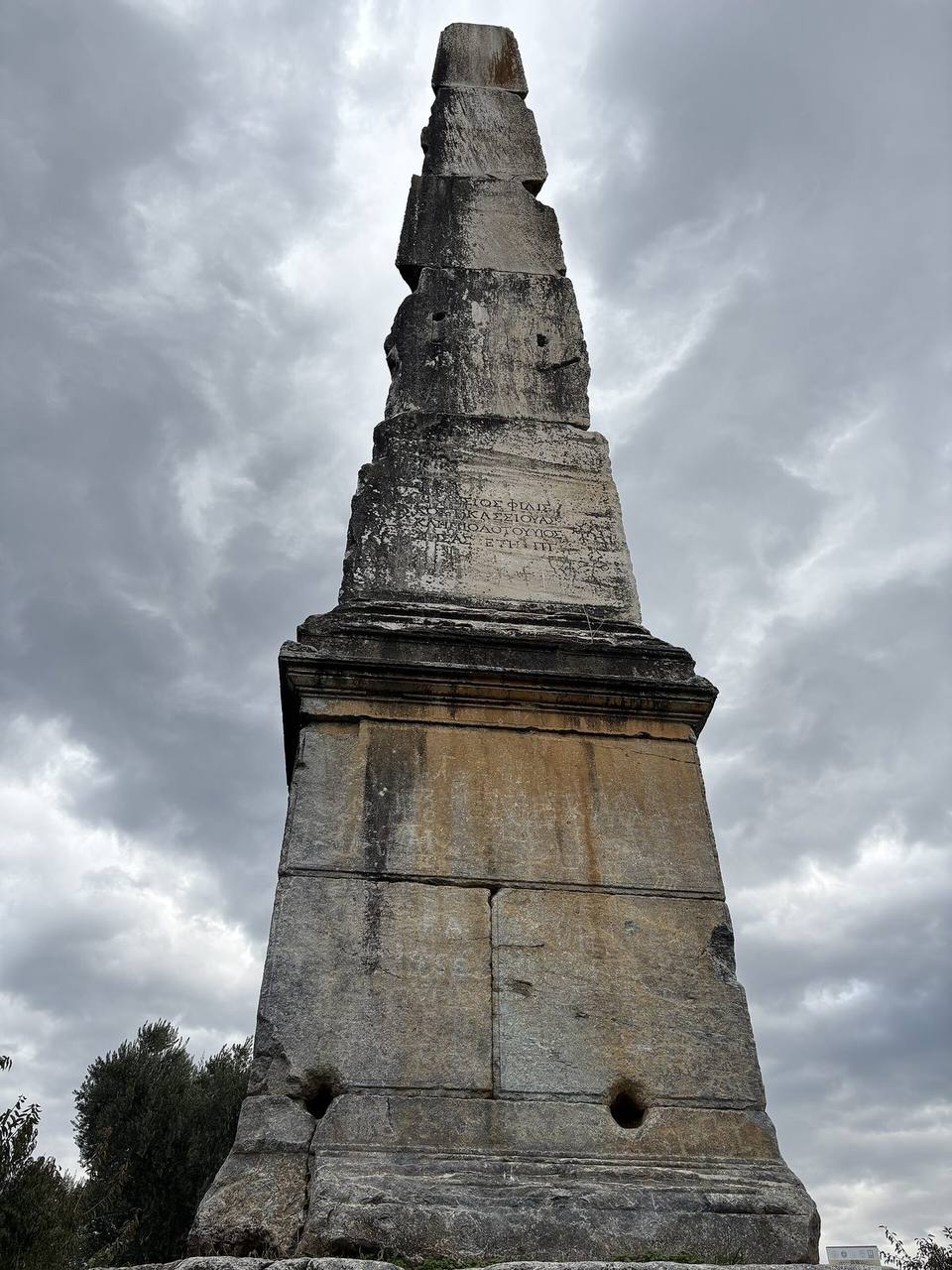
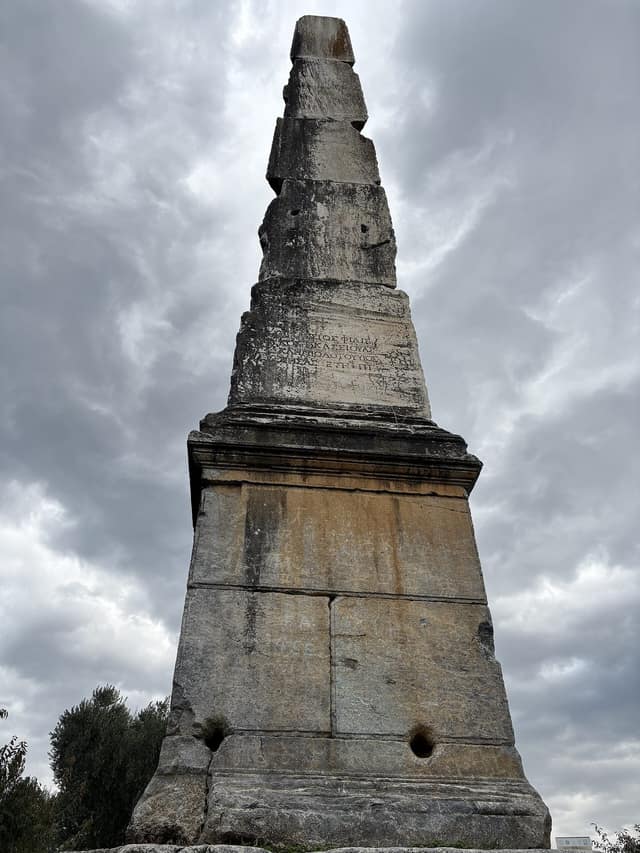
As you head north from the lakeshore, you pass through the İstanbul Gate, the northern entrance of the town. The İznik Municipality travel guide writes that this gate took its name because in antiquity it opened onto the road to İstanbul. According to the same guide, the gate was built by M. Plancius Varus, governor of the province of Bithynia, with the financial support of Gaius Cassius Khrestos of Nicaea. Keep this name in mind, because the last stop of the route belongs to a member of the same family. The Obelisk stands about seven kilometres north of the town among olive groves, and a vehicle is needed to get there. According to the guide, the monument was built on the road that led from İznik to İzmit in the Roman period. The cultural inventory record places the monument in the Roman period, in the 1st century AD. It is also known locally as Dikilitaş and Nişantaşı. After getting out of the car, look at the monument from a distance for a while and picture the old line of the road. Because the monument is built of five white marble blocks, it is also called Beştaş, the Five Stones. Its present height is 12 metres, and according to the municipality's guide the sixth stone that once stood at the top fell and was lost over time. The blocks, tapering upwards from the stepped base, give the monument the look of a pointed obelisk. Then approach the face that carries the inscription. As the guide reports, the Greek inscription states that Gaius Cassius Philiscus, son of Gaius Cassius Asklepiodotus, lived 83 years. The municipality's guide describes Philiscus as a close relative of Cassius Khrestos, who had the town gates built. So the family whose name you saw at the İstanbul Gate also left a trace beside the road outside the town. Look at the joints between the blocks and the signs of wear on the surface to see how the monument has stood for about two thousand years. The cultural inventory record lists the monument as accessible, and its surroundings are arranged so that visitors can walk around it. Do not climb the monument or its base, and do not enter the olive groves and farmland around it. Wait for low sun for photographs; the texture of the marble shows better in afternoon light. There is little shade in the open air, so bring water and a hat in summer. From here you can return to İznik and end the day on the lakeshore, or set off on the road to Bursa.
Source: İznik Belediyesi Gezi Rehberi; Kültür Envanteri, İznik Dikilitaşı.
Comments
Loading...
