

Tourist Streets & SquaresOld Town District
Yörük Köyü
35
No ratings yet
Sign in to like and rate
Yörük Village
About Venue
Yörük Köyü is a small settlement east of Safranbolu, known as a museum village for its traditional houses. The municipality and the provincial culture directorate place the village 11 kilometres from Safranbolu, while the Kültür Portalı and Turkish Wikipedia speak of 6 kilometres from the district centre and 14 kilometres from Karabük. The difference may come from the starting point used for the measurement, so it is enough to think of the trip as a short drive from Safranbolu. According to the municipality, the village is reached via the highway between Safranbolu and Araç.
The village was placed under protection by the Ministry of Culture and Tourism in 1997. The Kültür Portalı explains this by the village being a genuine Turkmen village and notes that it was included within an urban conservation area. The municipality describes the village as a small model of Safranbolu and writes that it holds 93 registered monuments. According to Turkish Wikipedia, the village has carried the same name since 1928.
The village's past is intertwined with the administrative structure of Safranbolu in the Ottoman period. According to the municipality's history page, Safranbolu in the Ottoman period was made up of two kazas, or districts. One of them was Medine-i Taraklı Borlu, which is today's historic Safranbolu, and the other was the kaza of Yörükan-ı Taraklı Borlu, whose centre was today's Yörük Köyü. The municipality reports that both kazas lay within the Sanjak of Bolu, attached to the Anatolian Beylerbeylik centred on Kütahya.
The Kültür Portalı writes that in the 16th century the nomadic communities living in this area were called Yörükan-ı Taraklı or Yörükan-ı Taraklıborlu. According to the same source, written accounts show that the Yörüks were nomadic in the 14th and 15th centuries and were settled over time by being attached to a kadı, or judge, under a tax system of their own. The source also mentions as a possibility that the village was founded by clans of the Karakeçili tribe and members of the Taraklı tribe.
According to a village tale related by the municipality, three brothers named Hüseyin, Hacı and Davut came to this area with their families and animals. According to the tale, the eldest brother Hüseyin founded Yörük Köyü, while the other two founded Hacılarobası and Davutobası, which carry their names. This is a legend and should be read as a story handed down by the village elders from generation to generation. According to English Wikipedia, saffron is still grown today in the village of Davutobası east of Safranbolu.
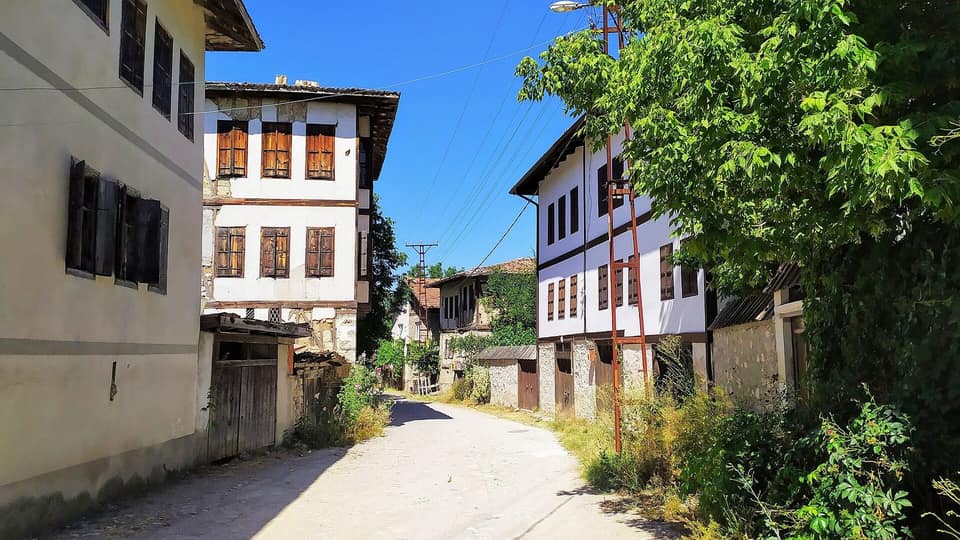
The clearest feature separating the village from Safranbolu is its street layout. The Kültür Portalı explains that the villagers, who had no problem with plots or rugged terrain, built their houses almost in terraced rows. Instead of the scattered clusters often seen in Anatolian villages, the houses line up along the main street. This terraced order continues in the regular streets that open from the square at the end of the main street.
One of the monumental houses of the village is the Sipahioğlu Visitor House. According to the Kültür Portalı, the house was built on two floors over a stone ground floor, like the other houses of the village. Its shareholders separated the harem and selamlık sections of the house and opened it for visits. The painted decorations in the rooms are the most striking feature of the house. The decorations use arrangements made of C and S scrolls, and the date 1294 in the Hijri calendar, that is 1877, can be read in the friezes and cartouches.
To tour the village it is enough to start walking along the main street and then wander into the side streets after the square. Whitewashed facades, wooden windows and stone ground floors follow one another along the street. The village is a living place; since people live in most of the houses, you should not enter courtyards and gardens without permission, and you should respect the privacy of residents when taking photographs. Check the opening days and entry conditions of the visitor house with local sources before you go.
Yörük Köyü can easily be visited as a half-day addition after seeing the Safranbolu Çarşı. After the crowded fabric of the Çarşı spread across the slopes, these streets lined up on flat ground show another, rural interpretation of the same building tradition. That is why the Kültür Portalı presents the village as a small model of Safranbolu. The provincial directorate also stresses that, with its historic houses and buildings, the village adds important variety to tourism in Safranbolu.
Comments
Loading...
Location - Yörük Köyü
Venue Info
AddressYörük Köyü, Safranbolu / Karabük
VenueSafranbolu, Karabük
TypeTourist Streets & Squares