

Historical & Cultural SitesArchaeological Sites
Xanthos (Ksanthos) Antik Kenti
13
No ratings yet
Sign in to like and rate
Xanthos (Ksanthos) Ancient City
About Venue
Xanthos (Ksanthos) Ancient City lies near the village of Kınık in the Kaş district, and its address is registered as Kınık Mahallesi. The former capital of ancient Lycia, it was regarded in antiquity as the region's great administrative centre. In inscriptions written in the Lycian language, the name of the city appears as Arnna. The city was founded on two hills that command the surrounding plain. Homer tells that the people of Xanthos under Sarpedon took part in the Trojan wars, yet excavation finds do not allow the settlement to be dated earlier than the 8th century BC. The history of Xanthos was shaped by sieges and periods of rebuilding. In 545-546 BC the Persian commander Harpagus besieged the city, and in 334 BC Alexander the Great took it. Having become the capital of the Lycian League in the 2nd century BC, the city was razed by the Roman Brutus in 42 BC and then rebuilt through the efforts of Marcus Antonius. In the 1st century AD an arch was built in the name of Vespasian, and most of the Roman structures seen today were put up in this period. The city continued to gain new buildings under Byzantine rule, but after the Arab raids following the 7th century it lost its importance and lived on in the guise of a small village. The site became widely known again when Charles Fellows discovered it in 1838, and Fellows carried some of the remains to London.
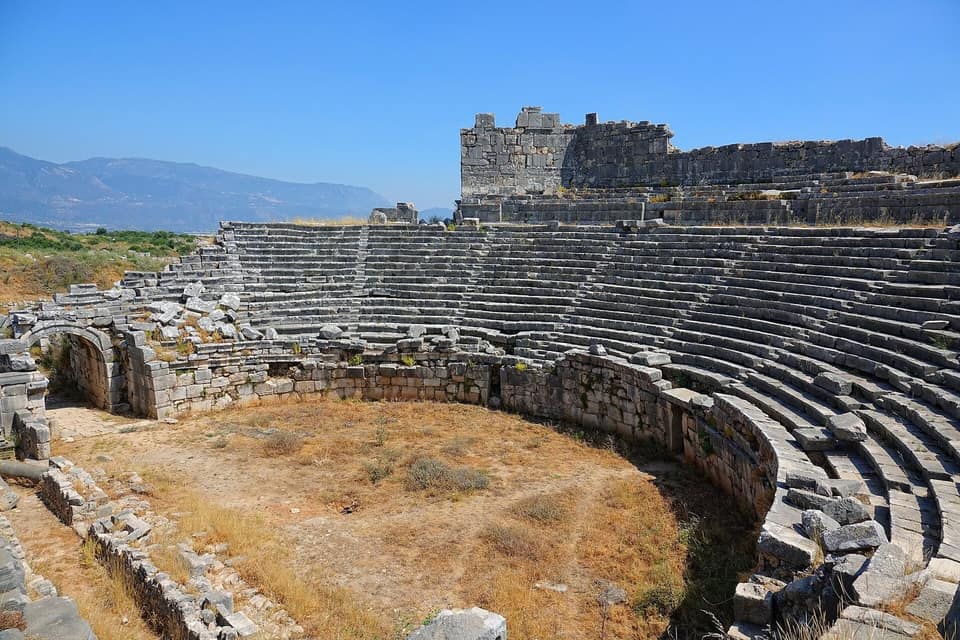
On a visit, the two separate acropoleis define the city: the Lycian Acropolis and the Roman Acropolis are both enclosed by walls in which different masonry systems can be seen. From the Roman-period theatre, to the north of the Lycian Acropolis, you can look out over the plain the city once commanded. The most interesting remains of Xanthos are gathered to the west of the theatre. One of them is the Harpy Tomb Monument, a tall rectangular monolithic pillar tomb decorated with reliefs; the harpy is depicted as a creature with a woman's body and the wings of a bird. Dated to the 5th century BC, the original reliefs of this monument are displayed today in the British Museum. Next to it stands another pillar-mounted Lycian sarcophagus from the 4th century BC. Adjoining the theatre lies the Roman-period agora, enclosed by shops on three sides. In the northeast corner of the agora rises another monumental tomb of the 5th century BC that closely resembles the Harpy Monument. The inscription on its shaft is written in both Lycian and Greek and tells the adventures of a Xanthian prince named Kherei. Many rock tombs and pillar tombs can be seen side by side on the Roman Acropolis. The Lion Tomb, the Payava Sarcophagus and the Merehi Sarcophagus on the southern slopes of this area are all displayed in the British Museum, apart from their bases. At the right edge of the ramp leading up into the site, only the foundations remain of the Nereid Monument, a temple-plan structure of the 4th century BC.
The neighbouring site of Letoon lies about 4 kilometres away, and because of their shared importance Xanthos was added to the UNESCO World Heritage List together with Letoon in 1988. Kaş-Fethiye buses can be used to reach the site. For visiting hours and entry conditions, check the current information on muze.gov.tr and the pages of the Antalya Provincial Directorate of Culture and Tourism. Comfortable shoes will serve you well at this open-air site. Mornings and late afternoons, when the light falls from the side, suit photographs of the theatre and the agora.
Comments
Loading...
Location - Xanthos (Ksanthos) Antik Kenti
Venue Info
AddressXanthos Antik Kenti, Kınık Mahallesi, Kaş / Antalya
VenueKaş, Antalya
TypeHistorical & Cultural Sites