

Historical & Cultural SitesMuseums
Van Kedisi Evi
10
No ratings yet
Sign in to like and rate
Van Cat House
Van Yüzüncü Yıl Üniversitesi Van Kedisi Araştırma Merkezi, Zeve Kampüsü, Tuşba / Van
Tuşba, Van
Get DirectionsApple MapsAbout Venue
The Van Cat House is the part of the Van Cat Research Center of Van Yüzüncü Yıl University that is open to visitors. The center is located on the Zeve Campus, about 13 kilometres from the city centre, in the district of Tuşba. It is a place where Van cats are studied, where the characteristics of the breed are being preserved and where original Van cats live together.
The center clearly describes itself not as a cat shelter but as a research unit. For this reason, cats in need of care are not taken in from outside, and no Van cats are brought in from elsewhere either. In this way the breed characteristics of the cats inside can be followed without being mixed. For the visitor, this means it is the most reliable place to see the breed itself.
Among local people the Van cat is called "pişik". In Van this cat is seen not only as an ornament or a mouse hunter but as a friend and a member of the family. It is said that in the past the cats spent the summer in the mountains and returned home in winter. According to the center, a Van cat that spends the summer hunting on the slopes of Erek Dağı and returns home for the winter is now very rarely seen.
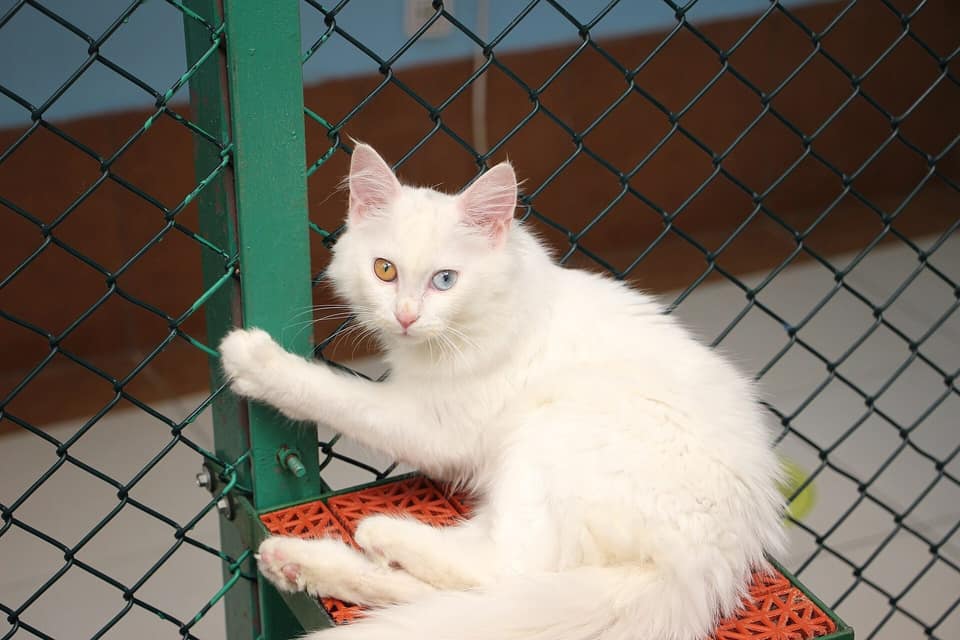
When you enter the center, the first thing to catch your attention will be the cats' eye colours. Van cats are divided into three groups by eye colour: those with two blue eyes, those with two amber eyes, and the odd-eyed cats with one blue and one amber eye. While the blue eye is always a shade of turquoise, the amber eye can range in tone from yellow to almond green. Trying to find all three groups as you walk between the enclosures is an enjoyable part of the visit.
When looking at the kittens, search for another detail. The eyes of newborn Van kittens are greyish, and their colour starts to become distinct a few weeks after birth. Many kittens have one or two black spots between their ears; the center notes that these spots are common in odd-eyed cats. As the kittens grow, the spots disappear or remain as a few black hairs among the white fur.
The Van cat was registered as a national breed, with all of its characteristics recorded, by a communiqué published in the Official Gazette dated 22 April 2006. According to the registration document, the breed's area of distribution is the Lake Van basin and the purpose of breeding is to preserve its purity. The document defines one variety whose body is entirely white and a second variety with reddish-yellow patches on the head, back and tail. The ears, nose and mouth are pink, and so are the paw pads.
The registration document also describes the cats' behaviour. Van cats like living with people in a family setting, are lively and enjoy playing. They can swim and like playing with water; this is the best-known trait that sets the breed apart from other cats. They have been observed testing the temperature of their food with their paws before starting to eat. It is also recorded that there is rivalry among the males which lasts until an order is established between them.
Another subject the center emphasises is the future of the breed. According to the center, these cats, which were once found in almost every house in Van, are decreasing in number and rapidly becoming crossbred. The very reason for the research center's existence is to document and protect this line. Every cat the visitor sees here is part of that work.
According to the center's announcements, visitors can feed the cats, go in among them, groom them and stroke them. Avoiding sudden movements as you approach the cats and not forcing them into your arms is good for both your comfort and theirs. Turning off the flash when taking photographs is the easiest way not to startle the cats. Since the visit takes place both indoors and outdoors, wear comfortable shoes.
Group visits on behalf of institutions and schools require an appointment arranged in advance with the center. Although the center's website states that it is open to visitors including on holidays, confirm the current visiting arrangements with the center before you go. The center has announced that it rehomes surplus kittens under certain conditions. Since the conditions and periods for rehoming can change, up-to-date information on this should be obtained directly from the center.
The center can be reached by the campus minibuses and city buses that leave from the city centre. After the visit it is easy to plan a visit to Van Fortress or the shore of Lake Erçek on the same day. The Van cat is the best-known living symbol of the city, and this visit is a warm way to get to know Van.
Comments
Loading...
Location - Van Kedisi Evi
Venue Info
AddressVan Yüzüncü Yıl Üniversitesi Van Kedisi Araştırma Merkezi, Zeve Kampüsü, Tuşba / Van
VenueTuşba, Van
TypeHistorical & Cultural Sites