

Historical & Cultural SitesCastles & Palaces
Van Kalesi ve Eski Van Şehri
42
No ratings yet
Sign in to like and rate
Van Castle and the Old City of Van
About Venue
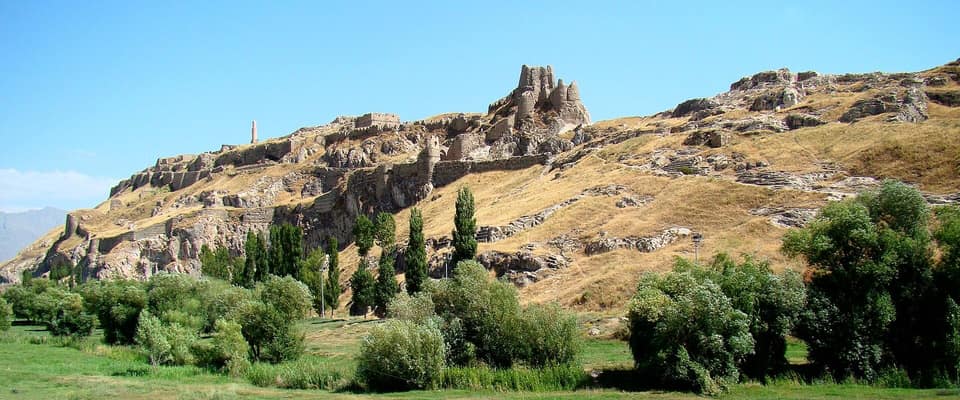
Van Fortress stands just east of the shore of Lake Van, on a long, steep rock that rises abruptly from the middle of the plain. The Van Provincial Directorate of Culture and Tourism states that Van Fortress, together with the mound to its north and the Old City of Van to its south, covers an area of about 97 hectares. For this reason the site is visited less as a single building than as a broad archaeological area made up of the rock, the mound and the fabric of an abandoned city.
The rock itself is made of conglomerate, a hard, pebbly stone. The provincial directorate gives its dimensions as roughly 1,345 metres long, 200 metres wide and 100 metres high. Other sources give slightly different figures; the TDV Encyclopedia of Islam, for example, notes that the fortress rises 80 metres above lake level and runs 1,200 metres from east to west.
The rock is the citadel of Tushpa, capital of the Kingdom of Urartu, which was organised as a state centred on Eastern Anatolia in the 9th century BC. The provincial directorate notes that Urartian rule in the region lasted about 250 years. The TDV Encyclopedia of Islam writes that the capital of Sardur I, the founder of the Urartian state, was Tushpa, today's Van Fortress. According to the same source, most of the Urartian building work at the fortress was completed under King Ishpuini and King Sardur II.
On the citadel, the traces of the Urartian period are carved into the bedrock itself. Platforms levelled by cutting the rock, the building foundations on those platforms and the bedding trenches of the walls are still easy to make out today. The provincial directorate notes that the citadel holds rock-cut tombs, royal annals carved on the bedrock, inscribed stelae and building inscriptions. The TDV Encyclopedia of Islam also records that the foundation inscriptions on the stone blocks of the Sardur Tower, south of the fortress, are the earliest known written sources of Urartian history. These lines in cuneiform are among the most important documents for understanding the Urartian language and the history of the kingdom.
The fortress remained in use for centuries after the Urartians. According to the TDV Encyclopedia of Islam, the inner citadel was repaired in 1548 under Suleiman the Magnificent and took on the character of an Ottoman fortress. In the Ottoman period Van was an important frontier fortress and the seat of a beylerbeyi, a provincial governor. The same source describes the east, west and north sides of the inner citadel as ringed by walls and towers reaching 30 metres in places, while the south face overlooking the city was a rock too sheer to climb.
The Old City of Van lies on the flat ground south of the rock. The provincial directorate states that an urban fabric some 800 years old can be traced here. The TDV Encyclopedia of Islam writes that the city began to take shape under the Seljuks and completed its growth in the Ottoman period between the 16th and 19th centuries. The outer walls that ringed the city had gates known as the Tabriz Gate, the Middle Gate, the Uğrun Gate and the Yalı or Pier Gate. The old city was abandoned at the beginning of the 20th century, and today's Van was rebuilt about 7 kilometres inland from the shore.
The remains of mosques, inns, baths, granaries and cisterns from the old city have survived to the present day. The best known is the Hüsrev Pasha Complex, which according to the TDV Encyclopedia of Islam is a work of the architect Sinan and, according to its inscription, was built in 1567-1568. The same source notes that the complex's mosque was restored through excavation and repair work between 1996 and 2007.
North of the rock lies the Van Fortress Mound, which runs in the same direction as the citadel. The provincial directorate notes that traces of a settlement culture about five thousand years old can be seen on the mound. According to an excavation report published in Colloquium Anatolicum, work on the mound resumed in 2010 and from 2012 took the name Excavations at the Old City, Fortress and Mound of Van. The same report records that in 2012 work was carried out on the mound, in the old city, at the old palace area on the upper citadel, at the Minua Fountain and around the Horhor Fountain. The report also notes that the mound had earlier been excavated in 1991 under Prof. Dr. Taner Tarhan.
The site is reached from the west of today's city centre, along the road that runs down towards the lake. The Van Fortress archaeological site is a unit of the Van Museum Directorate and appears in the provincial directorate's table among the places that can be entered with a Müzekart. Check the visiting hours and current entry conditions on the provincial directorate of culture and tourism's page before you go. The path up the rock is steep and stony, so shoes that grip and support the ankle are a good idea.
A sensible order is to start at the foot of the rock, climb first between the walls and the rock platforms, and then look down from the top over the flat ground of the old city to the south. Lake Van stretches blue to the west, and the modern city spreads out to the east. There is no shade on the rock at midday in summer, so do not forget to bring water and a hat.
In the provincial directorate's list of protected areas, Van Fortress and its surroundings are described as both an archaeological site and, together with the surrounding reed beds, a natural site. For this reason you should not touch the inscriptions, the rock surfaces or the excavation areas, and you should not stray from the marked paths. The rock of Tushpa is one of the rare places that shows an Urartian capital, an Ottoman frontier fortress and an abandoned city in a single view.
Comments
Loading...
Location - Van Kalesi ve Eski Van Şehri
Venue Info