

Historical & Cultural SitesArchaeological Sites
Tyana Antik Kenti
10
No ratings yet
Sign in to like and rate
The Ancient City of Tyana
About Venue
The ancient city of Tyana is an old Cappadocian city in the small town of Kemerhisar in the Bor district, most of which lies beneath the present-day settlement. The provincial culture and tourism directorate writes that the ruins extend under a large part of the town and that important sculpture and architectural pieces have come to light in various parts of it. The TDV Encyclopedia of Islam notes that this city, the oldest settlement near Niğde, lies 23 kilometres south of Niğde. According to the tourism master plan, Kemerhisar is 7 kilometres from the centre of the Bor district. The same plan notes that Tyana has been a place of settlement since the Neolithic Age and became an important trading centre from the Hittites onwards. The plan counts some fifteen states, from the Hattians to the Ottomans, that ruled these lands.
From the Hittites to Rome
According to the provincial directorate, the city was known as Tuwanuwa in the Hittite period and as Tyana in the Roman period. Tuwanuwa was one of the capitals of the Late Hittite period, and the famous king Warpalawa ruled here between 738 and 715 BC. In the Roman period, covering 30 BC to AD 395, the city went through the most important phase of its history with intensive building. It became a large city with palaces, temples, aqueducts and residential quarters, and during this period it twice served as the capital of the Kingdom of Southern Cappadocia. The tourism master plan relates that after Emperor Caracalla and his mother Julia Domna stayed in the city, Tyana was raised to the status of a Roman colony. The same plan records that the philosopher Apollonius of Tyana was born in the city and that it became the capital of Lesser Cappadocia in 371. According to the plan, the city changed hands frequently between Byzantium and the Arabs from the 700s onwards, and after it was burned and destroyed in 835 it never regained its former strength.
The Middle Ages and a change of name
According to the TDV entry, Arab geographers referred to the city as Tavana. Tyana briefly passed to the Muslims in 707, and the region changed hands between the Umayyads and Byzantium for a long time. TDV writes that the Abbasid caliph Harun al-Rashid finally brought the region into Islamic lands in 806, and that Niğde, rebuilt in 832, gradually grew and took the place of Tyana, which declined. According to the tourism master plan, the settlement was known as Kilisehisar in the Turkish period, and in the 1910s its name was changed to Kemerhisar because of the aqueducts.
The aqueducts
The most striking remains of the city today are the aqueducts that carried spring water from the Roman Pool at Bahçeli to the city. The provincial directorate's page on archaeological sites dates the aqueducts to the 2nd century AD, to the reigns of Trajan and Hadrian, while the directorate's Tyana brochure gives the 2nd and 3rd centuries AD. According to the tourism master plan, the aqueducts are about 3 kilometres long, of which a stretch of 1.5 kilometres is exposed. According to the brochure, the section from the Roman Pool to the inner parts of Kemerhisar lies underground, while the rest can be followed above ground as far as the excavation area. The road that passes between the arches is the first sign that you are approaching the edge of the ancient city.
Excavations and protection
According to the tourism master plan, the first archaeological excavations at Tyana were carried out in 1986-1988 by a team led by Prof. Dr. Aykut Çınaroğlu. The provincial directorate states that since 2000 a team from the University of Padua in Italy, led by Prof. Dr. Guido Rosada, has been conducting scientific excavations. The tourism master plan records that the work of this team, made up of academics from the University of Padua and Ca' Foscari University of Venice, actually began on 18 July 2001. The site is protected as a first-, second- and third-degree archaeological conservation area. The master plan points out that some of the archaeological structures stand above ground, while a significant part remains underground.
How to visit
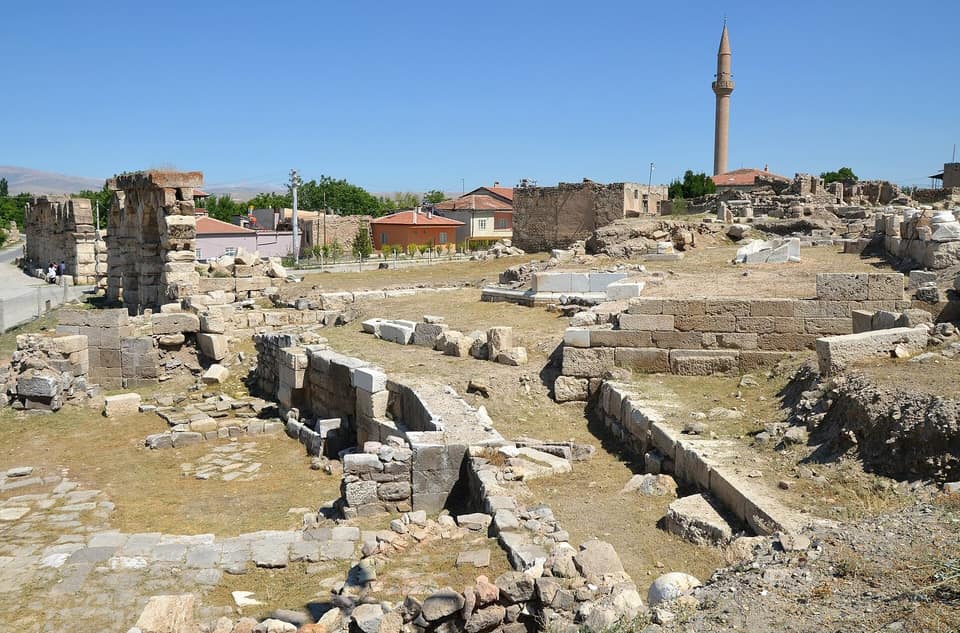
A visit can begin with the aqueducts and end at the excavation area inside the town. In the excavation area, cut-stone walls, foundations and traces of paving lie in the open, with the houses of the town visible behind them. As the remains are within an excavation and conservation area, stay within the marked boundaries and do not step on the stones. There is little shade, so in summer the early morning hours make for a more comfortable visit. Kemerhisar is well suited to being visited on the same day as the Roman Pool in the town of Bahçeli to the north. For current visiting conditions, check the announcements of the provincial culture and tourism directorate.
Comments
Loading...
Location - Tyana Antik Kenti
Venue Info
AddressKemerhisar, Bor/Niğde
VenueBor, Niğde
TypeHistorical & Cultural Sites