

Historical & Cultural SitesArchaeological Sites
Thyateira Antik Kenti ve Akhisar Müzesi
7
No ratings yet
Sign in to like and rate
The Ancient City of Thyatira and the Akhisar Museum
About Venue
Thyateira is the ancient name of Akhisar, and part of the city's remains can be seen today at the Tepe Mezarı site in the district centre. Akhisar Municipality writes that the city was one of the most important settlements of the Lydian state and the Kingdom of Pergamon, and was known by this name until the Byzantine period. According to the TDV Encyclopaedia of Islam, Akhisar was founded on a fertile plain watered by the Kumçayı, a tributary of the Gediz, at 115 metres above sea level. The same source states that the city's first name was Pelopeia and that it took the name Thyateira when it was settled with Macedonian soldiers in the Seleucid period. In the 14th century the town began to be called Akhisar because of its castle on a hill.
Thyateira was also the scene of a battle in the Roman period. The Manisa Provincial Directorate of Culture and Tourism relates that in AD 366 Procopius, who had rebelled for the Roman throne, and the troops loyal to Emperor Valens met in this city. The clash, remembered as the Battle of Thyatira, was won by the forces of Valens, and Procopius was captured.
According to the municipality's excavation project page, the city's remains are concentrated in two areas called Tepe Mezarlığı and Hastane Höyüğü. Tepe Mezarlığı is in Ragıpbey neighbourhood and Hastane Höyüğü in Kethüda neighbourhood, and the ground between the two is considered the centre of the ancient city. Tepe Mezarlığı, arranged as an archaeological site, covers an area of about 70 metres in each direction. The first excavation here was carried out in 1962 under Yusuf Boysal, but its results were never published.
Between 1968 and 1971 the archaeologist Rüstem Duyuran continued the excavations and uncovered remains from the Roman and Byzantine periods. Duyuran called a building running north to south, which he dated between the 2nd and 6th centuries AD, a basilica. The inner side of the northern end of this rectangular building, whose walls reach 4 to 5 metres in height, ends in a rounded apse. The building is about 10 metres wide, its preserved length is 43 metres, and to the south it continues under today's road and buildings. Fragments of mosaic, fresco and pottery and Roman coins were found in the excavations. Duyuran stated that the building had a timber roof and burned completely in a fire that broke out after it collapsed.
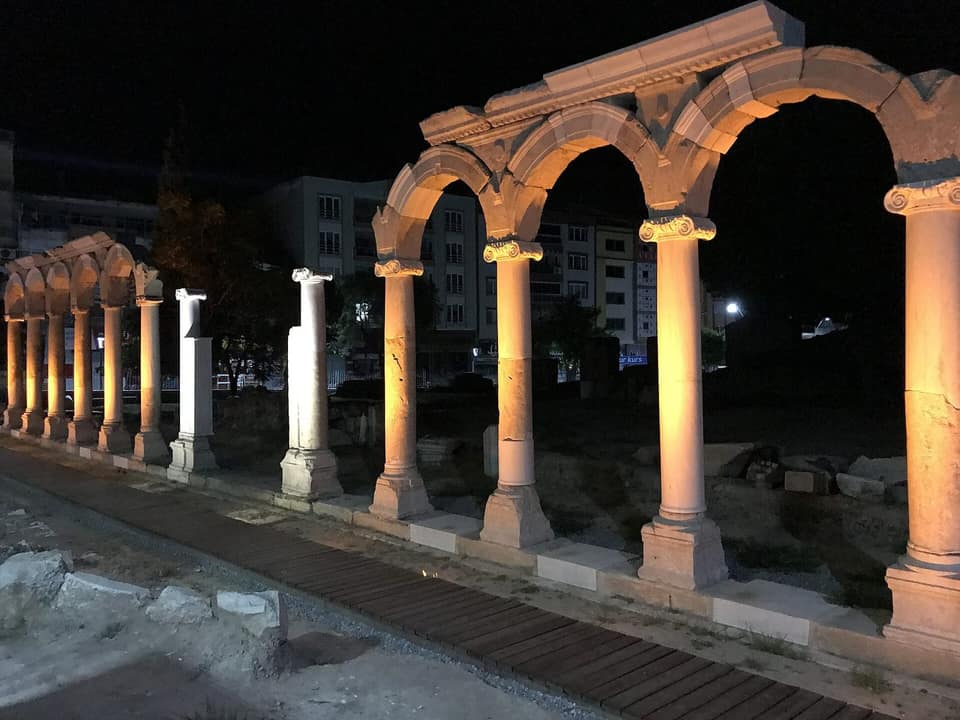
The most striking remain on the site today is the colonnaded Roman street dated between the 2nd and 4th centuries AD. According to the municipality's page, when combined with soundings made to the north, the street was found to reach a length of about 100 metres. The column bases and capitals found in place along the colonnaded street and portico date to the 2nd century AD. Most of the coins found in the burnt layer, however, belong to the 4th century, and some to the reign of Emperor Arcadius.
After 2011 new excavations began on the site under Prof. Dr. Engin Akdeniz. The Department of Archaeology of Dokuz Eylül University writes that these excavations were carried out between 2011 and 2021 with the permission of the Ministry of Culture and Tourism, on behalf of Aydın Adnan Menderes University and Dokuz Eylül University. The team's publications also cover finds at Hastane Höyüğü reaching back to the Late Bronze Age, as well as Lydian pottery. The municipality states that during this work the lighting system of Tepe Mezarlığı was repaired and the surroundings were landscaped.
Tepe Mezarlığı is an archaeological site to be visited together with the Akhisar Museum. According to the provincial directorate, the museum building was built in 1933 as a hospital in the name of Ali Şefik Bey and was later used as a school and a teachers' guesthouse. Work to convert the building into a museum began in 2007, and it opened to visitors on 18 May 2012. The museum, which is attached to the Manisa Museum, holds a total of 689 objects. The provincial directorate states that the Akhisar Museum and Tepe Mezarlığı can be visited with a single ticket.
Because the remains stand in the middle of a town, the site is easy to read even when seen from the street. When the row of columns is lit in the evening it creates a strong contrast with the surrounding buildings, and this is the most impressive hour for photographs. Following the city's long history in the museum first and then walking to the colonnaded street makes it easier to place the stones you see in context. Akhisar is easily reached by road from İzmir and Manisa, and because the site is in the district centre it can be explored on foot. For visiting days and hours, check current information on the page of the Manisa Provincial Directorate of Culture and Tourism.
Comments
Loading...
Location - Thyateira Antik Kenti ve Akhisar Müzesi
Venue Info
AddressTepe Mezarı mevkii, Ragıpbey Mahallesi, Akhisar / Manisa
VenueAkhisar, Manisa
TypeHistorical & Cultural Sites