

Historical & Cultural SitesHistorical Sites
Taşhan (Hekim Hanı)
6
No ratings yet
Sign in to like and rate
Taşhan (also known as Hekim Hanı)
About Venue
Taşhan is a Seljuk-period caravanserai standing in the centre of Hekimhan, a district in the northwest of Malatya province. The Provincial Directorate of Culture and Tourism notes that the building lies about 80 kilometres from Malatya city centre, right in the middle of Hekimhan. The TDV Encyclopedia of Islam describes it as a han built on the road between Malatya and Sivas. Known locally as Taşhan, the building also gave its name to the present-day district.
The name of the han comes from the profession of the man who built it. According to the inscriptions, its founder was the Malatya physician Ebu Salim bin Ebu'l Hasan. The Provincial Directorate of Culture and Tourism presents him as one of the famous doctors of his time. The history page of Hekimhan Municipality also explains that the building came to be called "Han-ı Hekim", the physician's han, and that the district's name derives from it.
Three separate inscriptions give the history of the building, and they make the han unusual in Anatolia. The first inscription sits above the entrance and repeats the same text in three languages, Arabic, Armenian and Syriac. The second inscription is in Arabic only and refers to the construction of the courtyard section. The third records a major repair carried out in the Ottoman period. The municipality's presentation notes that on the trilingual inscription the left edge is written in Armenian, the centre in Arabic and the right edge in Syriac, and that the texts confirm one another.
The date drawn from the inscriptions is 1218. The Provincial Directorate of Culture and Tourism writes that the building was erected in that year, in the reign of İzzeddin Keykavus I. The TDV Encyclopedia of Islam states instead that construction began in the year 615 of the Hijri calendar, that is 1218, and was completed in the reign of Alaeddin Keykubad I. The ministry page also says that the second Arabic inscription refers to the courtyard section added under Alaeddin Keykubad. Read together, the two sources suggest that the covered hall was begun in 1218 and the courtyard was added under the following sultan.
The Ottoman repair is dated to the Hijri year 1071. The TDV Encyclopedia of Islam converts this to September 1660 and names the architect of the repair as Hasan Ağa. The Provincial Directorate of Culture and Tourism links the same inscription to September 1661 and to the reign of Mehmed IV. Hekimhan Municipality's presentation associates the work of this period with the grand vizierate of Köprülü Mehmed Paşa. The small difference between the sources comes from converting the Hijri calendar to the Gregorian year.
The plan follows the usual layout of the Seljuk sultan hans. A wide courtyard lies at the front, with a large three-aisled covered hall behind it. The TDV Encyclopedia of Islam gives the courtyard as roughly 29 by 30 metres and the covered hall as 19 by 29 metres. Pointed-vaulted iwans of different sizes line the courtyard, and the corner spaces take the form of rooms. The ministry page notes that the corner rooms on either side of the entrance are square in plan and that each room has a hearth.
The covered hall is roofed with pointed vaults carried on ten cut-stone piers set in two rows. The central aisle is about 7.10 metres wide, and corbel projections on which the arches rest can be seen on the upper part of the piers. Light enters through three tall slit windows opening into the aisles from the back wall. The square buttresses supporting the west wall from outside are attributed to the Ottoman repair. The gargoyles that throw rainwater off the side walls also catch the eye.
The stonework makes it easier to read the different periods of the building. The TDV Encyclopedia of Islam records regular cut-stone masonry from the 17th-century repair on the west and back walls of the covered hall. On the outer face of the east wall, by contrast, large and more roughly dressed blocks can be seen. The same source notes various masons' marks on the walls of the covered hall. The encyclopedia adds that written sources mention a prayer room, a bath and a fountain among the parts of the han.
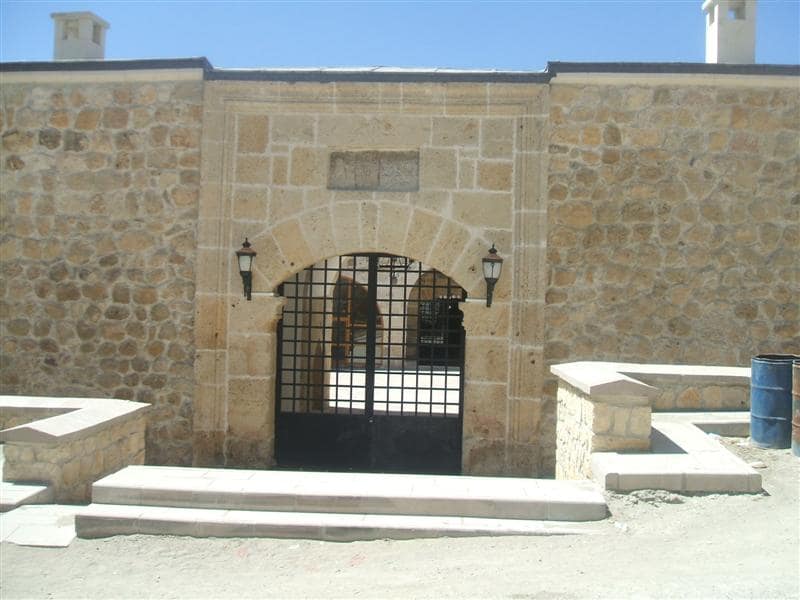
The building has been restored in recent times. The Provincial Directorate of Culture and Tourism reports that the han was restored by the Regional Directorate of Foundations between 2006 and 2009. Today the cut-stone facade, the arched entrance and the inscription niche above the doorway are clearly visible. The first place visitors should look is this arched gate and the inscription panel above it.
When you walk through the han, stop first in the courtyard to take in the row of iwans, then pass through the central iwan into the covered hall. In the covered hall, the three aisles formed by the rows of piers and the light filtering through the slit windows are a good way to grasp the scale of the space. Looking for masons' marks on the walls is a pastime of its own for those used to reading buildings. Because the use of the interior and its opening days can change, check the visiting conditions on the official page before you go.
Hekimhan is reached from Malatya by road, and since the building is in the district centre it is easy to find. Expect a drive of about 80 kilometres from the city centre, so Taşhan works well as the first stop of a half-day trip. The Ministry of Culture and Tourism's promotional site also mentions it as a han in the centre of Hekimhan, built in two sections. On the way back towards Malatya, Hekimhan can be combined in a single day with stops such as Arslantepe and the Malatya Museum.
Comments
Loading...
Location - Taşhan (Hekim Hanı)
Venue Info
AddressHekimhan ilçe merkezi, Malatya
VenueHekimhan, Malatya
TypeHistorical & Cultural Sites