

Historical & Cultural SitesArchaeological Sites
Smintheion Ören Yeri (Gülpınar)
12
No ratings yet
Sign in to like and rate
Smintheion Archaeological Site (Gülpınar)
About Venue
Smintheion is an archaeological site in Gülpınar, in the Ayvacık district of Çanakkale, holding the remains of an ancient sanctuary founded in the name of Apollo Smintheus. The site lies at the south-western corner of the Biga Peninsula, on the Aegean-facing coastal part of the Troad region. The excavation page of Ondokuz Mayıs University presents it as the second most important sanctuary of the Troad after the temple of Athena at Troy. The Çanakkale Provincial Directorate of Culture and Tourism also writes that the site was used by the city of Alexandria Troas in antiquity. Building remains from the Hellenistic and Roman periods can be seen here together with traces of a settlement going back to the Chalcolithic Age.
The name of the site comes from Apollo's epithet Smintheus. According to the excavation team, this epithet is associated with the mouse, and this is the only example among the known sanctuaries of Apollo in Anatolia to be linked with a mouse symbol. Mentioned in Homer's Iliad, the place is located in ancient geography near the town of Chryse. For this reason the temple is sometimes referred to in scholarly publications as the temple of Apollo Smintheus at Chryse.
At the centre of the site stands the Temple of Apollo Smintheus, built in the Ionic order in the 2nd century BC. Ondokuz Mayıs University dates the temple to around 150 BC. The most important feature that sets the temple apart from its peers is its relief friezes, which take their subject from the Trojan War described in the Iliad. With its friezes decorated with scenes from the Iliad, the temple is unique of its kind and is counted among the original works of Hellenistic western Anatolian architecture. One of the friezes shows the arrival of the Achaeans at Achilles' tent and the lament for Patroclus. The temple's figured column drums were also the subject of a preliminary report published in 1980 in Belleten, the journal of the Turkish Historical Society.
The temple's introduction to the scholarly world goes back to the 19th century. According to the preliminary report in Belleten, the building was first excavated in 1866 by Pullan on behalf of the Society of Dilettanti. Exactly a hundred years later, in 1966, H. Weber brought the temple back to scholarly attention. Systematic excavations began in 1980 under the direction of Prof. Dr. Coşkun Özgünel. These excavations uncovered, besides the temple, many structures connected with the sanctuary such as a bath, residences and the sacred way. The current director of the excavations is Assoc. Prof. Dr. David Kaplan, and the work is carried out by the Department of Archaeology of Ondokuz Mayıs University.
The temple's building stone has also drawn researchers' interest. A study by researchers from Middle East Technical University and Madrid examined how the tuff used in the temple was brought from ancient quarries in the area. According to the study, the stone of two of the three quarries examined shows properties similar to the tuff in the temple, and these quarries are considered possible sources for the building. In the Hellenistic period tuff was a frequently chosen building stone because it was easy to extract and transport.
The Great Roman Bath on the site is one of the important parts of the excavations. In the 2008 work, ceramics from the later phase after the building had lost its original function were found in the hot and warm rooms of the bath. Academic publications show that the Hellenistic and Roman buildings were reused again and again in Late Antiquity and dismantled as material for new buildings. In this period the site changed from a sanctuary into an ordinary settlement. The provincial directorate notes that the site also stands out for its water structures.
It would be incomplete to see Smintheion only as a place of the classical age. The excavations also found the remains of a prehistoric settlement dated to the 5th millennium BC. This Middle Chalcolithic period is one of the least known phases of western Anatolian prehistory. The same period coincides with a time when many Aegean islands were settled for the first time and trade between western Anatolia and the Aegean world increased.
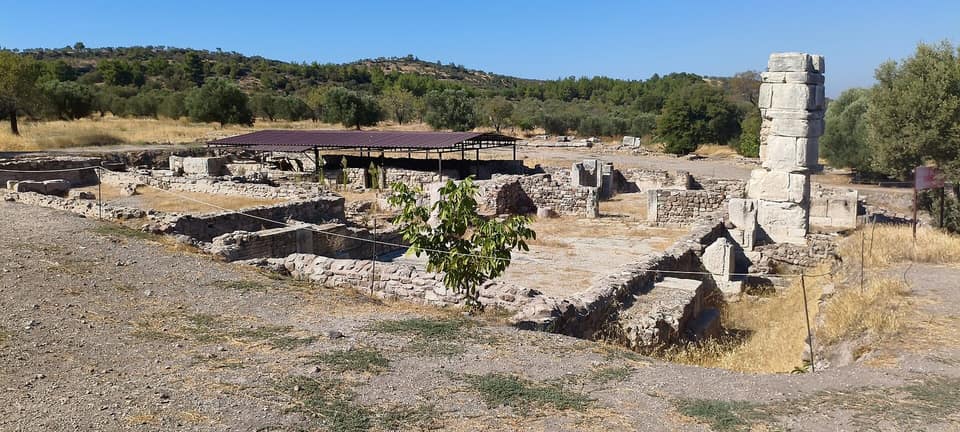
A museum displaying the temple friezes has been opened to visitors in the area where the excavations continue. Although the temple's restoration work is still going on, part of its architecture has been re-erected. Starting the walk at the temple area and going around the path that encircles the protected remains makes it easier to read the layout of the site. The single standing column fragment and the roofs protecting the excavation area are easy to pick out from a distance. You should not go beyond the ropes and warning signs at the edges of the excavation trenches.
The provincial directorate states that the site is not open in every season and that visits can depend on the excavation season. For this reason, check the current visiting information of the Ministry of Culture and Tourism before you go. Gülpınar is reached by road via Ayvacık, and coming by car is the most practical option. Since Assos, Babakale and Alexandria Troas lie on the same route, Smintheion is one of the natural stops of a day trip around the ancient cities of the Troad.
Comments
Loading...
Location - Smintheion Ören Yeri (Gülpınar)
Venue Info
AddressGülpınar, Ayvacık / Çanakkale
VenueAyvacık / Çanakkale, Çanakkale
TypeHistorical & Cultural Sites