

Historical & Cultural SitesMuseums
Sinop Arkeoloji Müzesi
12
No ratings yet
Sign in to like and rate
Sinop Archaeological Museum
About Venue
Sinop Archaeological Museum, officially the Sinop Museum, is the main museum presenting the history of the town and its surroundings from the Bronze Age to the Ottoman period. The Museums of Türkiye page writes that museum work in Sinop began in 1921, one of the earliest such efforts in the country. The objects were first kept at the Mekteb-i Idadi school, and together with finds from various parts of the town they were gathered in the Pervane Medrese in 1932 to form the core of a museum. The museum opened to visitors in 1941, became an office in 1945 and a directorate in 1947, and moved to its present building, constructed in 1970.
The collection rests largely on excavations carried out around the province. An article published in Belleten records that the first archaeological excavation in Sinop was carried out in the town centre between 1951 and 1953 by E. Akurgal, A. Erzen and L. Budde. Within the same project, A. Erzen also carried out a short excavation at Kocagöz Höyük in the village of Demirci, southwest of Sinop. According to the article, before this, in the early 1950s, A. Gökoğlu, then director of the Kastamonu Museum, had carried out a surface survey in the central district and in Ayancık, Boyabat and Gerze. In 1955 C. Burney took an interest in Kocagöz Höyük, and in 1970 J. A. Dengate ran a surface survey focused on Iron Age sites. In 1977 P. Donceel-Voute examined in detail the stretch of the Gökırmak Valley between Boyabat and Durağan. According to the museum page, the prehistoric section on the ground floor displays Bronze Age finds from the Kocagöz Höyük excavation dated between 3000 and 2700 BC. They include terracotta vases, bowls, cups, jugs, handled bowls, spindle whorls, bone tools, polished stone axes, and bronze needles and spearheads.
Between the gallery and the first hall are coins of the Hellenistic, Roman, Byzantine, Seljuk and Ottoman periods. At the end of this section are amphorae recovered from the Black Sea, which the museum presents as pieces that give the collection a special character. The classical section is arranged as a chronological sequence from the Hittite and Phrygian periods through the Archaic, Classical, Hellenistic, Roman and Byzantine periods. Here you see terracotta jugs, painted vessels, small grave finds, gold and bronze jewellery, glass objects and examples of Hellenistic and Roman sculpture. The same hall also displays finds from the Serapis temple, a cylinder seal, jewellery such as gold earrings and rings, and hoards of coins from the Seljuk and Ottoman periods. The ethnographic section shows clothing, handwork and woven textiles of the Sinop region, as well as weapons, writing sets and kitchen utensils. On the upper floor are Kula and Gördes carpets of the 17th and 18th centuries, manuscripts, examples of calligraphy and book covers. The same floor also holds a collection of icons in the Byzantine artistic style, made with generous use of gilding.
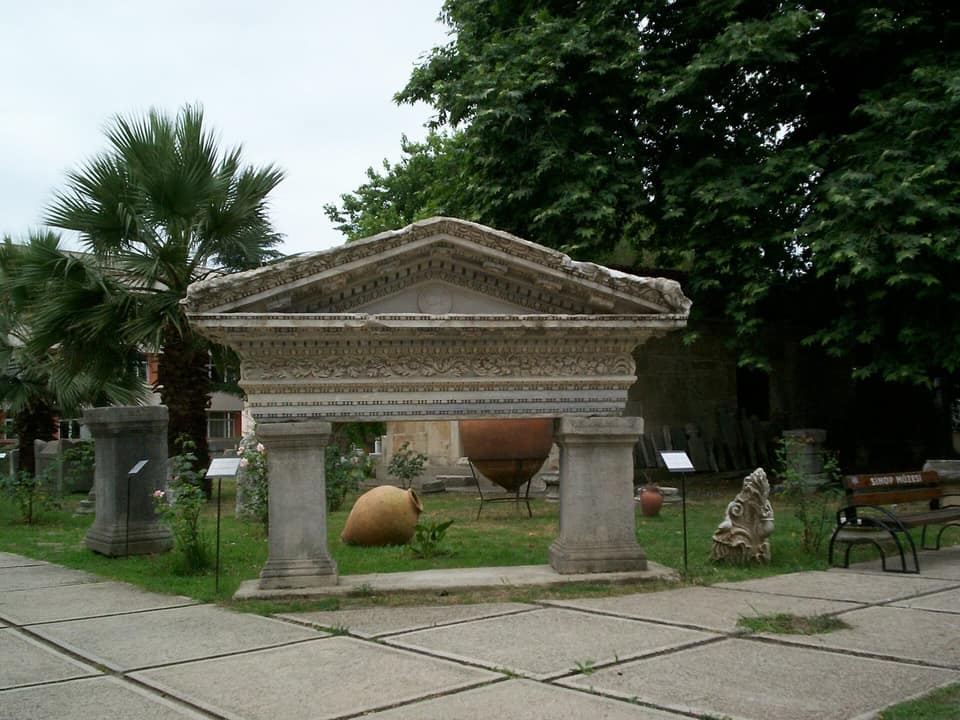
The museum garden is as interesting as the building itself. In the porticoes and the garden, architectural pieces, stelae, sarcophagi, altars, milestones and lion statues from the Archaic to the Ottoman period stand in the open air. Many old gravestones are also on open display and give the garden a further depth. The garden also holds the remains of the Serapis temple uncovered in place during the 1951 excavation. The provincial inventory describes it as a rectangular temple measuring 8.60 by 15 metres with an altar on its south side, possibly built in the 4th century BC. The museum page notes that figures of Serapis, Dionysus, Heracles, Isis and Kore were found in the excavation, and that an inscription suggests the temple belonged to Serapis. In the southwest corner of the garden stands the five tiered Naval Martyrs Monument, built for the sailors who died in the Sinop raid of 1853 and, according to the inventory, completed in 1933.
Starting with the prehistoric finds on the ground floor and following the halls in chronological order is the clearest way to read the town's story across thousands of years. Pause for a while in front of the amphorae, because they tell the story of Sinop's ancient sea trade better than anything else. After the indoor halls, set aside time to walk around the stone pieces and the foundations of the Serapis temple in the garden. The museum is run by the Ministry of Culture and Tourism, the MüzeKart is valid for Turkish citizens, and according to the provincial directorate museums are closed to visitors on Mondays. Check current visiting hours on muze.gov.tr. The museum is in the town centre on Okullar Street, within walking distance of the Pervane Medrese and Sinop Fortress.
Comments
Loading...
Location - Sinop Arkeoloji Müzesi
Venue Info
Addressİnce Dayı Mahallesi, Okullar Caddesi No:2, Sinop
VenueSinop Merkez, Sinop
TypeHistorical & Cultural Sites