

Historical & Cultural SitesHistorical Sites
Şifaiye Medresesi
12
No ratings yet
Sign in to like and rate
The Şifaiye Madrasa
About Venue
The Şifaiye Medresesi, also known as the Hospital of İzzeddin Keykavus, is a Seljuk building on the historic city square of Sivas, directly opposite the Çifte Minareli Medrese. The Culture Portal writes that, according to its inscription, the building was commissioned as a hospital in 1217 by the Seljuk sultan İzzeddin Keykavus I. The TDV Encyclopedia of Islam gives the same date from the single line inscription on the portal. The Culture Portal presents the building as the largest of the Seljuk hospitals in Anatolia. The municipality's route page notes that, as its inscriptions suggest, the building also served as a hospital for eye diseases.
According to the TDV, its surviving endowment deed shows that the building also worked as a medical school. The same source writes that the endowments of the hospital included seventy shops in Sivas, thirty shops in Ereğli and a number of villages. The Culture Portal states that the building was turned into a madrasa in 1768 and was used as a storehouse during the First World War. According to the municipality, some of its sections collapsed in later centuries and the building was then preserved through restorations. The TDV also notes that the building, once in ruins, was rescued by restorations in recent years.
The sources give different measurements for the building. The TDV writes that it covers an area of 61.90 by 46.80 metres, while the Culture Portal gives a size of about 48 by 68 metres. According to the TDV, the building runs east to west, with an open courtyard surrounded by arcades, and the courtyard measures 30.80 by 22.40 metres. The portal, the entrance iwan and the supports of the main iwan arcade are of cut stone, while the arcade vaults are of brick. The main iwan opens directly onto the courtyard through an arch 9.90 metres wide.
The iwan on the south side of the courtyard was closed off after the death of İzzeddin Keykavus I and turned into a tomb, where the sultan was buried. The TDV writes that the inscription on the tomb facade is dated 1220 and marks the year the iwan was converted. This facade is covered with compositions of brick and turquoise and aubergine purple tiles, and the TDV regards it as a splendid example of Seljuk tile art. Two small cartouches made with an incised technique state that the tile master came from Merend. The brick tomb, with a ten-sided drum and a conical roof, is the only part that rises above the south facade.
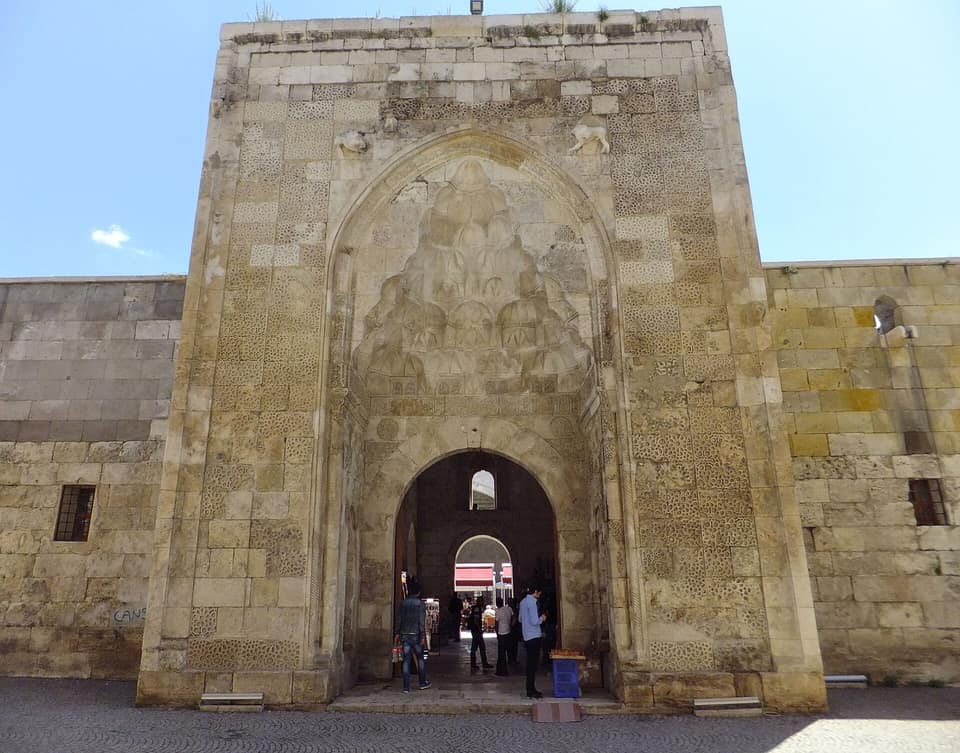
The portal is about 10.75 metres wide and, according to the TDV, rises a third higher than the facade. Two symmetrical animal figures sit in the spandrels of the portal arch. According to the Culture Portal, the lion on the right symbolises strength and the bull on the left symbolises health. On either side of the main iwan there are two human heads in high relief, the one on the right representing the moon and the one on the left the sun. The Culture Portal notes that the head in the moon symbol is carved as a woman with braided hair and the one in the sun symbol as a man.
Start your visit by looking at the portal from the square and finding the lion and the bull in the spandrels of the arch. Once through the doorway, walk to the middle of the courtyard and look at the moon and sun heads on either side of the main iwan. Then move to the south arcade and study the tile compositions on the tomb facade up close. Because the colours of the tiles look truer in shade, viewing them from the shaded side of the courtyard after midday works well. Check official sources for the building's current use and visiting conditions.
The municipality writes that the building can be reached by public transport or by car. On the city square, the madrasa is within walking distance of Gök Medrese, the Çifte Minareli Medrese and the Atatürk and Congress Museum. Because more than half a century separates it from the Çifte Minareli Medrese opposite, seeing the two portals one after the other makes it easier to follow how Seljuk stonework developed.
Comments
Loading...
Location - Şifaiye Medresesi
Venue Info
AddressTarihi Kent Meydanı, Sivas Merkez
VenueSivas Merkez, Sivas
TypeHistorical & Cultural Sites