

Historical & Cultural SitesHistorical Sites
Şenyuva Köprüsü
9
No ratings yet
Sign in to like and rate
Şenyuva Bridge
About Venue
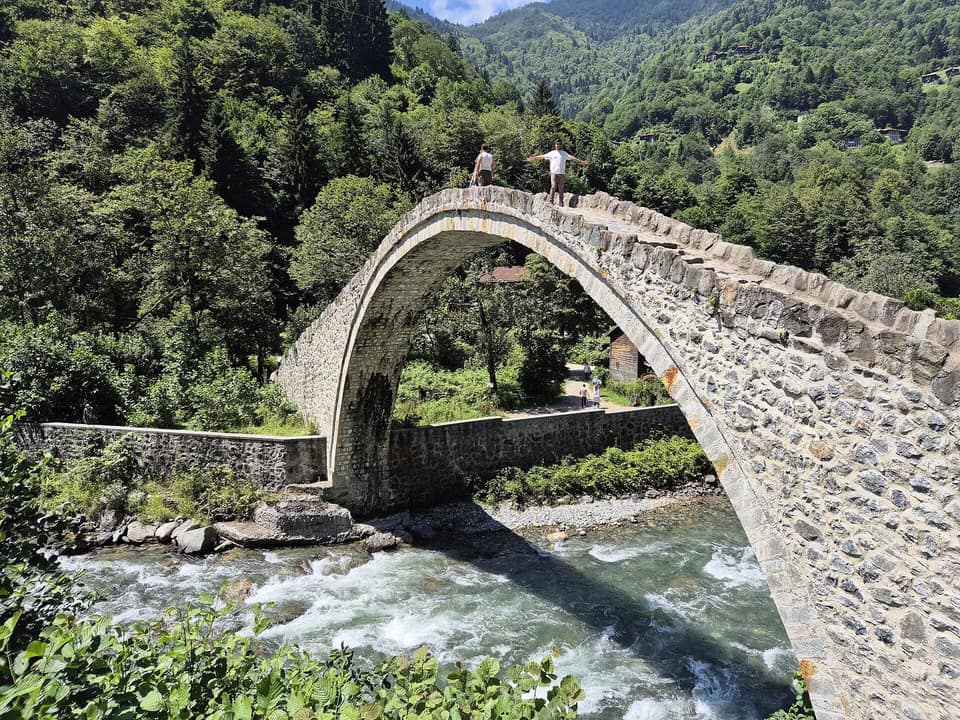
Şenyuva Bridge is a historic stone bridge crossing the Fırtına Stream with a single arch at Şenyuva village, on the road between Çamlıhemşin and Çat. The Eastern Black Sea Cultural Inventory records that it is one of the oldest bridges in the region and that it was built in the Hijri year 1107, that is 1696. The inventory record states that both the original and the present use of the structure is as a bridge, so it has been doing the same job for about three centuries. GoTürkiye's introduction to Rize lists Şenyuva Bridge among the province's arch bridges together with the Mikron, Ortan and Çat bridges. The Culture Portal, in its description of Kaçkar Mountains National Park, also mentions the bridges of the Fırtına Stream among the cultural assets of the area.
Structure
According to the inventory, the bridge is a masonry, single span arch bridge resting on two abutments. Rubble stone and cut stone were used together in its construction. The arch is built of neatly cut stone, while the other parts are of rubble stone. This arrangement shows that the load bearing part of the arch received the most careful workmanship. The bridge is recorded in the Eastern Black Sea Cultural Inventory under the code TR.ANT.53.051.054. The inventory gives the width of the bridge as 2 metres; the narrow deck is a reminder that the structure was built for pack animals and people on foot. The length of the bridge, however, appears with different values in the sources, so the figure should be thought of as an approximate size rather than an exact number. The crown of the arch rises to a point, and the middle of the bridge stands clearly higher than the two banks.
The arch bridges of Rize
The Rize Provincial Directorate of Culture and Tourism explains that many bridges were built in the province to cross river valleys and reach houses, plateaus and fields. The Culture Portal notes that the province's topography, which reaches 2000 metres within a distance of 50 kilometres from sea level, creates very steep slopes, and that fast flowing streams carve deep valleys. According to the same sources, bridges that wore out quickly under the regional climate were repaired often, and their original construction dates are mostly not known for certain. This is why the recorded construction year of Şenyuva is valuable. According to the Provincial Directorate, all of these bridges have an arc form with a round or slightly pointed arch rising on a pair of abutments on either side of the stream bed. The same source stresses that this form protected the bridges from floods. The abutments mostly rest on natural rock, and the parapets are made of a single row of stones. The Directorate writes that the height of the bridges varies from 2 or 3 metres to 15 or 20 metres depending on the depth of the valley. Their length varies between 20 and 45 metres depending on the width of the valleys. All of the bridges are rectangular in plan and many have a single round arch, though there are also examples with flattened or slightly pointed arches. The arches are built of neatly cut stone, while the abutments and other parts are of rubble stone. The Directorate also notes that iron railings were added to some bridges later.
The Fırtına Stream
The Rize Provincial Directorate of Culture and Tourism states that the Fırtına Stream, formed by the union of streams descending from the slopes of the Kaçkar Mountains facing the Black Sea, is the most important and best known watercourse in the province. The same source writes that the stream has a high flow and runs fast. According to the Directorate, the flow of some streams in the province is suited to river sports such as canoeing and rafting. Standing on the bridge you see this force directly, as the water rushes in foam beneath the arch.
Visiting
To see the bridge at its best, first look at it from the bank, from a point where you can frame the whole curve of the arch. Then walk slowly across the bridge and take in the valley from the crown of the arch. The stone surface becomes slippery after rain and the parapet is low, so take care, especially with children. According to the Culture Portal, the road to Pokut Plateau branches east from this village, so the bridge is a natural starting point for a trip to the plateau. Along the road through the Fırtına Valley, Zilkale and Palovit Waterfall can also be seen on the same day.
Comments
Loading...
Location - Şenyuva Köprüsü
Venue Info
AddressŞenyuva Köyü, Çamlıhemşin, Rize
VenueÇamlıhemşin, Rize
TypeHistorical & Cultural Sites