

Historical & Cultural SitesMuseums
Selçuklu Uygarlığı Müzesi (Çifte Medrese)
8
No ratings yet
Sign in to like and rate
Seljuk Civilization Museum (Double Madrasa)
Gevher Nesibe Mahallesi, Tekin Sokak No:1, Kocasinan/Kayseri
Kocasinan, Kayseri
Get DirectionsApple MapsAbout Venue
The Seljuk Civilisation Museum is housed in the Gevher Nesibe Hospital and Gıyasiye Madrasa, popularly known as the Twin Madrasa. According to the museum's official website, the complex was built in 1205-1206 by Gıyaseddin Keyhusrev I, following the will of his sister Gevher Nesibe Sultan, daughter of Kılıçarslan II. The inscription on the hospital's portal also gives the construction date as 1205-1206. The TDV Encyclopedia of Islam writes that because the two buildings stand side by side, they are known as the Twin Madrasa or the Twin Madrasas. According to a traditional account, Gevher Nesibe asked for a madrasa to be built where physicians would be trained to treat helpless patients, and donated her fortune to this purpose.
The complex was designed as an institution for medical education. According to TDV, in the 13th century teaching was theoretical in the Gıyasiye and practical in the Şifaiye. It is thought that students lived in small rooms opening onto the porticoes, that lessons were held in the large iwans in summer, and that these iwans were also used for examining patients. In the Gıyasiye, besides subjects such as anatomy and physiology, the works of Avicenna and al-Razi and the books of Hippocrates and Galen translated into Arabic were taught, while clinical training took place at the bedside in the Şifaiye. Endowment records from 1584 show that the professors were allotted 20 akçe a day each and the students 8 akçe, a ratio that shows the importance given to medical education at the time.
Both buildings follow a four-iwan courtyard plan and are linked to each other by a corridor. In the middle of the Gıyasiye's courtyard, which measures 7 by 12 metres, there is a rectangular pool. The courtyard and pool of the Şifaiye are square. TDV reports that light-sensitive medicines may have been prepared in the completely dark inner room east of the large iwan. The long space west of the large iwan is thought to have been the room for preparing surgery, and the three small rooms opening onto it the operating rooms. In the patients' section, reached through the corridor to the southwest, there are eighteen rooms in two rows of nine. Beside this section are a square brick bath and a room thought to have belonged to the chief physician because of its size. In the Gıyasiye part, between the iwan and the winter classroom, stands Gevher Nesibe's octagonal tomb tower.
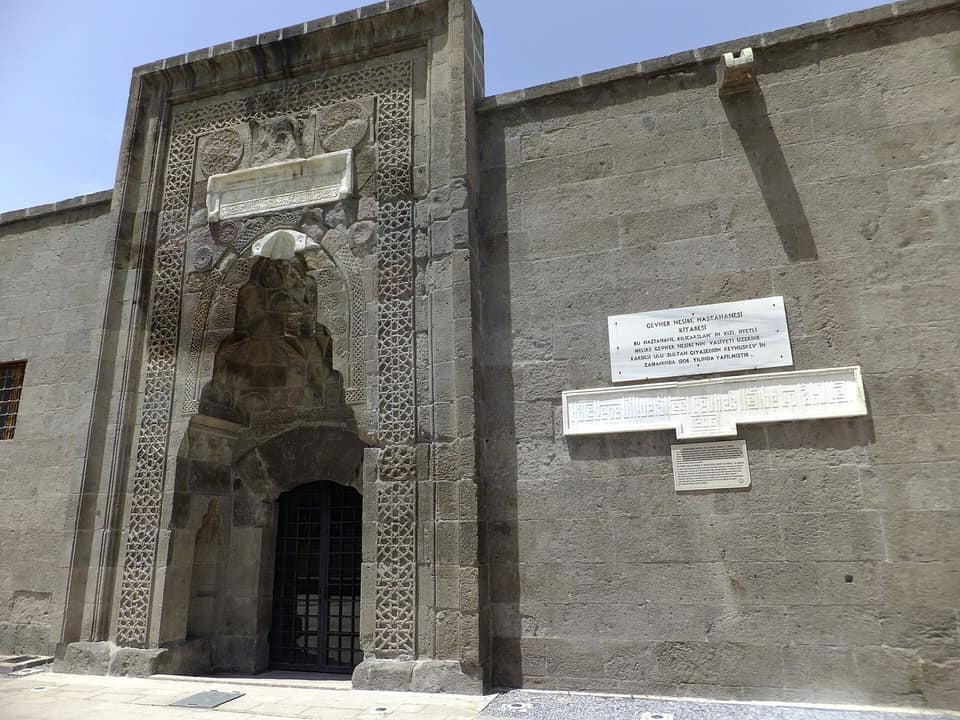
The whole weight of today's exterior is concentrated on the portal of the hospital on the left. In the upper corners of the muqarnas hood there are two large relief rosettes, and between them two facing snake figures that represent medicine. Above the niche on the right of the entrance there is a lion relief with its head turned towards the street. The two-line white marble inscription above the door was kept for many years in the Sahip Ata Madrasa before the restoration and was put back in place during the repairs. Because the original portal of the Gıyasiye collapsed completely, it is entered through a plain round-arched door built in the Ottoman period.
The building was also repaired in the Ottoman period; the first known repair was carried out by the architect Ömer Beşe in 1669. The major repair of 1955-1956 was made to mark the 750th anniversary of its construction. From the 1980s the building was used by Erciyes University as the Museum of the History of Medicine. In 2012 its use was transferred to Kayseri Metropolitan Municipality, and after two years of preparation it opened as the Seljuk Civilisation Museum on 21 February 2014.
The museum is planned thematically and consists of two main parts. The part devoted to Seljuk civilisation covers the Seljuk city, its architecture, art, science and clothing, as well as the Seljuks in Kayseri and in Anatolia. The part devoted to the hospital covers diseases, treatment methods and instruments, scholars, pharmacy, water and health, and healing with music and with colour. Alongside the objects there are interactive and technological areas, and a room with cartoons and games has been arranged for children.
The museum lies inside Mimarsinan Park, close to Cumhuriyet Meydanı. According to the official website, you can reach it by getting off at the Cumhuriyet Meydanı stop by tram or bus and walking for about five minutes. The best way to visit is to begin at the hospital's portal to see the snake figures and the lion relief, then to walk through the two courtyards one after the other. Check the museum's official website for opening hours and admission conditions before you go.
Comments
Loading...
Location - Selçuklu Uygarlığı Müzesi (Çifte Medrese)
Venue Info
AddressGevher Nesibe Mahallesi, Tekin Sokak No:1, Kocasinan/Kayseri
VenueKocasinan, Kayseri
TypeHistorical & Cultural Sites