

Health & SPAHammams & Thermal Springs
Sarıkaya Roma Hamamı (Basilica Therma)
13
No ratings yet
Sign in to like and rate
Sarıkaya Roman Bath (Basilica Therma)
About Venue
The Sarıkaya Roman Bath is a Roman-era thermal bath in the Sarıkaya district south of Yozgat, built directly over a hot spring. The General Directorate of Cultural Heritage and Museums describes it as the most distinctive surviving thermal bath of Roman architecture in Anatolia. The building is also known locally as the Kral Kızı Hamamı, the bath of the king's daughter, and Wikipedia also mentions the names Terzili Hamam and Kral Hamamı. The bath was added to the UNESCO World Heritage Tentative List in 2018.
The history of the bath goes back to the 2nd century AD. According to the ministry, the building was constructed in the Roman period over the thermal spring known as Aquae Sarvenae. The place name appears as Sarouena in Ptolemy's geography in the 2nd century, while the medieval copy of the Peutinger Map writes Aquas Aravenas in corrupted Latin. A bronze coin found in the excavations, bearing the portrait of Emperor Antoninus Pius on its obverse, has helped to date the building.
The name Basilica Therma comes from a later period. After Christianity spread in the region, a church was added to the north of the bath, and the place took the name Basilica Therma after that building. According to the sources, the town was a bishopric until 451. In Byzantine lists of bishoprics the name appears as Basilikai Thermai, meaning the royal baths. Only the foundations and low walls of the church survive today.
The building was never entirely abandoned over the centuries. The Kültür Portalı notes that Sarıkaya was also an important spa centre in the Seljuk and Ottoman periods. Excavations have yielded a Seljuk perfume vessel, a wooden comb with two lion figures and coins from the reign of Ahmed III. According to Yozgatpedia, the bath remained in use as a spa, with additions, until the 1970s. However, the infrastructure works of the Republican period and reinforced concrete construction largely damaged the building.
Those who introduced the bath to scholarship were Western travellers and researchers of the 19th century. Yozgatpedia attributes the first description to William Ramsay in 1883, while Wikipedia highlights the documentation by the French traveller Chantre in 1893-94. According to Wikipedia, the first excavation was carried out in 1932 by Richard C. Haines, in the same period as the Alişar excavation. The building was registered in 1987, and six seasons of excavation took place between 2010 and 2015 under the supervision of the Yozgat Museum Directorate. The area was declared a protected site in 2013, and the land around it was expropriated.
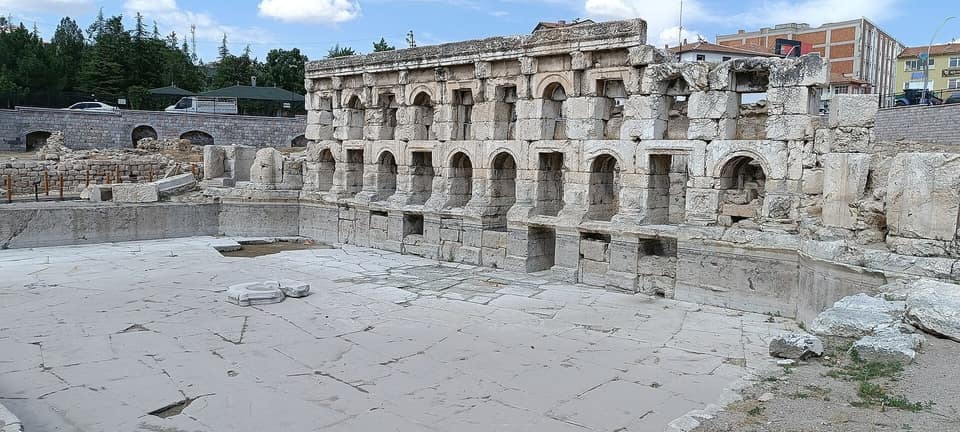
The most impressive surviving part today is the western facade. About 30 metres long, this facade rises as a wall of ten bays arranged in two arched storeys. The facade is crowned by an entablature in the Corinthian order, and the frieze shows bucrania and garland motifs, with lion-headed cornice pieces at the centre of the arches. At the northern and southern ends of the facade there are two small semicircular pools with marble-paved floors.
The heart of the building is its pools. According to Wikipedia, the large pool in front of the facade is 23.3 metres long, 12.8 metres wide and 1.34 metres deep. Behind the facade lies an inner pool measuring 16 by 4 metres, reached by stairs from both sides, whose water mixes with the large pool under the arches. To the east of it lies a third pool with rounded corners, where the thermal water bubbles up from the floor. The water temperature is given in the sources as between 45 and 48 degrees. Because the surrounding ground has risen over time, the bath now lies several metres below street level.
The best viewpoint for a visit is from the wooden walkway that surrounds the site, looking at the facade from the front. First stand opposite the large pool and take in the two-storey row of arches as a whole, then follow the walkway to the stepped inner pool behind the facade. For the details of the frieze and cornice at the top of the facade, the side light of the afternoon is best. The bath stands inside the town among modern buildings, so the surrounding buildings also enter the frame in wide-angle photographs.
Visiting conditions have changed over time. The Turkish Wikipedia article writes that visitor arrangements have been made and that the site is planned to open to visitors. So before you go, check the entry conditions and hours with the Yozgat Provincial Directorate of Culture and Tourism or Sarıkaya Municipality. Sarıkaya lies south of the city of Yozgat on the main road towards Kayseri, and the district is reached by road. The modern spa facilities in the town continue the same hot water tradition today.
Comments
Loading...
Location - Sarıkaya Roma Hamamı (Basilica Therma)
Venue Info
AddressKaplıca Mahallesi, Dutluk Caddesi, Sarıkaya/Yozgat
VenueSarıkaya, Yozgat
TypeHealth & SPA