

Historical & Cultural SitesArchaeological Sites
Sardes Antik Kenti
12
No ratings yet
Sign in to like and rate
Sardes Ancient City
About Venue
Sardis is the ancient city on the southern edge of the Gediz plain, leaning against the northern slopes of Bozdağ, that served as the capital of the Lydian Kingdom. Its remains spread on both sides of the İzmir-Ankara highway at Sart, about 9 kilometres from the centre of Salihli. The ancient name still lives on in the name of this small settlement. The Manisa Provincial Directorate of Culture and Tourism presents Sardis as the place where coins were first struck in recorded history and as the starting point of the famous Royal Road.
The ministry's museum portal writes that the city was founded in the Hermos, or Gediz, basin on the banks of the stream known as the Pactolus, today the Sart Çayı. According to the publications of the Sardis excavation run by Harvard and Cornell universities, in the 7th and 6th centuries BC the city became the centre of an empire that ruled western Anatolia under the dynasty stretching from Gyges to Croesus. The excavation team reports that the Lydian kings struck the world's first coins and made treaties with Mesopotamia, Egypt and the Greek world. The same source notes that the lower city was protected by a wall about 20 metres thick, and that the Lydian walls were only found in 1976.
When the Persians ended the Lydian Kingdom in 547 BC, Sardis became the centre of a major satrapy. According to the excavation team, the city was where the army mustered for the Persian kings' campaigns against Greece. After the conquest of Alexander the Great it belonged to the Hellenistic kingdoms and for a time served as the western capital of the Seleucid state. After the great earthquake of AD 17 the city was rebuilt, and in the Roman period it flourished with a stadium, aqueducts and monumental public buildings. Sardis became the capital of the province of Lydia under the reforms of Diocletian, declined in the 6th and 7th centuries, while its acropolis remained a strong fortress in the Byzantine period.
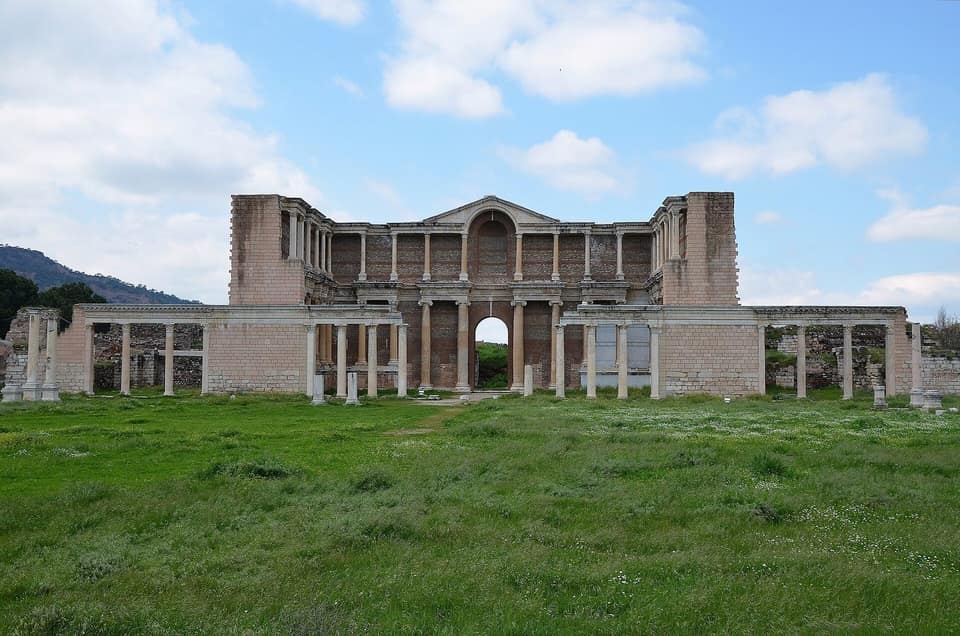
The first large building visitors meet is the bath and gymnasium complex to the north of the road. The excavation team writes that the complex covers about 23,000 square metres and was probably completed in the late 2nd or early 3rd century AD. The colonnaded courtyard in the eastern half, the palaestra, was used for sport and ceremony, while the vaulted halls to the west formed the bath. The two-storey colonnaded space between the palaestra and the bath is called the Marble Court. An inscription on its first storey dedicates the space to Emperor Caracalla, his brother Geta and their mother Julia Domna. The Marble Court and parts of the bath were rebuilt between 1964 and 1973, and today this is the most photographed façade on the site. One hall of the complex was later converted into a synagogue, and the building fell into ruin in the 7th century.
The marble-paved avenue along the southern side of the gymnasium and the small rooms behind its northern portico are also well worth seeing. The excavation team describes this row as a lively market in the 5th and 6th centuries, where in the final phase 34 rooms formed about a dozen shop units. The shops were abandoned after a fire in the early 7th century. The floor of the portico facing the avenue was covered with coloured mosaics, but these have been covered with earth for protection.
The second large area of the site is the Temple of Artemis inside the valley of the Sart Çayı. According to the excavation team the temple was begun in the Hellenistic period in the 3rd century BC, enlarged in the Roman period when its interior was divided in two, but never completed. The building faces west and is counted among the largest temples in the world. The two complete columns standing at the eastern end have stood since antiquity and have never been restored. The Roman architrave block carried by these two columns has been calculated to weigh 23.2 tonnes and to have been lifted 18 metres by crane. The unfinished column shafts are also valuable for architectural history, because they show that ancient masons set the stone in place first and finished it only afterwards.
According to the page of the Kula-Salihli UNESCO Global Geopark, when excavation began between 1910 and 1914 only the upper parts of two columns were visible above the ground. This thick fill is also important to earth scientists, because it measures the flood and erosion material that has built up in the valley over the last fifteen hundred years. That first major excavation was led by Howard Crosby Butler of Princeton University, and the work stopped with his death in 1922. The new expedition founded in 1958 by George Hanfmann and Henry Detweiler continues its work today.
The gold-bearing sands of the Sart Çayı are remembered as the source of Lydian wealth. The excavation team writes that in an area north of the stream a refinery from the first half of the 6th century BC was found, used to separate the alloy of gold and silver. The mosaics with animal figures from a Roman villa in the same area are now displayed in the Manisa Museum. According to the provincial directorate, the Sart hall of the museum is devoted to objects found in the excavations that have continued since 1958.
Sardis is on the UNESCO World Heritage List together with the Lydian Tumuli of Bin Tepe, and the provincial directorate has set up a protection centre that watches the area from the air. The easiest way to visit is to see the gymnasium and the avenue of shops first, then go south along the stream to the temple. The acropolis hill can be seen from both points and gives its best photograph in the morning light together with Bozdağ. At noon in summer there is little shade on the site, so a hat and water are a good idea. Opening hours differ for summer and winter; check current hours and tickets on the Türkiye Museums portal.
Comments
Loading...
Location - Sardes Antik Kenti
Venue Info
AddressSart Mahallesi, Salihli / Manisa
VenueSalihli, Manisa
TypeHistorical & Cultural Sites