

Historical & Cultural SitesArchaeological Sites
Sagalassos Antik Kenti
9
No ratings yet
Sign in to like and rate
Sagalassos Ancient City
About Venue
Sagalassos is a Pisidian city built on the slopes of the Taurus Mountains, within the boundaries of Ağlasun district in Burdur. According to the Ministry of Culture and Tourism, a road that branches off the 14th kilometre of the Burdur-Antalya highway reaches the ancient city about 20 kilometres later, at an elevation of 1500 to 1700 metres. That altitude means different weather from the plain around Burdur, so bring an extra layer, water and a hat. Ministry texts present Sagalassos as one of the important cities of the Eastern Mediterranean and one of the leading cities of Pisidia in the Roman Imperial period. According to Bilkent University's announcement, the city lived through the Hellenistic, Roman and Byzantine periods and reached its peak in the Roman Imperial era, between the 1st and 3rd centuries CE. The ministry record describes Sagalassos as one of the ancient cities of Asia Minor that have survived well to the present day.
The archaeological project at the site has continued since 1990 and was first led by a team headed by the Belgian Prof. Dr. Marc Waelkens. According to the Bilkent University page, management of the excavation passed to Bilkent University after 35 years under KU Leuven. The same page says the project is chaired by Peter Talloen, head of Bilkent's Department of Archaeology, and that experts from Koç University and a university in Brussels also take part. The project is not only an excavation; it combines archaeology with environmental science and heritage conservation. Excavations focus on urban spaces, namely the Roman Baths, the Upper Agora and the monumental fountains. Landscape studies examine terraced farming, water management and historical climate change. For this reason it is right to think of the site while walking not as a quiet open-air museum but as a scientific field that is still being worked.
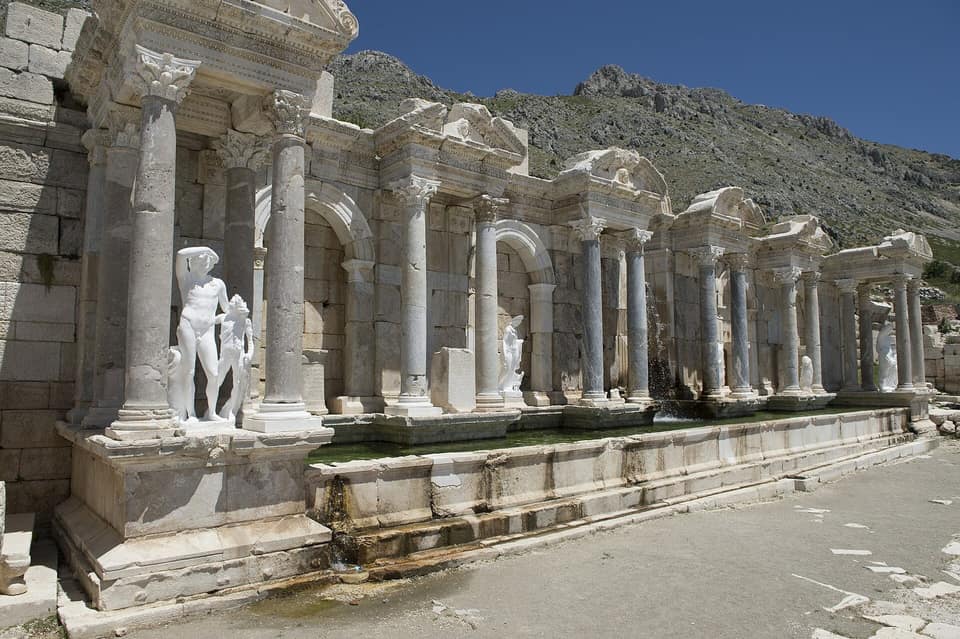
The restored structures include the Neon Library, the Hellenistic Fountain, the Heroon and the Antonine Fountain. The other structures that stand or have been uncovered by excavation are the Lower and Upper Agoras, the Roman Baths, the temples of Apollo Klarios and Antoninus Pius, the Colonnaded Street, the Macellum, the Urban Villa and the theatre. All of these are described as architecture and urban fabric; for the visitor the real value is that a Roman-period city can be read from its street to its square. As their names suggest, the Lower Agora and the Upper Agora lie at different levels of the city, so it makes sense to start low and work upward. In Bilkent's announcement the Antonine Fountain appears as a key structure whose restoration is meant to improve the visitor experience. According to museum records, the large aediculae on either side of the fountain held Dionysos and Satyr sculpture groups, which date to the 2nd century CE.
Those sculptures are displayed today on the lower floor of the Burdur Museum, so seeing the fountain on site together with its statues in the museum completes the visit. The Heroon is a monumental tomb structure; according to the museum record, in the frieze that surrounded the heroon in the northwest, thirteen dancing girls form a line dance while one of them plays a zither-like instrument. This frieze dates between 10 BCE and 10 CE and is now in the museum. The sundial found in the excavation in front of the heroon dates to the 2nd century CE. In this way you see the architecture of the heroon on site and its carved decoration in the museum. The museum's Sagalassos section also displays colossal statues of the Roman emperors Hadrian and Marcus Aurelius.
The theatre counts among the standing structures and is a good place to rest after a long walk. In Bilkent's account, material culture from pottery to inscriptions is studied to understand daily life and trade networks. Bioarchaeologists and environmental scientists, in turn, try to read ancient diets and ecological change from human, animal and plant remains. For photography, early morning and late afternoon soften the colour of the stone and bring out the depth of the fountain facades. The terrain is sloping and stony; sturdy shoes with flat soles are essential. The site is attached to the Burdur Museum Directorate and its address is registered as Kıraç neighbourhood in Ağlasun district.
On the Ministry of Culture and Tourism's museum page the site is shown as open every day, and the MuseumCard is stated to be valid for Turkish citizens. Opening and closing times and entrance fees can change over time; for current information check muze.gov.tr and the annual visiting-hours list of the Burdur Provincial Directorate of Culture and Tourism. The same page notes that a museum brochure can be downloaded. Reaching the site requires a vehicle on the final stretch after leaving the main road, so plan your route accordingly. If you tour the Sagalassos hall in the museum first, the fountain, heroon and baths you meet on site will make much more sense. Allow plenty of time for the walk, because the city spreads over a wide area and every terrace opens a different view.
Comments
Loading...
Location - Sagalassos Antik Kenti
Venue Info
AddressKıraç Mahallesi, Ağlasun, Burdur
VenueAğlasun, Burdur
TypeHistorical & Cultural Sites