

Historical & Cultural SitesMuseums
Rize Müzesi
5
No ratings yet
Sign in to like and rate
Rize Museum
Piriçelebi Mahallesi, Palmiye Sokak No: 4, Rize Merkez/Rize
Rize Merkez, Rize
Get DirectionsApple MapsAbout Venue
The Rize Museum occupies a historic mansion known locally as the Yellow House (Sarı Ev) in Piriçelebi Mahallesi in the city centre. The building was built in the 19th century as two floors over a basement. The Directorate General of Museums describes the Yellow House as one of the finest examples of the region's civil architecture. The mansion was arranged as a museum and opened to visitors on 27 June 1998. The Rize Provincial Directorate of Culture and Tourism refers to the building today as the city's museum and notes that all the museums of the province are gathered in the provincial centre. According to the same directorate, these museums house documents of social and historical events that affected not only Rize but the eastern Black Sea as a whole, along with ethnographic and archaeological finds. The promotional brochure of the Directorate General of Museums presents the building as a historic mansion that holds a mirror to the past.
Before touring the building, looking at its construction from outside makes the layout inside easier to understand. Traditional materials and techniques were used in Rize houses, and the Yellow House is an example of this tradition. The walls were raised in a technique of rubble stone with infill between timber, and they were covered with a hipped roof of Turkish tiles. According to the Directorate General of Museums, the town houses of Rize usually had two or three floors and the ground floor was used as a stable and cellar. Rooms and halls lie on the upper floors, and some of the rooms were decorated with carved woodwork. The German botanist Karl Koch, who visited the town in the mid-19th century, also noted that the houses of Rize stood in gardens and that their lower parts were of stone and their upper parts of timber. According to Koch these houses were spacious buildings standing apart from the shops and workplaces, and the streets of the town were paved with stone.
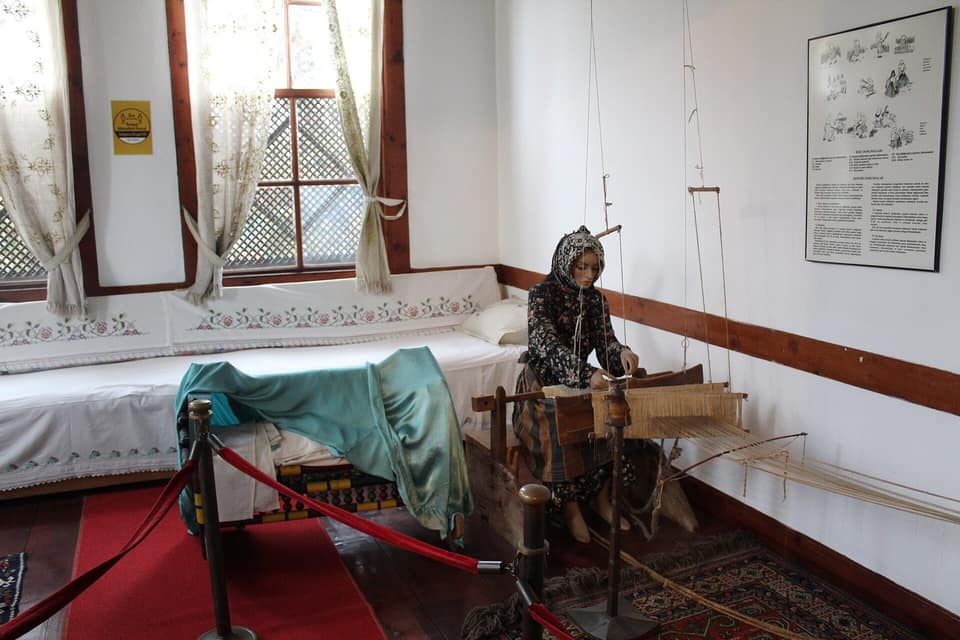
The original function of each floor can still be read in today's display. The stone basement was once a stable and storeroom, and today it is the exhibition hall where works are on show. This hall holds furniture in the Baroque and Rococo styles of the 17th and 18th centuries together with display cases. The first floor held the kitchen of the house and the rooms where guests were received. Most of this floor is now given over to the administrative offices of the Rize Museum Directorate. The kitchen opposite the stone stair at the museum entrance, however, has been arranged once more as a kitchen. Its centrepiece is a wide hearth with a large chain called klemuri hung in its middle. Copper kitchenware is displayed on the stone-paved floor, and the corner where maize was ground is brought to life with mannequins. The second floor is where the family of the house lived, and today it is displayed for the same purpose with its bedrooms and sitting rooms.
The collection ranges from archaeological finds to coins and ethnographic material. According to figures given by the Rize Provincial Directorate of Culture and Tourism, the museum displays a total of 1,799 works, including 76 archaeological objects, 594 coins and 1,129 ethnographic items. As the numbers show, the weight of the collection lies in the objects of everyday life. For this reason the museum is best visited as a place that tells of life inside a house rather than of the ancient history of Rize. In the rooms look at the embroidered covers, the timber lattice windows and the layout of the rooms, and in the kitchen notice how the hearth was planned as the heart of the house. As you move between floors, seeing how the sequence of stable, cellar, kitchen and bedroom rises from a stone basement to the family's living floor is the easiest way to read the house.
The neighbourhood around the museum has its own history too. The TDV Encyclopaedia of Islam writes that Piri Çelebi quarter appears in records of 1682 as a small settlement of sixteen households. The Directorate General of Museums states that the museum is closed on Mondays. As opening hours and entry conditions may change, check the current information on its page at muze.gov.tr. Because the museum is in the city centre, it is part of a route that can be walked together with Rize Castle and the Atatürk House Museum in Müftü Mahallesi.
Comments
Loading...
Location - Rize Müzesi
Venue Info
AddressPiriçelebi Mahallesi, Palmiye Sokak No: 4, Rize Merkez/Rize
VenueRize Merkez, Rize
TypeHistorical & Cultural Sites