

Historical & Cultural SitesArchaeological Sites
Prusias ad Hypium Antik Kenti
12
No ratings yet
Sign in to like and rate
The Ancient City of Prusias ad Hypium
About Venue
Prusias ad Hypium is an ancient city built on the slope of a hill overlooking the plain to the south, in Konuralp, north of Düzce. The excavation article in Höyük, the journal of the Turkish Historical Society, states that the city lies within today's Konuralp Çiftepınarlar neighbourhood, about 8 kilometres north of Düzce. The Düzce Provincial Directorate of Culture and Tourism writes that, according to ancient authors, the region was known as the homeland of Thracian peoples between 1200 and 700 BC. The city's first name was Kieros, and Prusias ad Hypium later became one of the twelve cities forming the Bithynian League. The sources do not agree on its foundation; the Provincial Directorate mentions the Megarians, while the Höyük article reports that Memnon of Heraclea attributed it to the Heracleans.
After a long period under the rule of Heraclea Pontica, the city was brought within the borders of the kingdom by King Prusias I of Bithynia. The king gave the city his own name, and the settlement took a name meaning Prusias near the Hypios, the ancient name of the Melen river. The region passed to Roman rule in 74 BC. According to the Provincial Directorate, the city began to grow in the 1st century AD and reached the peak of its prosperity in the 2nd and 3rd centuries. Dedicatory inscriptions found in the city show that most of its monumental buildings, such as the aqueducts, the agora, the council house, the theatre and the baths, were built in this period. In 1323 the city was taken by the Ottoman commander Konur Alp and became part of Ottoman territory. According to the Höyük article, the settlement was called Üskübü in the Ottoman period and later took its present name, Konuralp.
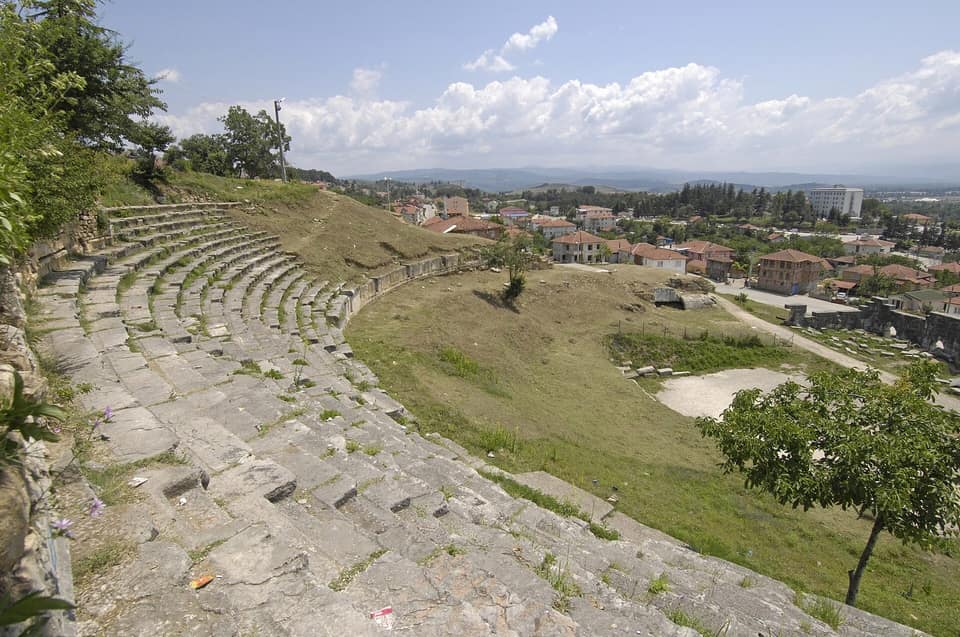
The most important building still standing in the city is the theatre, known locally as the Forty Steps. The Culture Portal presents it as the best-preserved ancient theatre surviving in the Black Sea Region. The building was constructed in the Hellenistic period and received additions in the Roman period. The seating area is divided into lower, middle and upper tiers, and the steps are made of local limestone. Lion paw reliefs are carved on the row ends beside the stairways. According to the Höyük article, the theatre was used until 2013 as a neighbourhood of about 22 houses, while the orchestra was turned into a cultivated garden. The same study explains that scientific excavations began in 2013 under the direction of Konuralp Museum and with the advice of the Archaeology Department of Düzce University. During the excavations it became clear that the orchestra lay beneath about 5 metres of fill. Survey and reconstruction work showed that the theatre held roughly 9,500 to 10,000 people. In its present state the stage building is about 50 metres long, 12 metres wide and 6 metres high, and its eastern part survives up to roof level. An inscription on the stage building records that in the reign of Emperor Hadrian a man of Prusias named Iulius Proklos had the stage building and its statues made. The excavations have also revealed remains from the Roman, Byzantine and Ottoman periods.
After the theatre, head for the Horse Gate, the entrance to the city. The lintel of the gate, made of local limestone, carries a horse relief and a Greek inscription from a grave stele that a man of Prusias had made for his mother. The western walls are 4.7 metres high and 118 metres long and were built of cut blocks without mortar. During repairs in the Eastern Roman period, altar stones and other architectural pieces were reused in the walls. Eleven retaining piers survive from the city's old water system, and these rubble stone piers are thought to have carried water channels. The Roman bridge was built by fitting white marble blocks together without any mortar. According to the measurements recorded by the Provincial Directorate, the visible length of the bridge today is 30.25 metres, while its original length was 39.20 metres.
Some of the remains lie among the houses and gardens of today's Konuralp, so the city has to be explored on foot, moving from one structure to the next. The upper rows of the theatre face the plain to the south, which is the best place to appreciate the commanding position of the building. Since a large part of the finds is displayed in the nearby Konuralp Museum, visiting the ancient city and the museum on the same day is a good plan. The Culture Portal advises those arriving on the D-100 or the TEM motorway to reach Düzce centre and continue 6 kilometres towards Konuralp. The Gölyaka exit is described for those coming from Istanbul and the Kaynaşlı exit for those coming from Ankara. Excavation and restoration work continues in the theatre, so some parts may be closed; check current visiting conditions with the Provincial Directorate of Culture and Tourism.
Comments
Loading...
Location - Prusias ad Hypium Antik Kenti
Venue Info
AddressKonuralp Çiftepınarlar Mahallesi, Düzce Merkez/Düzce
VenueDüzce Merkez, Düzce
TypeHistorical & Cultural Sites