

Historical & Cultural SitesArchaeological Sites
Priene Antik Kenti
5
No ratings yet
Sign in to like and rate
The Ancient City of Priene
About Venue
Priene is an Ionian city built on the southern slope of Samsun Dağı, known in antiquity as Mykale. The Kültür Portalı places the site about 15 kilometres southwest of the district of Söke, just above the neighbourhood of Güllübahçe. The city was one of the members of the Ionian League, and its name first appears in ancient sources in the 7th century BC. When it was founded it stood on the coast, and ancient writers tell us it had two harbours. The wide, flat plain you see today from the slope was sea in those days.
The reason for this view is the Büyük Menderes. The silt carried by the river over the centuries filled the gulf, first moving Priene away from the sea and then leaving it kilometres inland. The geographer Strabo also wrote that the alluvium of the Maeander had turned the coastal city of Priene into an inland town. Having lost its harbour, the city gradually declined, and according to the Kültür Portalı it was completely abandoned in the 13th century.
The city seen today is the one refounded in the middle of the 4th century BC. The new settlement was built on the grid plan associated with the name of Hippodamus of Miletus. According to Turkish Wikipedia, streets crossing the main east-west avenue at right angles divide the city into blocks of equal size. Each block measures about 35 by 47 metres, and at the founding eight long, narrow houses were placed in each of them. Because the slope is steep, many of the north-south streets turn into stepped lanes. The Kültür Portalı describes Priene as the best preserved example of town planning surviving from antiquity to the present day.
The walls around the city, however, do not follow this order. The city walls, about 2.5 kilometres long, follow the shape of the terrain and were built without mortar. The water system is also remarkable: clean water coming from above was collected by clay pipes in a basin above the theatre, and holes were opened in the walls for rainwater. The main avenues were paved with stone, while the side streets were mostly cut into the bedrock.
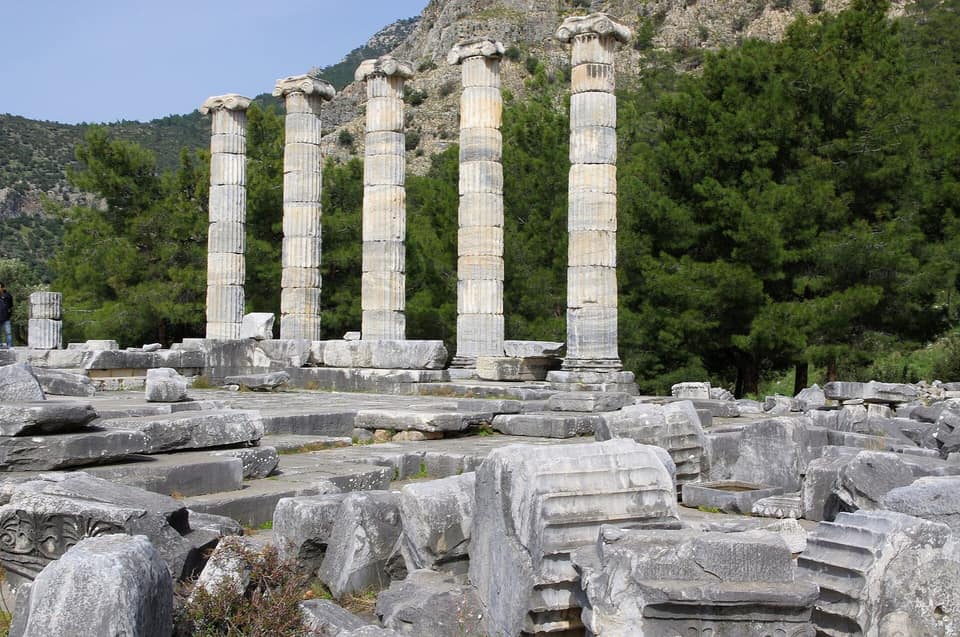
The most photographed building on the site is the Temple of Athena. Standing on a high terrace, the temple was built in the Ionic order with six columns on the short side and eleven on the long side. Its architect was Pytheos, also regarded as the architect of the Mausoleum at Halicarnassus. The Roman architect Vitruvius cited this building as a model when describing Ionic temples. It is also known that an edict Alexander the Great sent to the city in the summer of 334 BC was carved on marble blocks in the entrance part of the temple. The five columns standing today mark the most beautiful spot for looking out over the plain and the Menderes delta.
Another well preserved building is the bouleuterion, the council house. Turkish Wikipedia writes that this roofed hall, measuring 20 by 21 metres, has stepped seating along three of its sides and held about 640 people. The marble altar in its centre and the niche set aside for speakers can still be made out. The prytaneion right next to it was where the board that governed the city met, and it represented the state.
According to the Kültür Portalı, the theatre was built in 350 BC and seated 5 thousand people. What makes it valuable is that it kept its Hellenistic layout despite additions in the Roman era. The seats of honour in the front row and the lower storey of the stage building can still be seen today. The agora was a square in the middle of the city surrounded on three sides by colonnades, and according to an inscription the long stoa to its north was built by King Ariarathes VI of Cappadocia.
The houses of Priene are as important as its public buildings. The Kültür Portalı notes that its Late Classical and Hellenistic houses are among the best preserved examples of their kind and tell us a great deal about the history of settlement. That is why the city is called the "Pompeii of Anatolia". The upper gymnasium, the lower gymnasium and the stadium at the lowest point can also be visited.
The first scientific excavations in the city were begun by Carl Humann in 1895, and the work continued under Theodor Wiegand. According to Turkish Wikipedia, in the following decades excavations were carried out by German universities and by the Miletus Museum Directorate, and since 2018 they have been continued by another team. The Priene Archaeological Site was added to the UNESCO World Heritage Tentative List in 2018.
A visit starts from the entrance at Güllübahçe, and the path climbs up along the slope. Although the site lies in the shade of pine trees, the steps and uneven stones make closed shoes the sensible choice. If you come early in the morning you will walk in the cool and see the light over the plain at its softest. Check visiting hours and entry conditions on the Ministry's museum page.
The Kültür Portalı notes that Priene can be reached from the Efeler district of Aydın by metropolitan municipality buses and by Didim minibuses. For those coming by car, the road from Söke to Güllübahçe is the shortest route. Those who want to see Miletus and Didyma on the same day can continue south towards Balat.
Comments
Loading...
Location - Priene Antik Kenti
Venue Info
AddressPriene Ören Yeri, Güllübahçe, 09230 Söke / Aydın
VenueSöke, Aydın
TypeHistorical & Cultural Sites