

Historical & Cultural SitesArchaeological Sites
Pisidia Antiokheia Antik Kenti
11
No ratings yet
Sign in to like and rate
Ancient City of Pisidian Antioch
About Venue
Pisidian Antioch is an ancient city in the Lakes District, where the Mediterranean, Aegean and Central Anatolian regions meet, about 1 kilometre northeast of the centre of Yalvaç. It was founded on fertile land stretching along the southern slopes of the Sultan Mountains, on a hill whose highest point reaches 1236 metres. The Isparta Provincial Directorate of Culture and Tourism writes that the walled city area covered 46 hectares. North of the city flows the Anthius stream, which passes Gelendost and reaches Lake Eğirdir. The population of the city in the Roman period is estimated at about 70,000.
It is generally accepted that the city was founded by the Seleucid dynasty after the death of Alexander the Great. The provincial directorate writes that the most reasonable view is that the city was founded by Antiochus I, by fortifying an existing settlement, as an outpost controlling Galatian raids, and it places the founding at around 275 BC. The fact that finds from the sanctuary of Men to the northeast of the city go back to the fourth century BC shows that an earlier culture existed in the area. Surface surveys in and around Yalvaç have found Early Bronze Age settlements in nearly twenty mounds in the nearby villages. With the Treaty of Apamea in 188 BC the region was left to the Kingdom of Pergamon, and in 133 BC it came under Roman rule.
The history of research at the city is a story in itself. The first to describe the city in detail, setting out the ruins during his journey of 1833, was the English researcher Arundell. In 1911 Ramsay and his team began work here, and the following year the first excavations were carried out with the support of Princeton University. In 1914, in the excavation in front of the sanctuary of Augustus, the first fragments of the Res Gestae Divi Augusti, the text in which Augustus recounted his own deeds, were found. In 1924 excavations resumed under Robinson of the University of Michigan. The provincial directorate writes that blocks left unprotected after the excavations were carried to Yalvaç as building material; a short walk through the streets of the town is enough to see decorative pieces of the city in its walls. Between 1985 and 1995 excavations were continued by the museum directorate, and since 2008 the work has continued under the Department of Archaeology of Süleyman Demirel University.
Today, as in antiquity, you enter the city through the western gate. The gate was built for Emperor Hadrian, in his name and that of his wife Sabina, during the emperor's visit to Anatolia in AD 129. The pieces lined up next to the piers now visible at foundation level make up 65 percent of the structure. The Nikes, weapons, bulls' heads and garlands on these pieces show that the gate was built in the spirit of a triumphal arch. On the axis of the gate, about 7 metres away, the remains of a semicircular fountain basin have been found.
After the western gate, the Decumanus Maximus street rising towards the acropolis reaches the theatre after about 50 metres. The theatre, dating from the Hellenistic period, is poorly preserved, but excavations have shown that its facade was about 100 metres wide. With this measurement the provincial directorate compares the theatre with the theatre of Aspendos and writes that it is larger than the theatres of the other great cities of Pisidia. When you pass from this street to the beginning of the Cardo Maximus, a colonnaded street about 11 metres wide and 85 metres long runs to the Square of Tiberius. Statue bases found here show that this street was decorated with statues.
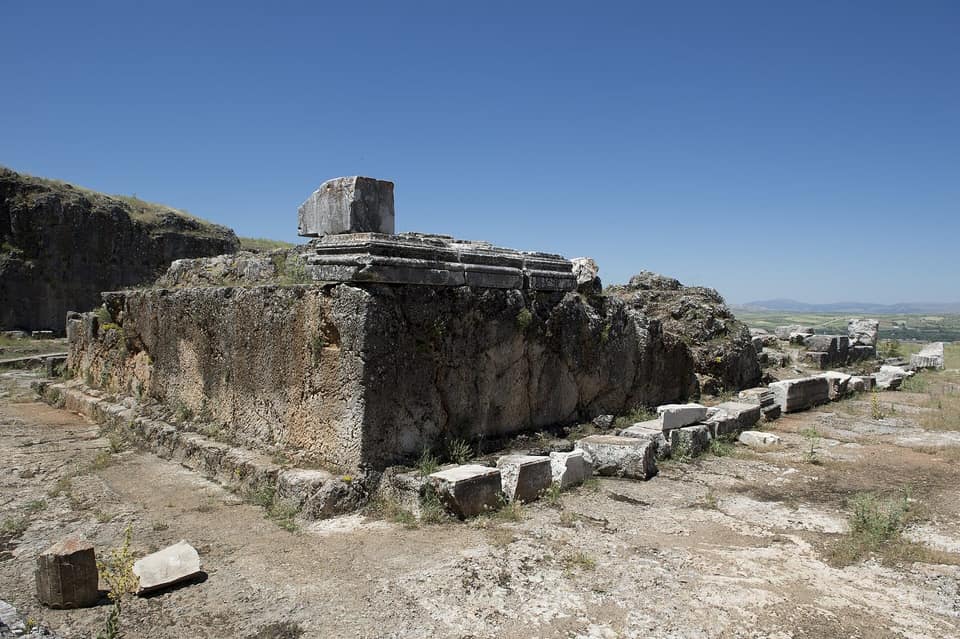
The city's most impressive group of buildings is the sanctuary of Augustus. This area is reached by climbing the steps of the three-arched Propylon, which carried four Corinthian columns on each of its front and back faces. The Temple of Augustus was built by carving into the rock at the highest point of the city, and behind it there is a semicircular colonnaded gallery. The U-shaped Nymphaeum in the north of the city stored the water arriving from the aqueducts and distributed it to most of the city. Right behind it you can follow the remains of 800 metres of arches of the system that brought water to the city from the Suçıktı spring in the Sultan Mountains, about 11 kilometres away. There are also remains of buildings from the late period in the city; the structure in the west known as the baths is thought, according to recent research, to have possibly been a headquarters building.
Start your visit at the western gate, follow the street up to the theatre, and then climb from the Square of Tiberius to the Propylon and the temple. From the highest point, where the temple stands, look out over the Yalvaç plain and the Sultan Mountains, then go down to the fountain building and the aqueducts in the north. The site is open and without shade, so in summer come early in the morning and bring a hat and water. The official museum page for the archaeological site states that it is open every day and that the Müzekart is valid; check that page for up-to-date visiting hours and entry conditions. Yalvaç is reached from Isparta by road, and the archaeological site is a short drive from the district centre.
Comments
Loading...
Location - Pisidia Antiokheia Antik Kenti
Venue Info