

Religious & Spiritual PlacesMosques
Pertev Paşa Camii
No ratings yet
Sign in to like and rate
Pertev Pasha Mosque
About Venue
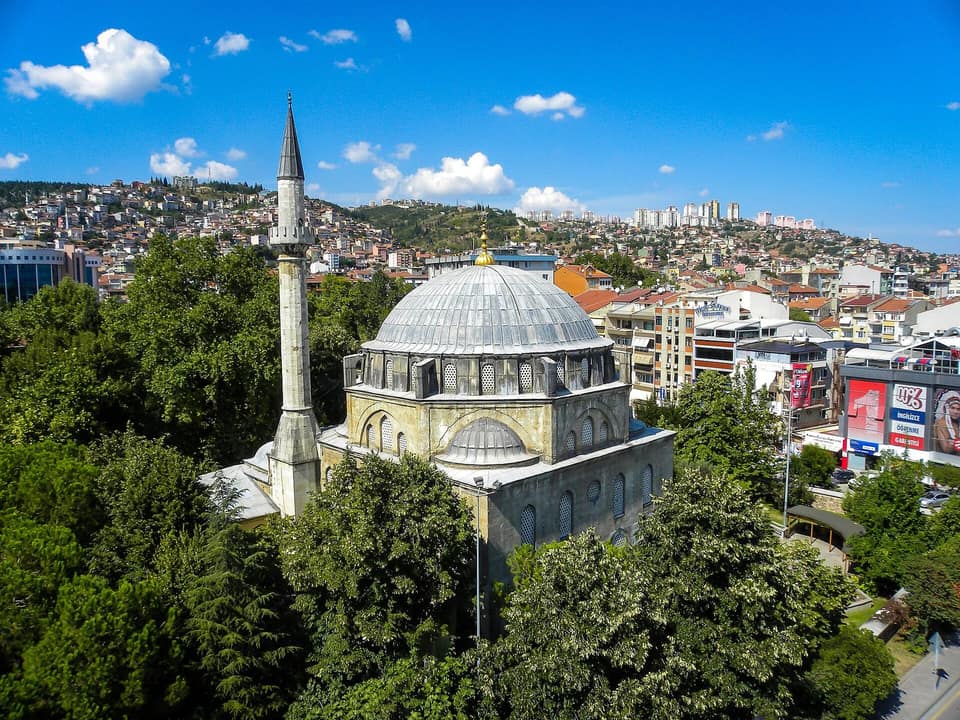
Pertev Pasha Mosque is a 16th century building in the center of Izmit, also known among locals as the Yeni Cuma Mosque. It is the main structure that survives in its original form from a large way-station complex built beside the military and caravan road running toward Istanbul, Damascus and Baghdad. According to the Turkish Encyclopedia of Islam, the complex was built at the wish of Pertev Pasha, who served as vizier under Suleiman the Magnificent and Selim II. After his death his steward Sinan Agha had it built by the architect Sinan, and it was completed in 1579. The complex originally consisted of a mosque, fountain, soup kitchen, caravanserai, shops, bath and primary school, arranged in a scattered layout. Today only the mosque and the fountain stand in their original state, while single walls of the caravanserai and soup kitchen and part of the bath survive as ruins. In Sinan's own memoirs only the mosque and the bath of this complex are named.
The mosque rises in the middle of a courtyard enclosed by a broad perimeter wall. The courtyard is entered through low arched gates on three sides, and above the western entrance a one-line inscription gives the date of the building. Built of cut stone, the structure has a plan close to a square and is covered by a dome on a tall octagonal drum. The double-layered porch in front of the prayer hall is its most striking architectural feature. In the inner porch there are three domes in the middle and a mirror vault on each side, and marble columns with muqarnas capitals are joined by pointed arches. The outer porch projects from the mass of the building and wraps the inner porch on three sides, so the stages of the transition to the dome can also be read from the exterior.
Inside, the transition from the square base to an octagon is made with squinches resting on muqarnas springers, and from the octagonal drum to the dome with pendentives. Light enters through three rows of windows on the walls and one row on the drum, and a round window opens above the mihrab. Wood, painted decoration and plaster are used for ornament, and the door leaves show kundekari joinery with mother-of-pearl inlay. The tourism guide of Kocaeli Metropolitan Municipality notes that, unusually for buildings of its period, no tile was used inside the mosque.
The ablution fountain to the north of the mosque has a twelve-sided plan and is covered by a broad-eaved roof carried on columns. To the southwest, beside the road, stands a three-part fountain group, one part for people and two for animals, which now sits below road level. The caravanserai stood to the west of the mosque; the Ottoman historian Joseph von Hammer spent a night in this inn on his way back from a journey to Bursa in the early 19th century and recorded it in his travel account. The wooden roof of the rectangular inn was carried by eighteen posts, and ten shops lined its south front. The bath, built as a double bath, fell into ruin in 1922, and today part of its foundations and some of the hot room remain.
The complex was repaired in 1719, 1764 and 1858, and in the repairs between 1952 and 1961 the courtyard walls, the upper cover of the fountain, the painted decoration and the plaster windows were renewed. When visiting, dress modestly, respect the hours of worship and keep quiet inside. Because visiting conditions can change, check the current information on the relevant official pages.
Comments
Loading...
Location - Pertev Paşa Camii
Venue Info
Venueİzmit, Kocaeli
TypeReligious & Spiritual Places