

Historical & Cultural SitesCastles & Palaces
Palu Kalesi
25
No ratings yet
Sign in to like and rate
Palu Castle
About Venue
Palu Castle rises about 1 kilometre east of the town of Palu in Elazığ, on a steep rock that commands a bend of the Murat River. The Palu District Governorate and the Municipality of Palu state that the castle has a history of about 3000 years and that its most important works belong to the Urartian period. The southern and southeastern sides of the castle are encircled by the Murat River, while its northern and western sides are protected by steep cliffs. This natural position made the castle easy to defend and hard to capture.
According to the paper presented at the International Palu Symposium by historian Murat Katar of Fırat University, the castle is also known locally as Karalar Castle. Katar dates Menua's reign to between 810 and 786 BC and explains that Urartian influence expanded westward during this period. Katar reports that Palu appears under the name Şebeteria in the inscription of the Urartian King Menua. Evliya Çelebi described it as a castle that stretches its head towards the sky. The Palu District Governorate also relates that Evliya Çelebi wrote that Timur, on seeing this castle, passed by without even trying to capture it.
The most valuable work in the castle is the cuneiform rock inscription of the Urartian King Menua. According to the GoTürkiye presentation, the inscription is on the northeast face of the castle and is about 3000 years old. The inscription tells of Menua's conquests in the region, the agreement he made with the king of Malatya and the founding of a temple. According to the translation quoted by Katar, the inscription records that Şebeteria, Huzana and Şupa were added to Urartian lands and that the king of Melitene was made to pay tribute at Şebeteria. For this reason the inscription is regarded as an important document for understanding the westward expansion of the Urartians.
Besides the inscription, other Urartian rock structures have also survived in the castle. Official sources list rock tombs, rock tunnels, temples, water cisterns, worship niches, rock stairs and rock storerooms. According to Katar's paper, there are three rock tombs in the steep section on the northwest of the castle, and Palu is the only Urartian castle that holds three multi-roomed tombs. The same study explains that the first two tombs were cut side by side to a shared design, while the entrance of the third has a niche beside it. The rock tunnel met on the way up to the castle is thought to run for about 16 metres and descend towards the river.
The history of the castle after the Urartians is also rich. The inventory of cultural assets published by the Municipality of Elazığ shows that structures of the Ottoman period such as a masjid, a mosque and a bath are registered in Old Palu. The Palu District Governorate notes that, according to some sources, the Artuqid ruler Belek Gazi married the Seljuk princess Ayşe Hatun at Palu Castle. Katar also writes that the last remains of the old Palu settlement extend along the southern and western foot of the castle.
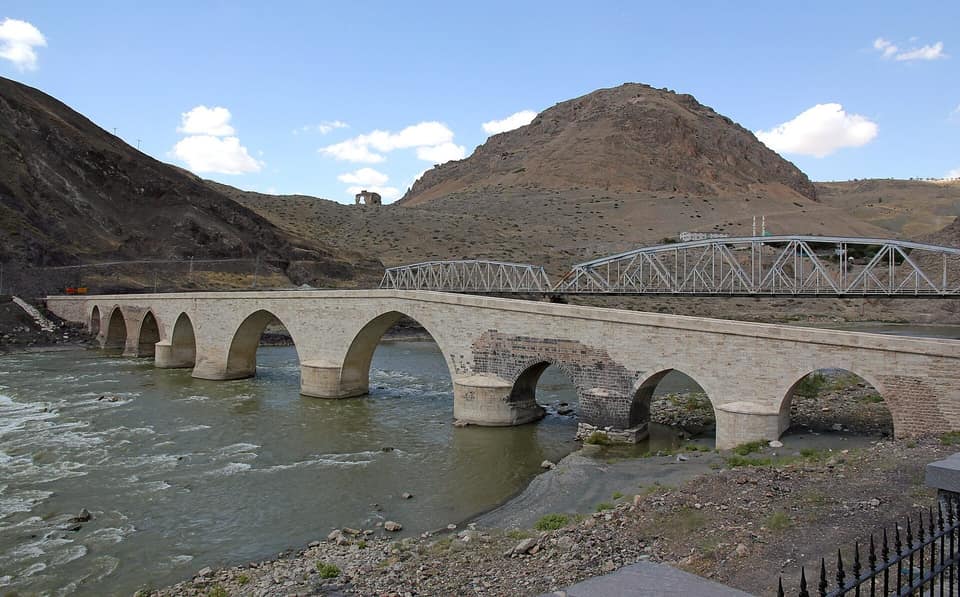
At the foot of the castle, over the Murat River, stands the historic Palu Stone Bridge. GoTürkiye writes that the bridge is 156 metres long, that its date of construction is unknown because it has no inscription, and that it is thought to have been built in the Roman period. The inventory of the Municipality of Elazığ, however, dates the bridge to the early 13th century, to the Seljuk and Artuqid period; both sources agree that the bridge was repaired in these periods. It is also reported that in historical sources the bridge was called the bridge connecting İstanbul to Baghdad.
It is a good idea to start from the river bank opposite the castle, because the conical castle hill and the bridge are best seen together from there. The climb to the castle follows a steep and in places uneven path, so bring sturdy shoes and water. Be careful when approaching the steep sections to see the inscription and the rock tombs, as there may not be railings everywhere. In summer the midday heat is strong on the rock, so morning or late afternoon is more suitable. Since archaeological work is carried out at the castle from time to time, visitors should not enter excavation areas and should follow the warning signs.
Palu is reached by road from the centre of Elazığ, and the castle can be seen a short way from the town centre. It is best to obtain current information on visiting conditions and ongoing work at the castle from the Palu District Governorate and the provincial culture and tourism directorate.
Comments
Loading...
Location - Palu Kalesi
Venue Info
AddressPalu / Elazığ
VenuePalu, Elazığ
TypeHistorical & Cultural Sites