

Religious & Spiritual PlacesReligious Complexes
Orhan Gazi Külliyesi
No ratings yet
Sign in to like and rate
Orhan Gazi Complex
Atatürk Caddesi, Büyükşehir Belediye Binası yanı, Osmangazi/Bursa
Osmangazi, Bursa
Get DirectionsApple MapsAbout Venue
The Orhan Gazi Complex is the first large group of buildings from the period when Bursa began to grow out of its small citadel settlement toward the lower city. When Orhan Gazi took Bursa in 1326, the town was no more than a settlement inside the citadel. The urban model that later Ottoman sultans would adopt was first applied here in 1339, when a complex of a mosque, a madrasa, a soup kitchen, a bath and a han was built outside the city walls. The land on which the complex stands was gained by changing the bed of the Gökdere stream. The walls that enclosed the complex were later extended to protect the whole lower town and appear in documents as the lower fortress.
Of the complex, the mosque, the han and the bath still stand; the madrasa, the school and the soup kitchen have not survived. According to the inscription over the main door, the central mosque was built in 1339 by Orhan Bey. The same inscription tells that it was burned in 1413 by Karamanoğlu Mehmed Bey II and that its repair was ordered in 1417 under Çelebi Mehmed. Sources describe it as the first building in Bursa built on the zaviye plan, that is, with side guest rooms, and as the first mosque of early Ottoman architecture to show the inverted T plan.
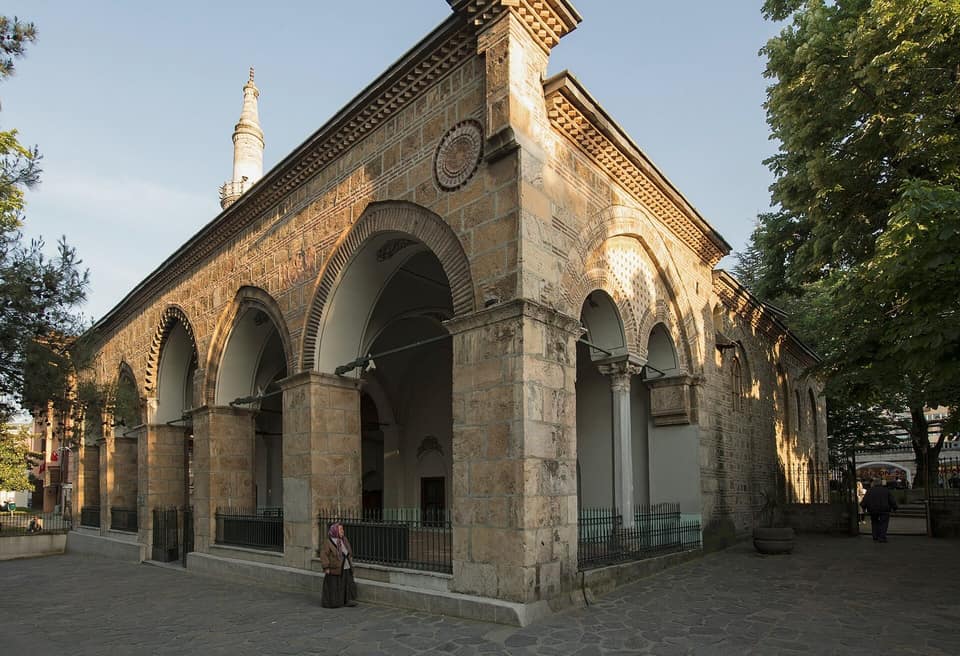
The plan has two domes in a row along the axis of the mihrab, two side iwans and a porch, and the rooms beside the iwans are the guest quarters. The walls are laid with rubble stone and brick, and brick sawtooth eaves and rosettes on the wall surface give the building a character of its own. The cut stone piers of the five-bay porch are joined by pointed brick arches, and the side facades use columns with reused Byzantine capitals. The dome of the central bay is raised above the others and rests on Turkish triangles.
The tie rods of the arches were originally oak and were replaced with iron rods in the repair by the architect Leon Parvillée in 1864. The minaret stands at the northeast corner; its first ten steps are of küfeki stone, the rest is of 17th century kaygan stone, and the lead cap was rebuilt in 1899 in somaki stone. In the early twentieth century, under Governor Reşid Pasha, a window in the east wall was turned into a door. A small room beside the entrance hall was converted into a library in 1863 and served as the Orhan Library until 1969.
The mihrab, with its capitaled colonnettes and muqarnas niche, is of the classical Ottoman form and served as a model for later Bursa mosques. Because its ornament was carved in relief, the baroque changes of the 19th century could be applied only to the crown, so the mihrab is less altered than the others. The bath of the complex is a double bath built side by side; the hot room has four iwans with cells at its corners, and the domes rest on drums with Turkish triangles. The bath was repaired after the fire of 1958 and is used as a market today.
The mosque stands on Atatürk Caddesi beside the Metropolitan Municipality building and can be reached on foot from the city center. The complex belongs to the Hanlar Bölgesi area within the Bursa and Cumalıkızık site, inscribed on the UNESCO World Heritage List in 2014. First look at the cut stone piers of the porch and the twin pointed arches, then follow the alternating courses of brick and stone. Koza Han lies between the Ulu Cami and the Orhan Mosque, so a visit links easily to a walk through the Hanlar Bölgesi. Because it is a place of worship, enter quietly, take off your shoes, wear clothes that cover shoulders and knees, and postpone your visit during prayer times.
Comments
Loading...
Location - Orhan Gazi Külliyesi
Venue Info
AddressAtatürk Caddesi, Büyükşehir Belediye Binası yanı, Osmangazi/Bursa
VenueOsmangazi, Bursa
TypeReligious & Spiritual Places