

Historical & Cultural SitesArchaeological Sites
Nysa Antik Kenti
36
No ratings yet
Sign in to like and rate
The Ancient City of Nysa
About Venue
Nysa is an ancient city built on the sheltered, south-facing slope of the Aydın Mountains, about three kilometres north of the centre of Sultanhisar. Overlooking the fertile plain north of the Maeander River, the city was one of the important cities of the province of Asia in the Roman period. The South Aegean Development Agency writes that the city was founded in the Hellenistic period, in the 3rd century BC. It was a crossing point on the routes linking inner Anatolia with Caria and Ionia.
The founding of the city is told through legend. According to Strabo, three brothers who came from Sparta founded three settlements bearing their own names north of the Maeander, and over time the people of these settlements joined together in Nysa. Sultanhisar Municipality notes that the city was known as Athymbra at its foundation. English Wikipedia, on the other hand, relates that the name Nysa came from one of the wives of the Seleucid king Antiochus I. Since the sources give different details on this point, placing the foundation in the Hellenistic period is the safest statement.
What makes Nysa unique is that it was built on both banks of a deep stream. The Tekkecik stream divides the city in two, and the sources therefore describe Nysa as a kind of twin city. In the Roman period, besides three bridges joining the two banks, a vaulted tunnel about 100 metres long was built over the stream bed. The structure is regarded as one of the cleverest examples of Roman engineering at Nysa.
The most visited building in the city is the theatre. Sultanhisar Municipality writes that the theatre held 12 thousand people and that a pool beneath the stone stage could be filled with water and used for shows. The friezes of the stage building are the theatre's most famous feature and depict mythological scenes. Climbing to the upper rows of the theatre is the best viewpoint for seeing how the city settles into the stream valley.
In the Roman period Nysa was a centre of education and culture. The famous geographer Strabo studied here in his youth and wrote about the city in detail in his work, the Geographika. The city's library, dated to the 2nd century AD, is presented as the second best preserved ancient library in Anatolia after the Library of Celsus at Ephesus. Aristodemus, whose lectures Strabo attended, and his cousin, another Aristodemus who taught Pompey, were both from Nysa. English Wikipedia writes that the city was a centre of learning that specialised in Homeric literature and the interpretation of epics.
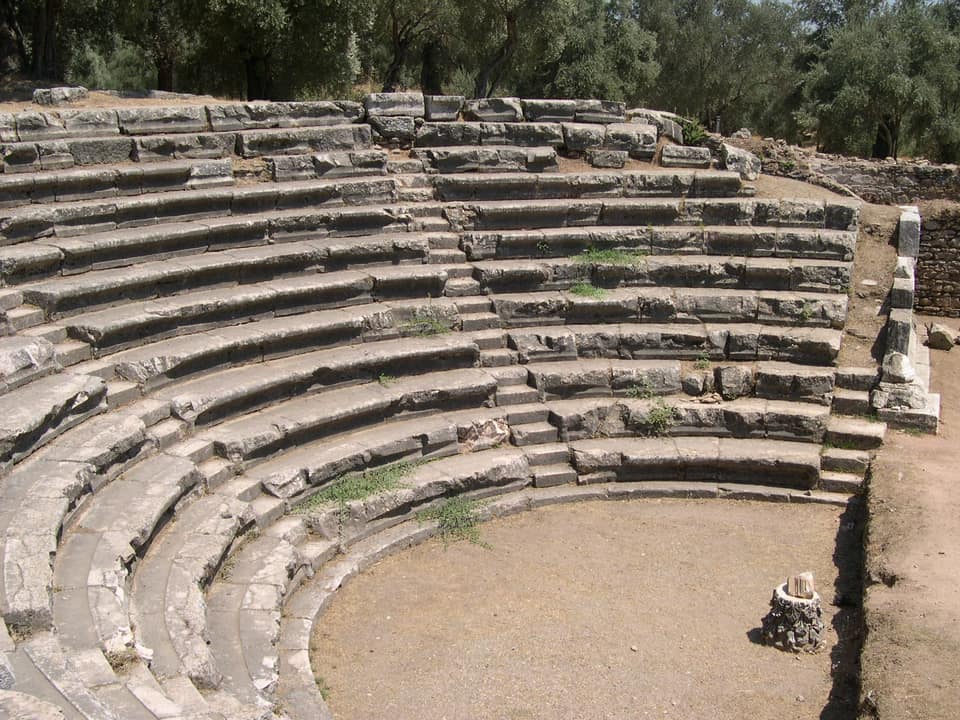
On the eastern bank of the stream lay the administrative and commercial centre of the city. According to Sultanhisar Municipality, the agora measures about 89 by 105 metres and is surrounded by columns on all four sides. The gerontikon near the agora, the council of elders, seated 600 to 800 people and was built in the 1st century AD and altered in the 2nd century. With its semicircular rows of seats, the gerontikon is one of the most elegant buildings in the city. In the restoration work carried out on this building, the mosaic floor and the marble blocks of the stage facade have been put back in place.
On the western bank of the city there is a gymnasium measuring about 70 by 165 metres. The stadium measures about 44 by 192 metres is credited with a capacity of 30 thousand and was described by Strabo as an amphitheatre, but it has been partly destroyed because of flood damage. In the necropolis west of the city, two-storey vaulted tomb buildings and sarcophagi can be seen. Because the buildings were set to follow the slope of the land, touring Nysa means constantly going up and down.
The first excavations in the city were begun in 1907 by the German researcher Walther von Diest. Excavation and restoration work continued between 1990 and 2010 under Vedat İdil of Ankara University, and since 2012 it has continued under Hakan Öztaner, also of Ankara University. The South Aegean Development Agency and Sultanhisar Municipality state that Nysa is the ancient city being developed as the first archaeopark in Turkey. Marble busts and statues from the excavations are displayed in the Nysa hall of the Aydın Archaeology Museum.
Nysa is an archaeological site easily reached by the road that turns north from Sultanhisar on the Aydın-Denizli highway. Because the buildings are spread over a wide slope, the visit is made on foot, and you need to allow time for crossing between the two banks. We recommend setting aside at least two hours to see the whole city. Since summer middays are hot, come early in the morning or late in the afternoon. Since visiting conditions may change, check the Ministry's current information before you go.
Comments
Loading...
Location - Nysa Antik Kenti
Venue Info
AddressSultanhisar / Aydın
VenueSultanhisar, Aydın
TypeHistorical & Cultural Sites