

Historical & Cultural SitesArchaeological Sites
Notion Antik Kenti
No ratings yet
Sign in to like and rate
Notion Ancient City
About Venue
Notion is an ancient harbour city built on two hills on the Aegean shore, within the boundaries of today's Ahmetbeyli neighbourhood in the Menderes district. The İzmir Provincial Directorate of Culture and Tourism places the city about 50 kilometres from İzmir and 15 kilometres from its old neighbour Colophon. The acropolis, which local people call "Kale" (the castle), spreads over two hills, and the temple dedicated to the city's chief goddess Athena Polias stands on the western hill in a position that fully overlooks the sea. Herodotus mentions Notion as an Aeolian city; like Colophon, it later became a member of the Athenian-Delian maritime league.
The history of Notion is closely intertwined with Colophon and the oracle of Apollo at Claros. As Colophon lost power, this coastal settlement gained importance and was referred to in ancient sources with names such as "Colophon on the sea" or "New Colophon". In the 3rd century BC the two cities formed a political union through a joint citizenship agreement. Notion was attached to King Attalus I of Pergamon in 218 BC, came briefly under the rule of the Syrian king Antiochus III, and then returned to the Pergamene kingdom. The city gained autonomous status with the Peace of Apamea in 188 BC and joined Rome's Province of Asia after 133 BC. The Provincial Directorate of Culture and Tourism also notes that the city never minted its own coins throughout its history.
Research carried out by the Kelsey Museum of the University of Michigan shows that Notion was a grid-planned city of about 32 hectares surrounded by stout fortification walls. The wall of about 4 kilometres that encircles the acropolis and is supported by towers was built in the Hellenistic period and repaired in Roman times. Two gates of the walls opening onto the ancient harbour lie to the north and west, and a stepped entrance lies at the southeast corner. Inside the walls are a theatre, a council house (bouleuterion), an agora, a hero shrine (heroon) and a small temple of Athena, surrounded by extensive residential districts. The surface survey carried out between 2014 and 2018 revealed that the city was most intensively occupied from the 3rd century BC to the 1st century AD. The same studies link the abandonment of the city to the rapid growth of nearby Ephesus, promoted by the Roman administration.
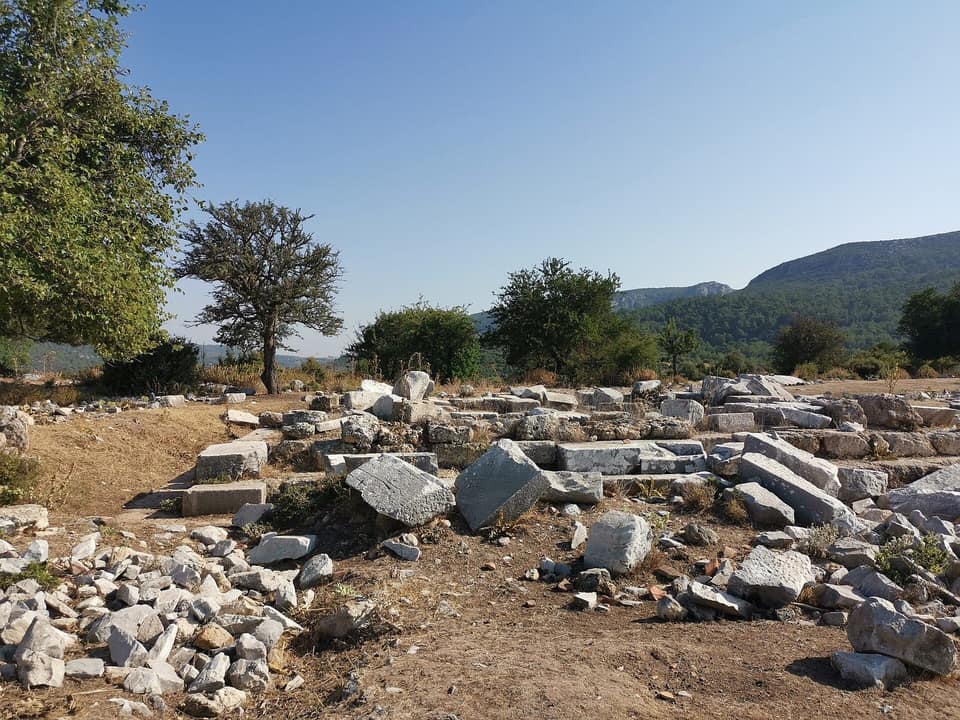
The most remarkable feature of the site is that the remains lie only lightly buried and there are no modern buildings on top of them. Because the foundations of hundreds of ancient walls are exposed, it is possible to read the city as a whole urban fabric rather than as a set of isolated buildings. Excavations carried out since 2022 together with archaeologists from Sinop and Adnan Menderes universities have focused on a large peristyle house west of the agora, the council house east of the agora and a warehouse outside the walls next to the beach on the west side. This warehouse by the beach is described as evidence that interest in the commercial value of the harbour revived in the late Roman period, long after the city had been abandoned.
If you begin your visit at the remains of the temple of Athena on the western hill, you can see both the sea and the city plan spread between the two hills at the same time. Following the line of the walls as you walk down towards the seating rows of the theatre and the agora makes it easier to understand the city's relationship with its harbour. The site is open ground with little shade; in summer it is best to come early in the morning or late in the afternoon and to bring water and sturdy shoes. Because excavations are ongoing, the work areas must not be entered and loose stones should not be stepped on. You are advised to check the current visiting conditions with the İzmir Provincial Directorate of Culture and Tourism. Visiting Notion on the same day as the nearby Claros archaeological site lets you see on the spot the bond between the oracle and the harbour city.
Comments
Loading...
Location - Notion Antik Kenti
Venue Info
AddressAhmetbeyli, Menderes
VenueMenderes, İzmir
TypeHistorical & Cultural Sites