

Historical & Cultural SitesCastles & Palaces
Niksar Kalesi
38
No ratings yet
Sign in to like and rate
Niksar Castle
About Venue
Niksar Castle is the large castle that forms the historic core of Niksar in the Kelkit valley and overlooks the district centre from above. The TDV Encyclopedia of Islam writes that the old nucleus of the town is the castle on the hill between the Çanakçı stream, which flows into the Kelkit, and the Maduru streams. The Tokat Provincial Directorate of Culture and Tourism also notes that the castle stands on the hill north of the valley formed by the Çanakçı stream, and presents it as the second largest castle in Türkiye. Niksar is set on the right bank of the Kelkit valley, about 350 metres above sea level.
Official sources put different emphases on the founding of the castle. The Culture Portal writes that the castle was essentially built in the time of the Kingdom of Pontus and was called Kaberia, reaching its present appearance with structures added in the Roman period. The provincial directorate, by contrast, says the castle was first founded in the Roman period, enlarged in the Byzantine period and also fortified in the Islamic period. TDV relates that the town, called Kaberia in the Pontic period, is mentioned as one of the fortified capitals of Mithridates, that General Pompey refounded it and renamed it Diospolis, and that in the time of Emperor Tiberius it was called Neokaisareia. According to the encyclopedia, the name Harsanisiya was also used alongside Neokaisareia in the Byzantine period, and the Danişmendname records the town both as Harsanosiyye and as Niksar. With the Turkish capture of the town, according to the Tokat Governor's Office, the name Nik-hisar, meaning "good fortress", appeared and was shortened in speech to Niksar.
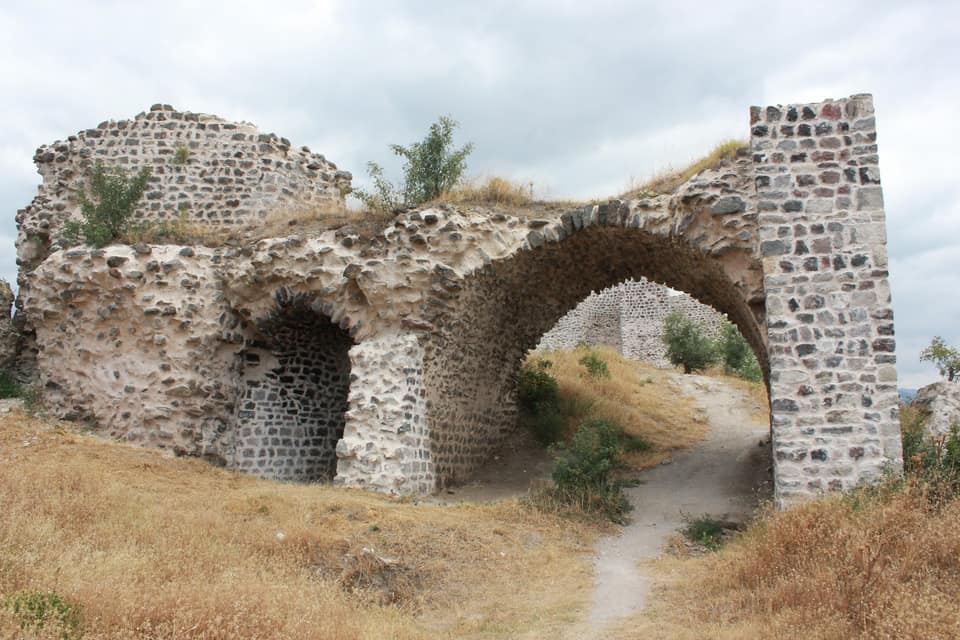
According to the Culture Portal, the walls, which defined the acropolis area when they were built, formed three separate lines, an inner, middle and outer wall, as in a typical Roman defensive plan. The castle was strengthened in the 7th and 9th centuries against raids coming from the south. TDV writes that in the Ottoman period the castle consisted of three parts and that the inner castle had a mosque, a madrasa and a bath, showing that the first settlement was gathered here. The middle castle stretching down the slope formed the suburb, while the outer castle outside the walls held the expanding market and buildings of the town. Official descriptions state that the castle today holds the remains of two baths, two small mosques, a madrasa and a prison.
TDV records that during the raids of 1068 the Turks came as far as the walls of Niksar. After the Battle of Manzikert, Niksar was taken from Byzantium by the Danishmendids and became their centre. The Tokat Governor's Office writes that Gümüştekin Ahmet Gazi, famed under the title Danişmend, made Niksar the capital of his state after conquering it. According to TDV, the Danishmendid ruler Gümüştegin Gazi imprisoned the Crusader prince Bohemond of Antioch, whom he had captured in 1100, in Niksar Castle, and Bohemond was released for a ransom only in the summer of 1103. In the winter of 1140 a Byzantine army attacked the town but withdrew without result. The encyclopedia records that in the last years of Sultan Mesud I, Niksar was in the hands of his son-in-law Nizameddin Yağıbasan, and that the town passed to the Seljuks after 1175. The Yağıbasan Madrasa, which it lists among the works still standing in Niksar today, bears the name of this period.
In the 17th century Evliya Çelebi described the castle and the town in detail. As TDV reports, the traveller wrote that there were 300 houses inside the area enclosed by the walls and 2,700 houses in the forty-three quarters outside the castle. The traveller also recorded the number of shops in the town as 500. The encyclopedia writes that Niksar was an economically lively centre in the 15th and 16th centuries as well, and that in the last quarter of the 16th century the town had a bedesten, a caravanserai and an inn. The Yusufşah, Melikgazi, Kılıcarslan and Çepni quarters close to the castle are, according to the encyclopedia, the oldest quarters of the town. The castle's official address is also in Yusufşah, one of these quarters.
The castle is reached from the district centre by climbing up the castle street; wear comfortable shoes, as the slope is steep in places. At the top, follow the path that passes between the arched gateway and wall remains built of rubble stone, and try to see how the lines of walls enclose one another. As the remains are scattered in the open, do not climb the walls, and carry water on summer days in the shadeless area. From the top, the Kelkit valley and the fabric of the town growing below open up as a wide view. The Culture Portal notes that access is provided by district buses running from Tokat centre to Niksar. Check the castle's current visiting conditions from official sources before you go; when you come down, you can also see the Danishmendid-period buildings in the district centre on the same trip.
Comments
Loading...
Location - Niksar Kalesi
Venue Info
AddressYusufşah Mahallesi, Kale Sokak No: 24, Niksar / Tokat
VenueNiksar, Tokat
TypeHistorical & Cultural Sites