

Historical & Cultural SitesMuseums
Necmi Asfuroğlu Arkeoloji Müzesi
5
No ratings yet
Sign in to like and rate
Necmi Asfuroğlu Archaeology Museum
About Venue
Necmi Asfuroğlu Archaeology Museum is an archaeology museum in the centre of Antakya that shows the city's ancient layers in the very place where they were excavated. According to the Ministry of Culture and Tourism's museum page, the museum was founded in 2009 to preserve and display in situ the remains uncovered during the excavations for a hotel construction in the city centre. The museum was transferred to the Ministry of Culture and Tourism in 2019 and opened to visitors. Keeping the finds on the ground where they were found, without moving them, is the main feature that sets this museum apart from Hatay Archaeology Museum. There, the works have been brought into halls; here, the visitor comes to the layer where the works lie. The Ministry states that this feature makes the museum one of the few examples of its kind in the world.
The story the museum tells begins with the founding of the city. The Ministry page recalls that today's Antakya was founded around 300 BC by Seleucus I, one of the commanders of Alexander the Great, in the name of his father Antiochus. Through the Roman, Byzantine and Ottoman periods that followed, the city remained one of the important cities of the Eastern Mediterranean. In the museum you can see the layers of this roughly 2,300 year history of settlement, sometimes stacked on top of one another and sometimes intertwined. The works found in the excavations are displayed alongside these layers. That is why the real pleasure of the visit is to think about which period's floor a wall rests on and at what level a mosaic has survived.
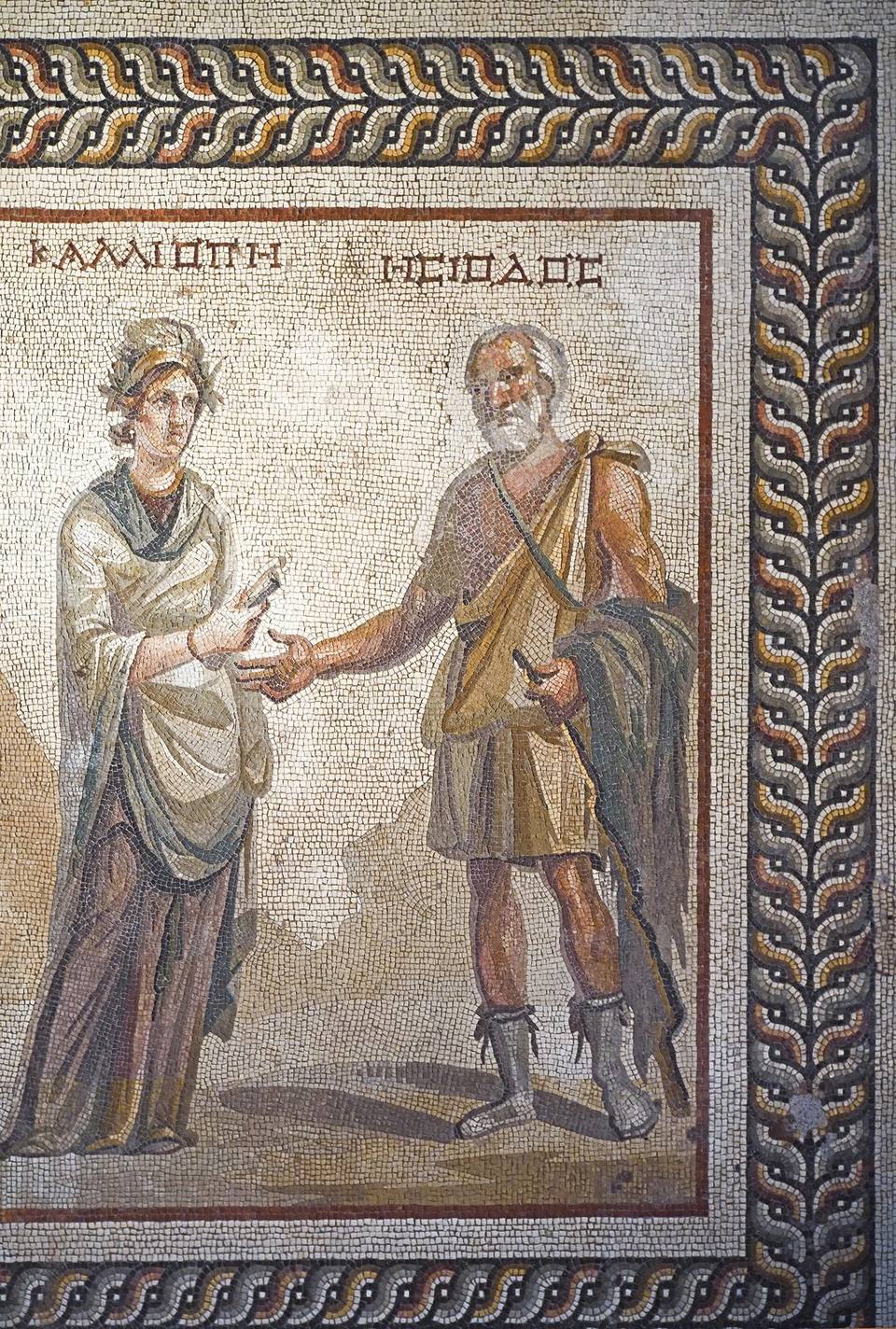
The most striking part of the museum is its Roman floor mosaics preserved in place. The Ministry writes that among these mosaics of various sizes, a floor mosaic from a Roman villa dated to the 2nd century AD stands out. On the main panel of this mosaic, which is divided into four panels, the main figures are the mythological winged horse Pegasus and three nymphs preparing him for a ceremony. The three smaller panels below the main panel show the Muses and the meeting between one of them, Calliope, and the writer Hesiod. In the scene where Calliope and Hesiod shake hands, the names of the figures are set into the mosaic in Greek letters; finding and trying to read these inscriptions makes the scene easier to understand. The Ministry also notes that a mosaic of about 1,050 square metres, regarded as the world's largest single piece mosaic, is among the museum's remarkable works. Take time to watch this large mosaic from different angles to grasp it as a whole.
The material of the mosaics has also been the subject of academic study. A study published in the Journal of Mosaic Research in 2021 examined 60 stone tessera samples taken from six mosaics found in the excavation area. According to the study, one of these six mosaics belongs to the Roman period and the others to the Early Byzantine period between the 5th and 6th centuries AD. The mosaics were generally made with the opus tessellatum technique and with geometric patterns. The analyses showed that most of the tesserae are limestone, and that rocks such as siltstone, claystone and radiolarite were also used. The researchers concluded that these rock types are found in and around Antakya. Knowing that most of the coloured stones came from the region's own rocks helps you see how rich a colour range the craftsmen built with local material.
The museum is in the city centre on Süreyya Halefoğlu Street, close to the west bank of the Asi River. Because it is near the historic core of Antakya, it can be combined with a walk through the city. The walkways that pass over the mosaics can be narrow, so at busy moments wait your turn without hurrying. Not touching the remains preserved in place and staying on the marked paths is important for the life of the works. Check the visiting conditions on the official page before you go. The Ministry lists Hatay Archaeology Museum among the places to visit for the rich collection of Antakya and its surroundings; visiting both museums on the same day gives you the chance to see mosaics both in place and in a museum hall.
Comments
Loading...
Location - Necmi Asfuroğlu Arkeoloji Müzesi
Venue Info
AddressHaraparası, Süreyya Halefoğlu Caddesi No:64, Antakya / Hatay
VenueAntakya, Hatay
TypeHistorical & Cultural Sites