

Religious & Spiritual PlacesMosques
Muradiye Camii
5
No ratings yet
Sign in to like and rate
Muradiye Mosque
About Venue
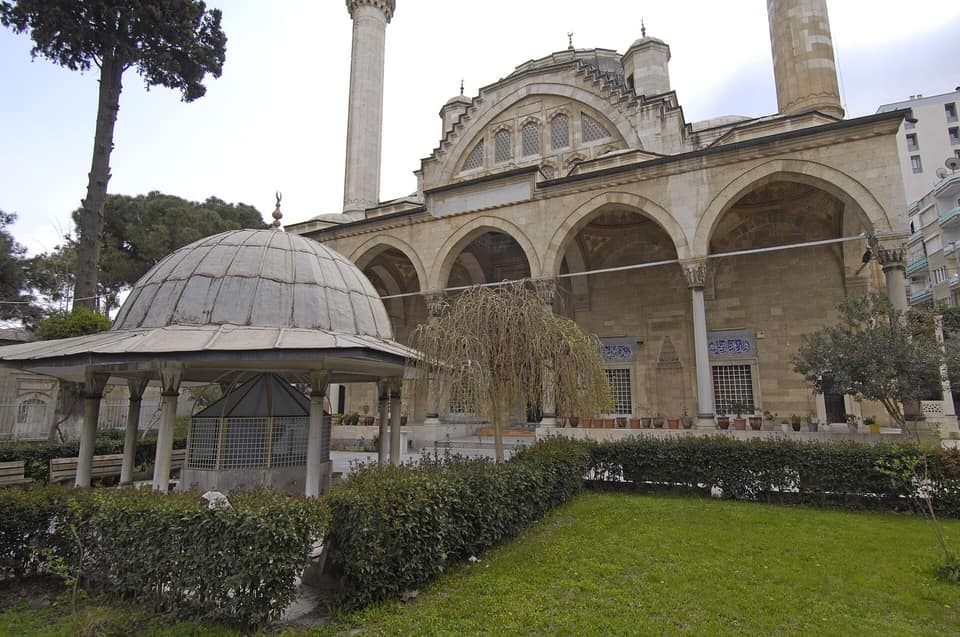
Muradiye Mosque is the centre of a complex that rises just below Mount Spil in the south of Manisa, near the Sultan Mosque, and it is counted among the most important Ottoman buildings in the city. The complex was commissioned by Murad III, who spent part of his years as a prince in Manisa. Before it, the site held a small mosque with a dervish lodge beside it, which Murad had built in 1570-1572 while he was still a prince. When the congregation grew, permission was given to enlarge the building, but the old structure was demolished down to its foundations and the present complex was planned by Mimar Sinan in 1583. According to the inscriptions above the door and on either side of it, construction of the mosque began in February 1583 and was completed at the end of 1586. The work was first directed by the architect Mahmud Ağa, and after his death Mehmed Ağa took it over; the madrasa, the soup kitchen and the other units were finished by 1593.
Specialists explain that the showy entrance facade departs from the restrained aesthetic of Sinan's buildings because the architects who carried out the work did not keep strictly to his plan. The centre of the mosque, which has a transverse rectangular plan, is covered by a dome 10.80 metres in diameter, while the side sections are roofed with half cross vaults. In the five-bay portico, which opens onto a walled courtyard with an ablution fountain, six marble columns with muqarnas capitals carry pointed arches. The single-balcony minarets at the two corners of the entrance and the octagonal fountain in the middle of the courtyard were restored faithfully to their original form in 1956. Inside, the most striking feature is the high-quality Iznik tilework of the second half of the 16th century; blue and white underglaze tiles cover above all the mihrab wall. The multicoloured painted decoration inside the dome, on the pendentives and around the windows is known to be the work of twelve painters from Istanbul led by Mehmed Halife. The marble mihrab with its polygonal niche, the marble minbar with its rich stonework and the sultan's loge in the southeast corner are also details worth a close look.
The madrasa northeast of the mosque and the arcaded soup kitchen to its east housed the city's museum for many years. Finds gathered from the region were first stored in the madrasa, which opened as a museum on 29 October 1937, and after 1972 the soup kitchen was also added as exhibition space. Inside the courtyard, southeast of the mosque, stands a small octagonal library built in 1806 by Karaosmanoğlu Hacı Hüseyin Ağa. Damaged in the earthquake of 1688, the complex underwent a major repair in the 1780s and was restored by the General Directorate of Foundations between 1952 and 1964. Because the Sultan Mosque lies about 200 metres to the west, the two complexes are easy to see on the same walk, and the Ulu Mosque on the slope to the south is also a short walk away. As the mosque is open for worship, visitors should come outside prayer times, take off their shoes at the door and dress modestly.
Comments
Loading...
Location - Muradiye Camii
Venue Info
VenueŞehzadeler, Manisa
TypeReligious & Spiritual Places