

Historical & Cultural SitesArchaeological Sites
Milet Antik Kenti
7
No ratings yet
Sign in to like and rate
The Ancient City of Miletus
About Venue
Miletus, known in antiquity as Miletos, was one of the largest harbour cities of Ionia. Its remains lie within the neighbourhood of Balat in the district of Didim, on the plain where the Büyük Menderes reaches the sea. According to Turkish Wikipedia, because its harbour filled with the river's silt, the site now lies about 10 kilometres inland. English Wikipedia writes that the harbour mouth began to silt up around 1000 BC. The Aydın book of the South Aegean Development Agency notes that Herodotus called Miletus the jewel of Ionia.
The city's history goes back a long way. Turkish Wikipedia explains that the city called Millawanda in Hittite documents was Miletus and that written records from the Late Bronze Age survive. The Ministry's site page quotes two founding stories from Pausanias: in one the settlers come from Crete, in the other from Athens. The Ministry also notes plainly that these stories cannot be proven.
Miletus had its most brilliant period in the 7th and 6th centuries BC. It grew very rich through the colonies it founded on the shores of the Black Sea and the Mediterranean, and according to the Kültür Portalı it became the capital of the Ionian league. The city's old acropolis was abandoned after the Persian invasion of 494 BC. According to the Ministry, the Hellenistic city afterwards took shape around the Lion Harbour and the theatre.
The name of Miletus holds a special place in the history of science and thought. The Ministry page states that the progress of ancient Greek science began through the Milesian school. Thales, regarded as the father of philosophy, is remembered for calculating solar eclipses, Anaximander for laws that tried to explain the universe, and Hecataeus as the man who drew the first map of the world. Hippodamus, known for the grid plan, was also a son of this city.
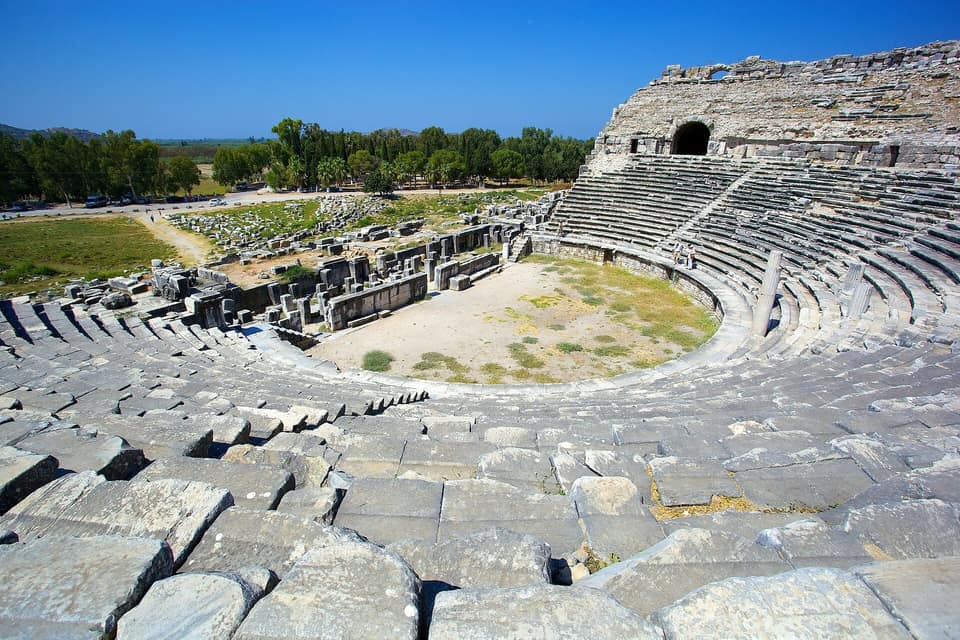
The building that greets you as soon as you enter the site is the theatre. Turkish Wikipedia writes that the theatre held 15 thousand people, was built in the 4th century BC and took its present form in the Roman period. From the upper rows of the theatre the sites of the city's old harbours could be seen. Today anyone looking from the same point sees the plain, rows of trees and, far off, the bed of the Menderes. Sitting on the steps and watching this expanse for a while is the easiest way to understand where the sea has gone.
The path down from behind the theatre towards the plain leads you to the buildings of the Roman period. The Baths of Faustina were built with money given by Faustina, wife of the Roman emperor Marcus Aurelius, and their vaulted halls still stand. The Harbour Monument was erected in memory of the naval battle of Actium in 31 BC. The bouleuterion, the city's council hall, was a meeting place for 1500 people according to Turkish Wikipedia. The monumental gate of the South Agora was taken apart in the excavations of the early 20th century, carried to Berlin and rebuilt there in the Pergamon Museum.
In the southern part of the site you see the city's Turkish period face. Known as Palatia in the Byzantine period, the city came under Turkish rule in the 13th century and took the name Balat. The Kültür Portalı writes that Orhan, a Menteşe bey, struck coins in his own name here. The mosque of the complex built by the Menteşe bey İlyas Bey at the beginning of the 15th century still stands with its single dome and marble cladding. English Wikipedia notes that the İlyas Bey Complex is a cultural heritage site that has received a Europa Nostra award.
The first excavations at Miletus were made in 1873 by the French archaeologist Olivier Rayet, followed by the German archaeologist Theodor Wiegand. The Kültür Portalı writes that village life at Balat continued until the earthquake of 1955 and that the village was moved afterwards. The Ministry page states that the ticket bought for the site also allows a visit to the Miletus Museum. According to the South Aegean Development Agency, the museum displays finds from the excavations at Miletus, Didim and Priene in its garden and indoor halls. The lion statues that are the symbol of the city, inscriptions, sarcophagi and column capitals are the most looked at pieces of this collection.
The site is large and its buildings are scattered across the plain. Allow at least two hours for walking between the theatre, the baths and the complex. In summer the plain gets very hot at midday and shade is scarce, so choose the morning or late afternoon and do not forget a hat and water. Check visiting hours and entry conditions on the Ministry's museum page before you go.
The Kültür Portalı gives the address of the site as the neighbourhood of Balat, Didim. The road branching off the Söke to Didim highway towards Akköy brings you to Balat. According to the South Aegean Development Agency, Didim is only 20 kilometres away, while the road to the north leads to Priene.
Comments
Loading...
Location - Milet Antik Kenti
Venue Info
AddressBalat Mahallesi, Hacılar Sokak No:9, 09290 Didim / Aydın
VenueDidim, Aydın
TypeHistorical & Cultural Sites