

Historical & Cultural SitesArchaeological Sites
Maşat Höyük
No ratings yet
Sign in to like and rate
Maşat Mound
About Venue
Maşat Höyük is a settlement mound rising in the middle of a broad plain at the village of Yalınyazı in Zile district. The Tokat Provincial Directorate of Culture and Tourism describes the finds unearthed here as the most important discoveries shedding light on the history of Tokat. The mound is accepted as the site of a city known as Tapigga in the Hittite period. An article published in 1979 in Belleten, the journal of the Turkish Historical Society, also refers to the site plainly as ancient Tapigga.
Systematic excavations at the site began in 1973 under the direction of Prof. Dr. Tahsin Özgüç of Ankara University and, according to official sources, continued until 1984. The Belleten article records that an excavation was also carried out on the mound in 1945 and that its results agreed with later observations. Özgüç's main aim was to expose the complete plan of the Hittite palace on the summit of the hill. The Hittite and Early Bronze Age settlements in the lower city were planned to be studied later.
Official sources count three major periods at the mound. Settlements of the Early Bronze Age around 3000 BC, the Hittite Age around 2000 BC and the Phrygian or Iron Age around 1000 BC were built one on top of the other. According to the Belleten article, there are two Hittite and three Iron Age building levels above the ruins of the Hittite palace. When the deep foundations of the palace were laid, the Early Bronze Age buildings below were largely destroyed, and only fragments remained beneath the floors of the courtyard and the northern colonnade.
The real fame of Maşat Höyük comes from the Hittite cuneiform tablets found here. The Provincial Directorate of Culture and Tourism highlights these tablets as the most important find of the excavations. The tablets are considered among the documents reflecting the administrative affairs of a frontier lordship attached to the Hittite capital Hattusa. According to the footnotes of the Belleten article, Prof. Dr. Sedat Alp published a study examining the geography of the Upper Yeşilırmak region in the light of these tablets. In this way a small hill became an archive consulted for understanding the place names of the region in the Hittite period.
The excavations revealed the palace of a frontier lord attached to the Hittite state at Hattusa. According to the Culture Portal, the city's fairly wide, stone-paved streets were also uncovered. A terracotta brazier used for heating the palaces, of a kind not found anywhere else in Türkiye, was also discovered here. Terracotta vessels, rhyta and various seals used in the palace are among the most important finds.
The Early Bronze Age levels also yielded interesting information. According to the Belleten article, the latest houses of this period were destroyed by a violent fire that affected the entire mound. The foundations of the houses were made of large, rough limestone blocks or of two rows of smaller stones, and the walls were raised in mudbrick covered with thick plaster. The floors were of packed earth, and the hearths stood inside the rooms. The dead were buried under the floors of the houses, some of them inside large jars, with bronze pins, earrings and bracelets placed beside them. The article states that the pottery of this period shares the same tradition as contemporary examples from the region between the Yeşilırmak and the Kızılırmak.
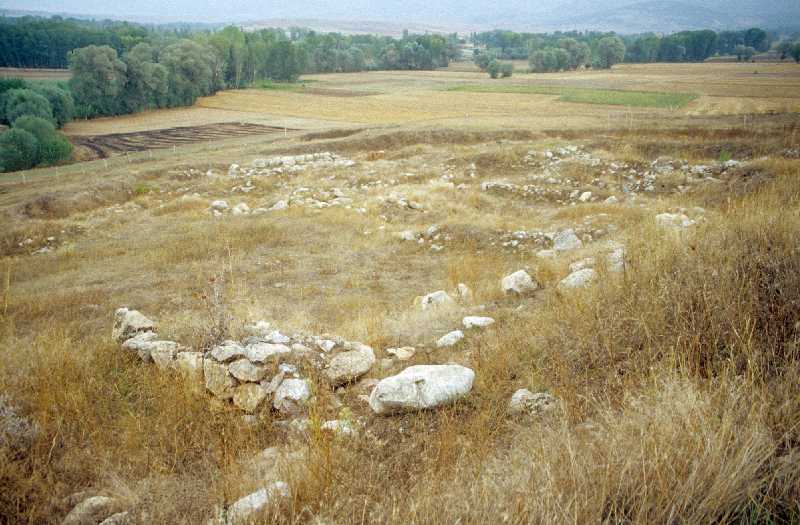
What you see on the mound today is not a museum display but open land. In the excavated areas the rows of stone foundation walls can be picked out among the grass, and from the top a wide view opens over the surrounding fields and the plain. The Belleten article writes that the slopes of the mound were damaged by erosion and by long years of use as farmland. For this reason you should not climb on the remains, move stones, or walk into the cultivated fields around them.
The real home of the finds is the Tokat Museum. According to the Culture Portal, the finds from Maşat Höyük make up the largest part of the museum's archaeological display, and the tablets and palace objects are exhibited there. The Early Bronze Age pottery studied in the Belleten article is also kept in the Tokat Museum. That is why calling at the museum before or after visiting the mound is the best way to make sense of the foundation walls on site.
Yalınyazı is reached by way of Zile; Zile is served by buses leaving from Tokat bus station, but you need your own vehicle to continue to the village and the mound. Assume there is no shade or service on site and come with water, a hat and sturdy shoes. Get current information on visiting conditions from the Tokat Provincial Directorate of Culture and Tourism or the Tokat Museum. When you visit it on the same day as Zile Castle, you also complete the Hittite story that unfolded on this plain long before the Roman history of Zela.
Comments
Loading...
Location - Maşat Höyük
Venue Info
AddressYalınyazı Köyü, Zile / Tokat
VenueZile, Tokat
TypeHistorical & Cultural Sites